
 New AI features are available
 Listed in
 An old MPEG or MPG video may still play on your computer, but sharing it with a phone, web browser, smart TV or video editor can be less straightforward. Converting the file to MP4 usually solves the problem and can also make the video easier to upload, archive and manage.
The most widely compatible choice is normally an MP4 file containing H.264 video and AAC audio. However, the right conversion method depends on the size of your video, the number of files you need to process and whether you are comfortable uploading the footage to an online service.
In this guide, we explain how to convert MPEG to MP4 with the best video converter software on computer, online, and smartphones. We also cover the settings that matter, how to minimize quality loss and the difference between transcoding and simply changing a file extension.
MPEG vs MP4: What Is Actually Being Converted
MPEG and MP4 are related terms, but they do not describe exactly the same thing.
MPEG is the name of the Moving Picture Experts Group and a family of video and audio standards. The extension alone does not reveal every technical detail about the file, but files ending in .mpeg or .mpg commonly contain MPEG-1 or MPEG-2 video.
MP4 is a multimedia container. It can hold video, audio, subtitles, chapters and metadata. The video inside an MP4 file may be encoded with H.264, HEVC, MPEG-4 Part 2 or another compatible codec.

This distinction matters because converting MPEG to MP4 can involve one of two processes:
📦 Remuxing moves existing video and audio streams of an MPEG file into a different container without encoding them again. This is faster and does not alter the encoded video, but it only works when the original streams are compatible with the destination container.
🔄 Transcoding decodes the original media stream and re-encodes them using different settings or codecs. Many older MPEG-1 and MPEG-2 videos need to be transcoded to H.264 to achieve reliable playback on current devices and websites.
In practice, transcoding MPEG to MP4 is the more common approach because it creates an MP4 file with codecs that are widely supported by current devices and platforms. However, some of the methods covered in this guide can also remux MPEG streams into an MP4 container when re-encoding is unnecessary. We will point out which tools support each option.
Which MPEG-to-MP4 Method Should You Choose
| Method | Best for | Platforms | Batch conversion | Main limitation |
|---|---|---|---|---|
Remux/trancode large MPEG files, easy to use, faster speed, best quality |
Windows, macOS |
Yes |
Can't run on the browser |
|
Small, non-sensitive files |
Any modern browser |
Depends on the service |
Strict limits on size/length/format |
|
A completely free desktop solution |
Windows, macOS, Linux |
Yes |
Steep learning curve |
|
Occasional conversions with software that may already be installed |
Windows, macOS, Linux |
Limited |
Not beginner-friendly |
|
Mac users whose source files can already be imported |
macOS |
No |
Can't hanble many older MPEG file |
Our recommendation:
For a large MPEG file or a folder containing multiple videos, a desktop converter is usually the most practical option. VideoProc Converter AI provides a more guided workflow, batch processing, hardware acceleration, and ready-made device presets. HandBrake is the stronger choice for users who need a completely free and open-source desktop converter.
VLC works well for an occasional one-off conversion when it is already installed. An online converter is convenient for a small, non-sensitive video, but it is less suitable for private footage, slow internet connections, or multi-gigabyte files. iMovie is useful when the MPEG file imports successfully and basic editing is required before export.
Method 1. Convert MPEG to MP4 on Windows and Mac
Best for: Large files, batch conversion or remuxing, fast speed, ready-made device profiles, and AI quality enhancement.
VideoProc Converter AI provides a simple way to convert MPEG to MP4, especially for older videos from DVDs, camcorders, TV recordings, or legacy media libraries. Its ready-made profiles let you export videos for iPhone, iPad, Android devices, smart TVs, Xbox, PlayStation, YouTube, Facebook, and more without manually adjusting complex codec settings.
It supports more than 420 formats and device profiles, including MPEG-1, MPEG-2, MPEG-4, and MPG, making it useful for mixed collections of old video files. Level-3 hardware acceleration helps process large or lengthy MPEG videos at up to 47 times real-time playback while keeping CPU usage relatively low, although actual speed depends on the hardware and output settings.
You can also trim, crop, merge, and compress MPEG videos before conversion. For low-resolution footage, the built-in Super Resolution tool can upscale video to as high as 4K and improve perceived sharpness, helping older MPEG recordings look better on modern displays.
VideoProc Converter AI - Best MPEG to MP4 Converter Free Download
- Easy, free, fast, and the best video quality retained.
- Smooth batch conversion from MPEG to MP4 on any computer.
- Superb compatibility with 4K, 1080p, HEVC, and all videos from MPEG family.
- Well-rounded presets and custom settings for users of all levels.
- Additional: cut, merge, crop, rotate, fix choppy videos, improve video quality, etc.
 Excellent
Download VideoProc Converter AI and Convert MPEG to MP4 on Mac and Windows with Ease!

How to Convert MPEG to MP4 with VideoProc
Step 1. Launch VideoProc Converter AI on Windows or Mac.
Step 2. Select "Video Converter" on the main interface and drag .mpeg videos to it to import.
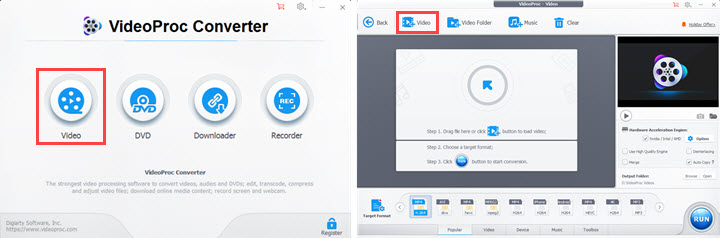
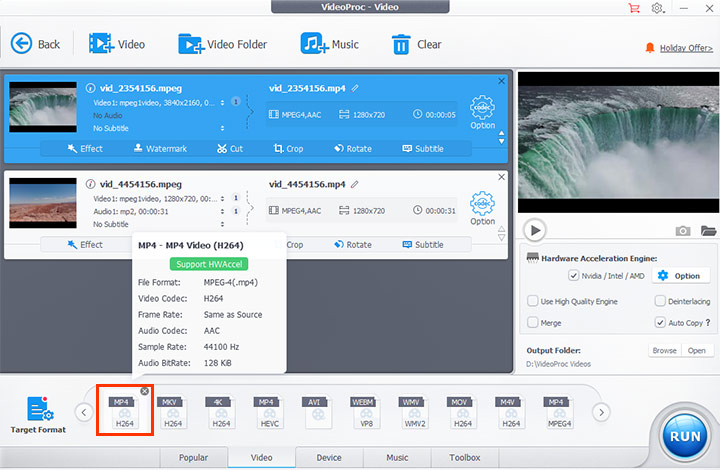
Step 3. Click Video in the output-format section at the bottom of the interface. Find MP4 Video, then choose H.264 MP4 for the widest compatibility, HEVC MP4 for a smaller file at similar quality, or AV1 MP4 for more efficient compression on supported devices.
Tips:
- If you only want to remux MPEG to MP4, which means placing the original MPEG stream inside an MP4 container without re-encoding it, click Target Format and select MP4 MPEG. Since the video stream is copied rather than transcoded, the process is much faster and preserves the original quality.
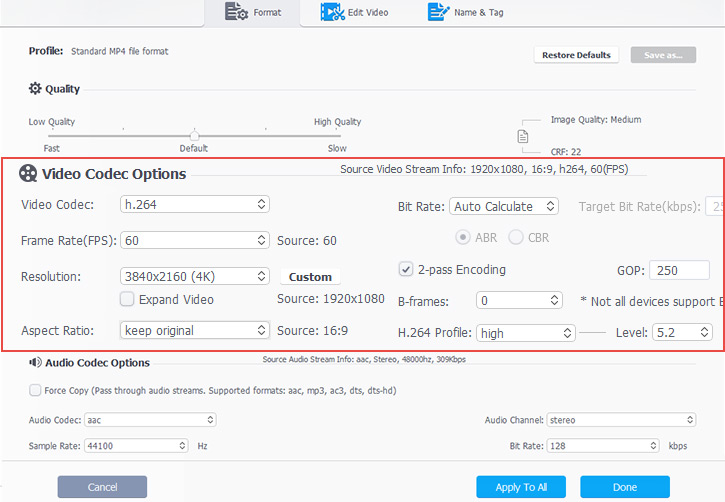
- Click the gear-shaped Codec Option button if you need to adjust the resolution, frame rate, bitrate, aspect ratio, or audio settings.
Step 4. Enable hardware acceleration to speed up the conversion, and enable High Quality Engine to preserve as much of the original video quality as possible. Then choose an output folder and click RUN to convert the MPEG file to MP4 on your computer.
VideoProc Converter AI Can Handle the Conversion of 370+ Formats! Watch This Video to Learn More.
Choose VideoProc Converter AI if:
- You need to convert large or lengthy MPEG videos.
- You want to process multiple MPEG or MPG files in a batch.
- You prefer ready-made MP4 profiles for phones, TVs, game consoles, and social platforms.
- You want to trim, crop, merge, compress, or enhance the video before conversion.
- You want to use hardware acceleration to reduce conversion time and CPU usage.
- You need to remux MPEG into MP4 without re-encoding the original video stream.
Look elsewhere if:
- You want a completely free and open-source MPEG-to-MP4 converter.
Method 2. Convert MPEG to MP4 Online
Best for: Converting one or two small MPEG files without installing additional software.
An online MPEG-to-MP4 converter runs directly in your browser. You upload the MPEG or MPG file, choose MP4 as the output format, adjust the conversion settings, and download the finished video when processing is complete.
Services such as CloudConvert and FreeConvert usually provide more control than basic one-click converters. Depending on the platform, you may be able to select the video codec, resolution, frame rate, audio codec, and output quality.
Online conversion is most practical for short videos and occasional use. Large MPEG files can take a long time because the entire video must first be uploaded to the service and then downloaded again after conversion.
How to Convert a Small MPEG File to MP4 Online
Most online MPEG-to-MP4 converters follow a similar workflow, although the button names and available settings may vary slightly. The steps below use Convertio as an example. Convertio is an online MPEG to MP4 converter. It gains popularity among global users for its fast and ads-free conversion features. And all conversions are performed in the cloud and won't take up any capacity on your computer.
Step 1. Open the Convertio MPEG-to-MP4 converter in your browser.
Step 2. Click Choose Files and upload the MPEG or MPG video from your computer. You can also drag the file onto the page or import it from Google Drive or Dropbox.
Step 3. Make sure MP4 is selected as the output format. You can add more MPEG files at this stage if you need to convert several videos.
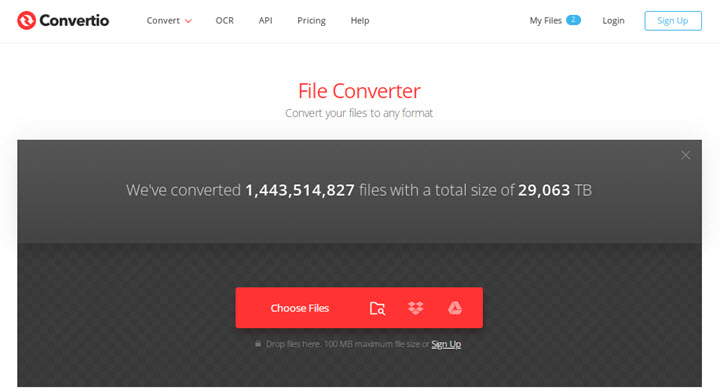
Step 4. Click Convert and keep the browser tab open while Convertio uploads and processes the file. The total time of converting MPEG to MP4 will depend on the file size and your upload speed.
Choose an online converter if:
- Only one or two small MPEG files need to be converted.
- Installing additional software is not possible or desirable.
- The conversion is being performed on a restricted work or school computer.
- A fast and stable internet connection is available.
- The footage contains no private, confidential, or commercially sensitive material.
Look elsewhere if:
- The MPEG file is several gigabytes in size.
- The upload connection is slow or unreliable.
- Multiple files or dependable batch processing are required.
- The footage contains personal, business, or confidential information.
- Advanced control over codecs, subtitles, quality, or audio tracks is needed.
- File-size limits, daily quotas, or processing queues would be restrictive.
Method 3. Convert MPEG to MP4 with VLC
Best for: A quick conversion when VLC is already installed.
VLC is an open-sourced media player and converter that supports a wide array of media formats. As for MPEG to MP4 conversion, it accepts MPEG-1, MPEG-2, and MPEG-4, and lets you convert them to MP4 H.264 for free. Besides, VLC is available on Windows, Mac, and Linux. Let's see how to use it to convert MPEG to MP4 for free.
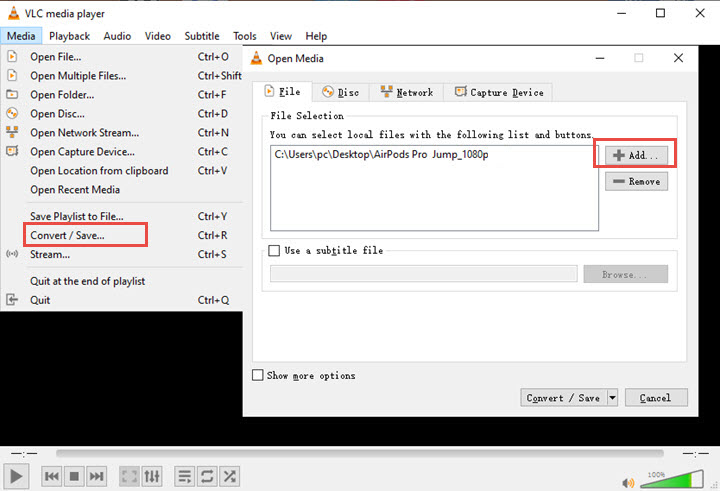
Step 1. Open VLC Media Player. Click Media in the top menu, then select Convert/Save.
Step 2. In the File tab, click + Add and select the MPEG or MPG video you want to convert. Once the file appears in the list, click Convert/Save at the bottom.
Step 3. Open the Profile menu and select Video - H.264 + MP3 (MP4). This preset creates an MP4 file with H.264 video, which works with most computers, phones, TVs, and media players.
Tip: To use a different video or audio codec, click the wrench icon next to the selected profile. You can then customize the encapsulation format, video codec, audio codec, bitrate, frame rate, and other settings.
Step 4. Click Browse next to the destination field. Choose where you want to save the converted video, enter a filename, and make sure it ends with .mp4.
Step 5. Click Start to convert the MPEG file to MP4. VLC will show the conversion progress in the playback bar.
Step 6. When the conversion from MPEG to MP4 is complete, open the destination folder and play the MP4 file to check the video quality, audio, and duration.
Choose VLC if:
- VLC Media Player is already installed.
- Only occasional MPEG conversions are required.
- A free tool for Windows, macOS, or Linux is preferred.
- Advanced editing and compression features are unnecessary.
- Manual selection of codecs and output profiles is acceptable.
Look elsewhere if:
- A large collection of MPEG files needs to be converted.
- A more beginner-friendly interface is important.
- Precise control over output quality and file size is required.
- Ready-made presets are needed for phones, TVs, consoles, or social platforms.
- Unusual video or audio codecs may require detailed troubleshooting.
Methdod 4. Convert MPEG to MP4 for Free with HandBrake
Best for: Users who want a completely free, open-source MPEG-to-MP4 converter with detailed control over video quality and compression.
HandBrake is a popular video transcoder available for Windows, macOS, and Linux. It can open common MPEG and MPG files and convert them into MP4, MKV, or WebM. Unlike a basic one-click converter, HandBrake gives you control over the video encoder, quality level, frame rate, dimensions, audio tracks, subtitles, and filters.
Its built-in presets make the process more approachable. The General presets create MP4 files intended to work with a wide range of devices and applications, while separate presets are available for Android devices, Apple products, PlayStation, Xbox, Roku, Chromecast, and online sharing. However, it is primarily a transcoder. It re-encodes the video rather than simply moving the original MPEG stream into an MP4 container, so it is not the best choice when you only want to remux MPEG to MP4.
How to convert MPEG to MP4 for Free with HandBrake
Step 1. Download and install HandBrake, then open the program. Click Open Source and select the MPEG or MPG file. You can also drag the video directly into the HandBrake window.
Step 2. Open the Preset menu and choose a preset that matches the source video. Fast 1080p30 is a suitable starting point for most HD videos, while Fast 720p30 works well for lower-resolution footage.
Step 3. Open the Summary tab and make sure MP4 is selected as the output format. Go to the Video tab and select H.264 (x264) for broad compatibility. Keep the frame rate set to Same as source.
Step 4. Check the Dimensions tab and keep the original resolution. If the MPEG video shows horizontal lines during movement, open Filters and enable Decomb. Open the Audio tab and select AAC as the audio codec. Then click Browse and choose the output folder and filename.
Step 5. Click Start Encode to convert the MPEG file to MP4. When the process is complete, play the output file to check the image quality, sound, and aspect ratio.
Choose iMovie if:
- The MPEG or MPG file imports successfully.
- iMovie is already part of the existing Mac workflow.
- Trimming, cropping, stabilization, or other edits are needed before export.
- Only one or two videos need to be processed.
- Using software already installed on the Mac is preferred.
Look elsewhere if:
- The MPEG file cannot be imported into iMovie.
- Only remuxing is required, with no re-encoding.
- Several MPEG files need to be converted in a batch.
- Detailed control over codecs, bitrate, audio tracks, or subtitles is required.
- No editing is needed before format conversion.
Method 5. Convert MPEG to MP4 for Free with iMovie
Best for: Mac users who want to make basic edits before exporting a compatible MPEG video as MP4.
iMovie is a free video editor included with most Macs. It is a practical option when you already have it installed and want to trim unwanted footage, crop the frame, correct colors, stabilize shaky video, or add titles before converting the file.
However, iMovie is not a universal MPEG converter. Some MPEG and MPG files, particularly older videos using MPEG-1, MPEG-2, or specialized audio codecs, may not import successfully. Apple notes that older or specialized media formats may not work when the device, operating system, or application does not support the format.
Step 1. Open iMovie on your Mac. In the Projects window, click Create New, then select Movie to create a blank project.
Step 2. Click the Import Media button at the top of the window. Locate the MPEG or MPG file, select it, and click Import Selected.
Step 3. Once the video appears in the media browser, drag it onto the timeline at the bottom of the window. You can also select the clip and press the E key to add it to the movie.
Step 4. Make any necessary edits. For example, you can trim the beginning or end, split the clip, crop black borders, adjust the color, stabilize shaky footage, or change the audio volume. Skip this step when you only need format conversion.
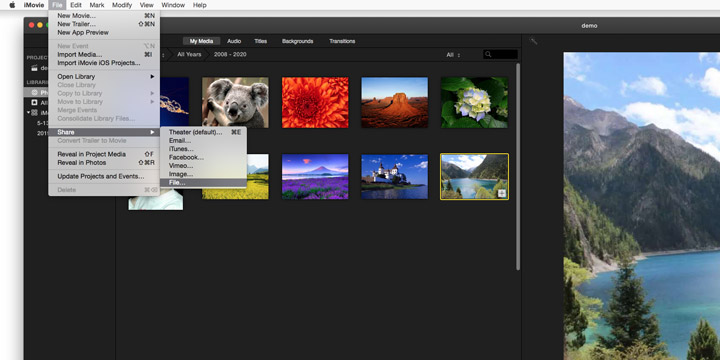
Step 5. Click the Share button in the upper-right corner and select Export File. Alternatively, choose File > Share > File from the menu bar. Apple’s current iMovie guide uses this workflow to export a project as a standalone video file.
Step 6. Set Format to include both video and audio. Choose a resolution that matches the original MPEG file. Click Next, enter a filename, choose the destination folder, and click Save.
Choose iMovie if:
- The MPEG or MPG file imports successfully into iMovie.
- You already use iMovie on your Mac.
- You want to trim, crop, stabilize, or edit the video before exporting it.
- You only need to process one or two videos.
- You prefer to use software that is already available on your Mac.
Look elsewhere if:
- iMovie cannot import the MPEG file.
- You only want to remux the video without re-encoding it.
- You need to convert multiple MPEG files in a batch.
- You want detailed control over the video codec, bitrate, audio tracks, or subtitles.
- You only need format conversion and do not require video editing.
FAQ
How do I convert MPEG to MP4 on Mac?
VideoProc Converter AI is an MPEG to MP4 converter compatible with macOS 10.13 and later. You can import your .mpeg files to it, set MP4 as the output format, and export. And soon you'll get files in MP4 on your Mac.
How do I convert MPEG to MP4 for free?
In VideoProc Converter AI, you can convert MPEG files under 5 minutes for free. It won't put watermarks or limits on file size, video quality, and batch conversions.
What's the difference between MPEG and MP4?
MP4 can store video streams, audio streams, subtitles, still images, and other data, while MPEG files can't be packed with much essential data like chapters.
Another difference lies in coding schemes. MP4 employs more modern encoders H.264 and HEVC and is more widely-supported. While MPEG uses MPEG-1 and MPEG-2 and can't be opened by some players.
What is the difference between MPG and MPEG?
MPEG refers to the group developing the standards as well as the collection of standards itself. While MPG refers specifically to the file extension used for older MPEG-1 and MPEG-2 video file formats. All MPG files are MPEG encoded, but not all MPEG file formats use the .mpg extension (for example, MPEG-4 files use .mp4). MPG is now considered a legacy video file container tied mainly to MPEG-1 and MPEG-2 video. MPEG standards have evolved beyond MPEG-1/2.
How to play MPEG file?
You can use powerful media players like 5KPlayer, VLC media player, or Windows Media Player. If failed, try to install MPEG codec packs on your computer or just convert it to MP4 with the guide above.
Is MPEG outdated?
Sort of. MPEG is commonly used for media storage and DVD distribution. While MP4 has wider device support and is more commonly used for online distribution and mobile devices.