 Upgraded AI Performance in V8
Summary: This post will look at how to merge videos in VLC and the easiest ways to fix the common "VLC merge videos not working" error.
Can VLC really merge videos? While VLC is best known as a versatile media player, it also offers basic video editing features, including the ability to combine video clips. If you want to create a single file from multiple videos for easier viewing or sharing highlights, VLC seems like a convenient option.
Many tutorials tell you that you can combine videos in VLC easily by following the steps below:
- • Hit "Media" > "Multiple video files", and press "Add" to import videos.
- • Press "Browse" to set up the output file location.
- • Click on "Play" and choose "Convert" from the drop-down menu.
However, even when these steps are followed correctly, problems often arise. Users frequently report issues such as videos merging with no image or audio and video falling out of sync. In this article, we will show you how to merge videos in VLC effectively, whether your clips are in portrait, landscape, or a mix of orientations. We will also cover the simplest ways to troubleshoot common VLC merging errors, helping you avoid frustration and save time.

How to Merge Multiple Videos to a New One in VLC
VLC is a cross-platform media player which goes compatible with Windows, macOS, Linux, Android, iOS, and some others. This guide was carried out on Windows 10.
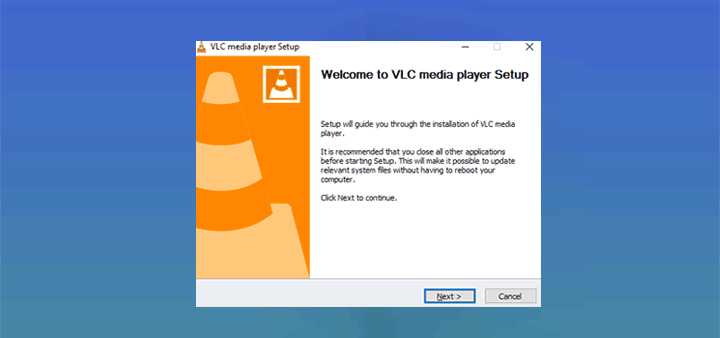
Step 1. Download VLC
Visit VLC download site: videolan.org. Choose an edition that matches your operating system. Click to download the setup file.
Step 2. Install VLC
Right-click the setup file and follow the on-screen instructions to install it on your computer. Once the installation is complete, launch the program.
Step 3. Merge Videos in VLC with Command-line
Create a new folder and move all your videos need to be merged to here. Hold "Shift" and right-click on the new folder. Select "Open command window here". Type the following command and press "Enter" to enable VLC to merge your videos. "vlc_location" file1.mp4 file2.mp4 --sout "#gather:std{access=file,dst=final.mp4}" --sout-keep.
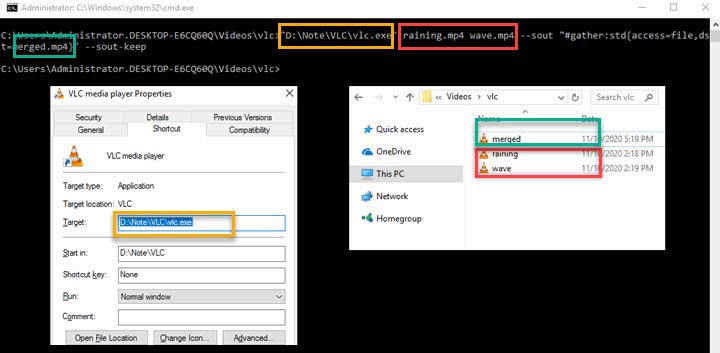
Command line explain:
- vlc_location refers to the location of the vlc on your computer. To get it: Right-click on the VLC media player on the startup menu, choose "Open file location". Again, you right-click on VlC media player, choose "Properties". The location of VLC has been selected and highlighted in blue.
- file1 and file2 are the file name of your source videos. In my case, I need to replace file1 with raining and file2 with wave. final stands for the name of the final merged videos, here I change it to merged. You can name it in your favor.
Step 4. Play the VLC Merged Video
Go to the folder that was created in step 3 to find the merged video. Open the video merged by VLC and start to enjoy it on your PC or Mac.
| File name | File size | Resolution |
|---|---|---|
1.raining |
69 MB |
1024*436 |
2.wave |
81.5 MB |
1920*800 |
merged.mp4 |
86.4 MB |
1024*448 |
How to Fix VLC Merge Videos Not Working (or Only Sound)
Sometimes, VLC may fail to merge videos properly, or the merged file might play only sound with no image. This usually happens because VLC's merge function is not as flexible as dedicated video editing software. It requires all videos to share certain characteristics:
- Same format: VLC can only merge files with identical video codecs and containers. For example, it can merge MP4 with MP4, but not MP4 with AVI or MOV.
- Same resolution and orientation: Mixing vertical and horizontal videos, or videos with very different resolutions, can cause playback issues in the merged file.
- Uncorrupted source files: If one of the source videos is damaged or incomplete, VLC may fail to include the video track in the final merged file.
Because of these limitations, users often run into problems like videos merging with only audio, videos appearing rotated incorrectly, or VLC failing to merge entirely. Fortunately, these issues can usually be fixed by converting videos to the same format, correcting their orientation, or checking for corrupted files.
How to Convert Your Videos to the Same Formats for Merging in VLC
Step 1. Launch VLC and select "Media" on the main toolbar.
Step 2. Click "Open Multiple Files". After that, add video clips by clicking "+ Add".
Step 3. Unfold the "Play" button and select "Convert".
Step 4. Select a profile i.e. Video – H.264 + MP3 (MP4).
Step 5. Click "Start" button to run video converting process.
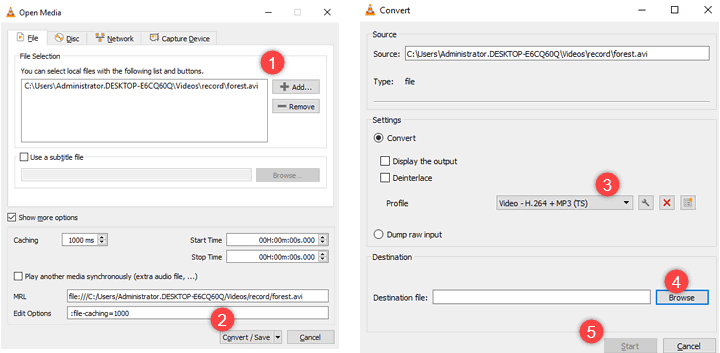
How to Change Portrait Videos to Landscape for Merging in VLC:
Step 1. Open the video that you want to change its orientation in VLC.
Step 2. Go to Tools > Effects and Filters > Video Effects > Geometry.
Step 3. Check Transform and select the correct rotation (90°, 180°, etc.).
Step 4. Save the rotated video.
Step 5. Repeat steps 1–4 for any other videos that need rotation.
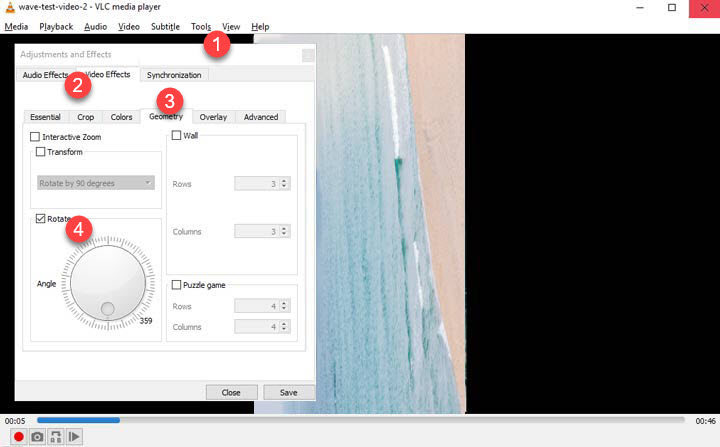
Note: VLC's Batch Conversion & Rotate Limitation
VLC has limitations when working with multiple videos. You cannot choose a destination folder when converting several videos at once, so each file must be converted individually, which can be slow. Similarly, VLC cannot rotate multiple videos at the same time; each video has to be opened and rotated one by one.
In other words, if you only have a few videos, VLC's single-file conversion and rotation work just fine. However, if you're dealing with 10 or more clips, it's much more efficient to use a tool that supports batch converting and rotating. One of the best options is VideoProc Converter AI, which allows you to both convert and merge multiple videos in batch, saving the final merged file in any format and to any location you choose.
How to Check If a Video Is Corrupted
Go and play the source video clips to see if any of them are corrupted. There is also a chance that the video conversion operated by VLC is incomplete or there was a video codec issue but VLC forced itself to complete the conversion. Try playing the merged video using some other media players such as Windows Media Player, KMPlayer, Potlayer, etc.
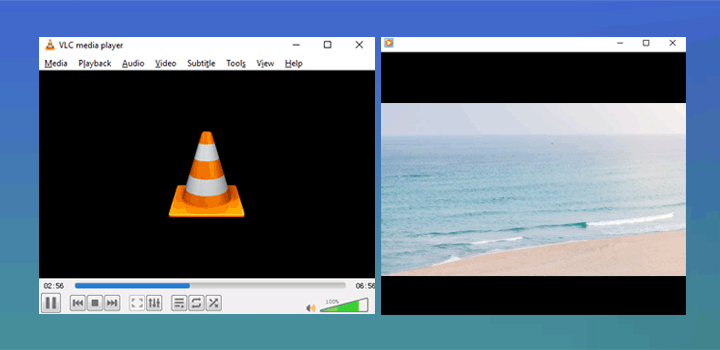
The Easiest and Error-Free Alternative to Merge Videos in VLC
Merging videos in VLC often causes problems because the software requires all videos to have the same format, resolution, and orientation. Combining files with different settings can lead to errors, missing video, or audio-only playback. Batch conversion and rotation are also limited, which makes processing multiple videos slow and tedious.
For a smoother experience, you can use a program like VideoProc Converter AI. It allows you to merge multiple videos even if they have different formats, resolutions, or aspect ratios. You can import your clips, choose an output format, enable the merge option, and create a single video file without worrying about compatibility issues.

Step 1. Download, install, and run VideoProc Converter AI. Click Video Converter. Drag & drop your video clips that you wanted to merge.
Step 2. Click "Target Format", and check "Merge" option.

Step 3. Click the "RUN" button to convert and combine videos in one shot.