New AI features are available

We've seen a sheer rise of H.265/HEVC codec in video production as it's more efficient in video compression. Videos from iPhone, Android, GoPro, DJI, and DSLRs are encoded in HEVC for a better compression ratio. This efficient codec makes great contributions to 4K and 8K content. However, it's still not as widely supported as H.264.
Today, we'll introduce 3 best video converters to transcode HEVC/H.265 to H.264 to meet all your needs, including how to convert HEVC to H.264 without losing quality and how to convert HEVC to H.264 free online.
If you want a reliable application to convert H.265 to H.264, go straight to VideoProc Converter AI and start converting H.265 videos right away. If not, check the next part and find the best H.265 to H.264 conversion plan in your case.
Method 1. VideoProc Converter AI - Fast H265 to H264 Converter
VideoProc Converter AI is an easy yet powerful h265 to h264 converter available on Mac and Windows. To be specific, it can be used for video conversion, quick edit, compression, fix, download, and screen recording.
When it comes to converting HEVC videos to H.264, VideoProc Converter AI is definitely the easiest and the most advanced HEVC converter at your disposal. It can decode and convert all sorts of HEVC videos, including MOV, MP4, MKV, 4K/8K, HDR 10-bit, high FPS, 3D, 360-degree, and HEVC videos from iPhone, GoPro, DJI, etc. Backed by the unique GPU acceleration of H.264 encoding, it lets you convert H.265 to H.264/AVC without waiting a long time or suffering from crashes, even on old and low-end Mac and Windows PCs.

VideoProc Converter AI - Best H265 to H264 Converter on Mac/PC
- Advanced decoders and encoders for H.265/HEVC, H.264, VP8, VP9, AV1, DivX…
- Total control over video quality, format container, resolution, bitrate, and file size.
- 47x faster processing speed boosted by Level-3 Hardware Acceleration.
- Compatible with 420+ video and audio file formats and codecs.
- Edit, remux, compress, deinterlace, upscale, fix, download, and beyond.
Excellent 


Free download and install VideoProc Converter AI to convert H.265 to H.264 in 3 steps!
Step 1. Launch VideoProc Converter AI. Click "Video Converter" and "+Video" to import HEVC files from your computer.
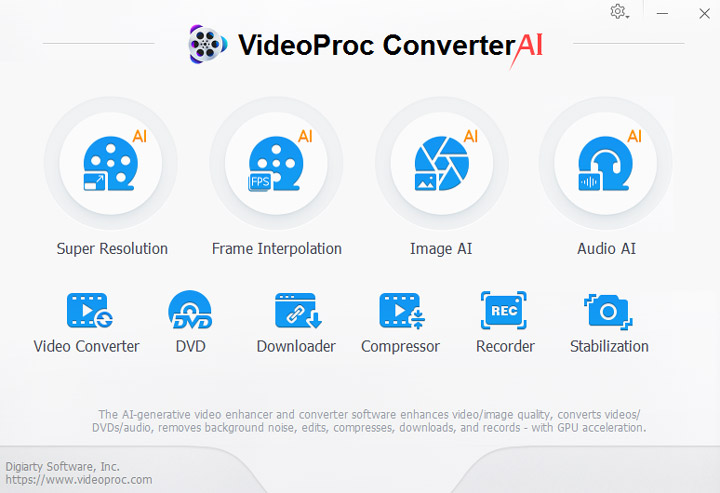
Step 2. Click Video at the bottom and select "MP4 H.264" as your target format.
Step 3. Select an output folder. Hit the RUN button to start converting H.265 to H.264.

Alternatively, you can open "Target Format" and find the best H.264 format for various needs in one click.
VideoProc Converter AI has preset profiles for H.264 4K, H.264 HD, H.264 for iPhone, iPad, and Android phones of all versions, H.264 for TV, Xbox, PS4/5, H.264 for web videos (YouTube, Facebook, Vimeo, etc.), and H.264 for video editors like iMovie and Final Cut Pro.
 Tips: How to Convert H265 to H264 without Quality Loss
Before exporting the video, click the gear icon and you can control the final quality with the following options:
 Keep original resolution and frame rate.
MP4 H.264 videos are output in 1080p @29.97fps in default. If you input a 4K HEVC video, you need to choose "Keep Original" to prevent quality loss.
Tweak video bitrate manually.
VideoProc Converter AI calculates the best bitrate for H.264 encoding automatically. To convert HEVC to H.264 with the max quality, you can set it to manual and input a target bitrate in reference to your source video.
Enable 2-pass encoding.
2-pass encoding strategy analyzes the video during the 1st pass and apply the best bitrate to retain the quality as much as possible with the analysis results. It's effective to keep video quality when transcoding H.265 to H.264, meanwhile it takes more time to complete.

Video Tutorial: How to Convert HEVC H.265 to H.264 in VideoProc Converter AI
Method 2. VLC - Free H265 to H264 Converter
VLC is a powerful video player that functions as a h.265 to h.264 converter at the same. It provides solutions to free convert HEVC to H.264 on Mac, Windows, and Linux. In addition to HEVC/H.265, H.264/AVC, it supports MPEG-2, MPEG-4, VP8, DivX, and most audio codecs. In a nutshell, it benefits both video playback and transcoding.
Step 1. Open VLC media player on your computer. Click Media > Convert/Save.
Step 2. Import an HEVC/H.265 video to it and hit the convert button at the bottom.
Step 3. Expand the drop-down menu of Profile and select Video – MP4 H.264 + MP3. Click the wrench icon and choose H.264 in Video Codec. Click Save.

Step 4. Browse the destination file and start to convert HEVC video to H.264 in VLC.
Be aware: It's slower than most H.265 to H.264 converters. And you may get videos without sound due to unknown errors.
Method 3. HandBrake
HandBrake is a popular, free, open‑source video transcoder available for Windows, macOS, and Linux. The software ships with a comprehensive library of device-specific presets, allowing you to optimise output for smartphones, game consoles, tablets, or streaming platforms with a single click. Batch processing is built right in, so you can queue multiple videos and let HandBrake run overnight without supervision.
That said, HandBrake is not without its limitations. It consumes more system memory and CPU overhead than some dedicated converter software. Advanced users may also find the preset system somewhat restrictive, as it does not expose every exotic encoder flag through the GUI.
Follow the steps below to convert H.265 to H.264 with HandBrake.
Step 1. Download and install HandBrake from the official website and launch it.
Step 2. Click the Open Source button and select your file to load your H.265 file.
Step 3. On the right-hand side, pick a preset that matches your target device (e.g., Fast 1080p30). This automatically sets resolution, frame rate, and encoder to H.264.
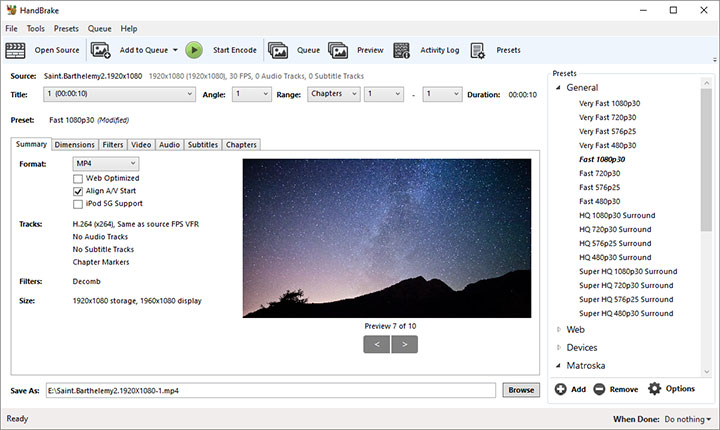
Step 4. Go to the Video tab to set Video Encoder to H.264 (x264) or H.264 (Intel QSV/NVENC/AMF) if you have hardware support.
Step 5. Adjust audio and subtitles in the corresponding tabs if necessary.
Step 6. At the bottom, select where to save the converted file.
Step 7. Click the green Start Encode button. HandBrake will process the file and show a progress bar.
Method 4. AnyConv - Online H265 to H264 Converter
If you only have one or two HEVC files to convert and do not care about the image quality, online H265 to H264 converters would worth a try. Without installing anything on your computer or learning much knowledge about codecs, you just need to upload and wait for them to transcode H.265 to H.264. Below is how to convert HEVC to H.264 online with AnyConv File Converter.
Step 1. Go to anyconv.com using the browser on your Mac or PC. Hit the red button to select an HEVC video on your computer.
Step 2. Choose H264 in the target format drop-down menu. Hit Upload and wait for it to transcode H.265 to H.264.

Step 3. When it is done, save the H.264 video from this website.
Be aware: Online converts impose limits on file size, conversion speed, and output quality. For anyone needs to convert HEVC videos over 50MB to H.264 without losing quality or without watermark, desktop video converters work much better.
Method 5. Convert H265 to H264 FFmpeg
FFmpeg is the industry-standard multimedia framework, used by many GUI tools under the hood. It is lightweight, scriptable, and runs on all platforms. For users comfortable with the terminal, FFmpeg offers the most control and flexibility. Because it operates entirely in the terminal without any graphical overhead, it is exceptionally fast and resource-efficient, often outperforming GUI tools even when using the same underlying x264 library.
However, this immense power comes with a steep learning curve. The command syntax is dense and unforgiving—a misplaced colon or a forgotten stream specifier can produce a silent failure, an unexpected audio drop, or a completely garbled output, and the error messages are often cryptic to newcomers. For users who are not comfortable with the terminal or who only need an occasional conversion, FFmpeg can feel intimidating and overly complex, with a much higher risk of user error compared to a guided graphical interface.
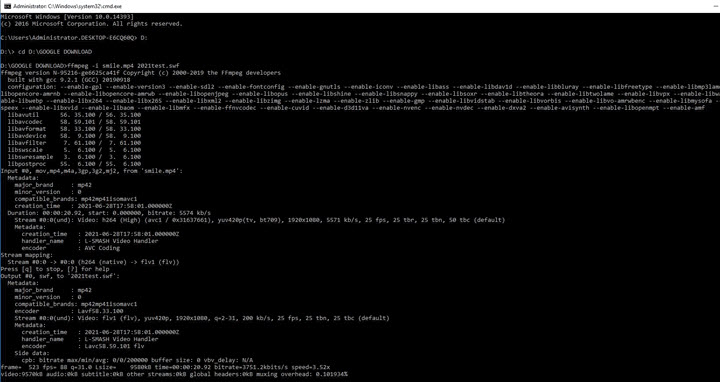
Here's how to convert H.265 to H.264 using FFmpeg.
Step 1. Download, install, and add FFmpeg to your system PATH.
Step 2. Open your terminal (Command Prompt on Windows, Terminal on macOS/Linux).
Step 3. Run the following command.
ffmpeg -i input.mp4 -c:v libx264 -crf 23 -preset medium -c:a aac -b:a 128k output.mp4
Here is an explanation of the key parameters:
-i input.mp4– Specifies the input file (supports any container: .mkv, .mp4, .mov, etc.).-c:v libx264– Sets the video codec to H.264 (software x264). If your device supports NVIDIA NVENC, change `-c:v libx264` to `-c:v h264_nvenc` to utilize hardware acceleration.-crf 23– Constant Rate Factor; lower = better quality (18–28 is typical, 23 is a good default).-preset medium– Balance between encoding speed and file size. Use slow for better compression, fast for quicker encode.-c:a aac– Audio codec to AAC (widely compatible).-b:a 128k– Audio bitrate (adjust to your preference).output.mp4– The output file name.
What Devices Support HEVC and Which Don't
HEVC playback depends on the device hardware, operating system, player, and video specifications. Support for an 8-bit HEVC file does not necessarily mean a device can smoothly play 10-bit HDR footage or high-bitrate 4K video.
1. Which hardware can support HEVC decoding and playback?
- Intel Core processors with supported integrated graphics: HEVC hardware acceleration starts with 6th-generation Skylake processors. 7th-generation Kaby Lake adds hardware decoding for 10-bit HEVC, which is important for many HDR videos.
- Nvidia GPUs with compatible NVDEC hardware: support varies by GPU model and HEVC profile. Check Nvidia's decode support matrix instead of assuming every GPU in a newer series supports the same formats.
- Compatible AMD Radeon GPUs and Ryzen APUs: check the exact model's media-engine specifications. For example, Radeon RX 7900 series GPUs support HEVC hardware encoding and decoding.
- Apple silicon Macs and compatible iPhone and iPad hardware: playback capabilities vary with the device, resolution, frame rate, and HDR format.
- Android phones and tablets with compatible media decoders: chipset support varies, so check the device's supported HEVC profile, bit depth, and maximum resolution.
A compatible player may also decode HEVC in software when hardware acceleration is unavailable. However, software decoding can use more CPU power and may struggle with demanding 4K or high-frame-rate footage.
2. Which devices can support HEVC decoding and playback?
- Windows 11 and Windows 10 PCs with a compatible player. Apps that rely on Windows codecs may require Microsoft's HEVC Video Extensions; an HEVC-capable third-party player can provide another playback option.
- Macs running macOS High Sierra 10.13 or later, including newer macOS releases. Smooth playback depends on the Mac hardware and video specifications.
- Compatible iPhones and iPads running iOS 11 or later or iPadOS. Older models may have limitations when playing high-resolution or high-frame-rate HEVC footage.
- Android phones and tablets: Android lists HEVC decoding support from Android 5.0 onward, but this does not guarantee support for every 4K, 10-bit, or HDR file.
- Apple TV 4K, which supports HEVC Main and Main 10 video up to 2160p at 60fps within its supported format specifications.
- Chromecast Ultra, Chromecast with Google TV, and Google TV Streamer, which support HEVC Main and Main 10 within their documented playback limits.
For smart TVs, Roku devices, Fire TV devices, and game consoles, check the exact model and playback app. Streaming-service support, local-file playback, and USB playback may have different requirements.
3. Which devices don't support HEVC, or may have trouble playing it?
- Standard Chromecast devices from the first, second, and third generations do not list HEVC among their supported video codecs.
- Older devices or playback apps without an HEVC decoder cannot play HEVC files directly.
- Devices with only 8-bit HEVC decoding may fail to play 10-bit HEVC files through hardware acceleration.
- Even an HEVC-compatible device may reject a file that exceeds its supported profile, level, resolution, frame rate, or bitrate, or uses an unsupported container or audio codec.
Android devices, Apple TV devices, and PlayStation consoles should not be grouped into a blanket list of unsupported products. Compatibility must be checked for the specific model, app, and playback method.
4. Five media players that can play HEVC files
- VLC media player: supports HEVC playback, with hardware acceleration available on compatible systems.
- mpv: supports HEVC playback and can use supported hardware-decoding APIs or fall back to software decoding.
- Kodi: supports HEVC playback, with performance depending on the platform and available hardware acceleration.
- QuickTime Player on compatible Macs: can play supported HEVC media on macOS High Sierra or later.
- Windows Media Player or Media Player: can play supported HEVC files when the required codec support is installed.
If your device or player cannot play HEVC videos recorded on an iPhone, follow the guide above to convert H.265/HEVC to H.264 video in an MP4 container. For broader compatibility, use AAC audio and choose a resolution and frame rate your target device supports. HDR footage may also need HDR-to-SDR tone mapping.
HEVC (H.265) vs H.264 (AVC)
| Comparison | HEVC (H.265) | H.264 (AVC) |
|---|---|---|
Standard |
Also known as MPEG-H Part 2; developed as the successor to H.264/AVC. |
Also known as MPEG-4 Part 10 or Advanced Video Coding. |
First standardized |
2013. |
2003. |
Compression efficiency |
Can deliver comparable visual quality at a substantially lower bitrate. Around 50% bitrate savings is a common reference target, but actual savings depend on the content, encoder, and settings. |
Typically requires a higher bitrate for comparable visual quality. File size also depends on duration, audio, and encoding settings. |
Resolution |
Commonly used for 4K and 8K video. Actual playback limits depend on the codec level and device. |
Commonly used for HD and 4K video. 4K is not an absolute limit of the standard; higher resolutions are possible at appropriate levels. |
Frame rate |
Supports high-frame-rate video, with limits determined by resolution, codec level, and the implementation. |
Can exceed 60fps. There is no universal 60fps limit across all resolutions and codec levels. |
Compatibility and processing |
Useful for reducing storage and bandwidth, but generally more demanding to encode and decode. Older devices and apps may require codec installation or conversion. |
Generally offers broader compatibility across older devices, browsers, editing tools, and playback apps. |
Choose HEVC when smaller files matter and your target devices support it. Choose H.264 in an MP4 container when broad playback compatibility is the priority.
Should You Convert HEVC H265 to H264
Despite H.265 doubled the encoding efficiency, H.264 wins back by its wide compatibility and gains 84% adoptions according to Bitmovin video codec survey of the year. Here comes many circumstances under which we need H.264 AVC rather than H.265 HEVC codec.
1. Can't upload H.265 videos to popular platforms.
Still, many social media platforms do not support videos encoded with H.265. Some of them stop you from uploading H.265 files, and some take it upon themselves to transcode H.264 to H.265 with visible quality loss. If you ever run into the trouble with apps below, convert H.265 to H.264 by yourself in advance.

2. Can't play H.265 videos on old devices.
H.265 was standardized in 2013 and the stable version of its encoder x.265 was released in 2016. Before that, TVs, smartphones, and computers were shipped without HEVC support. Aged devices cannot HEVC videos, so you have to transcode them to H.264 which came into being 10 years earlier than HEVC.
3. HEVC codec is missing in some players or OS.
Though the media player or the operating system you are using is up to date, there are chances the HEVC codec is missing. For example, HEVC is not natively supported by Windows 11 and Windows 10. Typically, you'll be asked to install an HEVC codec either paid or free. If you don't want to put your PC at risk by installing a code pack, converting it to H.264/AVC is necessary.
4. HEVC codec is unfriendly to video editing.
Editing videos in HEVC codec would drive many users crazy with severe lagging or crashing, esp. when rendering the timeline in real time and exporting. That's because HEVC was not born for post editing. It needs 10x computing power than its predecessor H.264/AVC. To solve HEVC codec issues in Premiere Pro and other video editing software, transcode HEVC to ProRes (for original image quality) or H.264 (for smooth performance).
FAQs
Does converting H265 to H264 lose quality?
Some quality loss is inevitable when converting from the more modern and efficient H265 codec to the older H264, especially if trying to maintain a similar file size. The key is managing the bitrate and settings to balance quality and file size for your needs and that's where VideoProc Converter AI comes to help.
Is H264 higher quality than H265?
H265 is almost always higher visual quality than H264 at real-world bitrates, enabling greater efficiency for streaming and storage. Only at very high bitrates does H264 see marginal gains due to simpler encoding.
Is H265 lighter than H264?
When optimally encoded, H265 (HEVC) can deliver the same video quality as H264 at about half the file size, making it significantly lighter and better suited to streaming and storage applications. The efficiency gains are most notable at lower bitrates.
Why is H265 so slow?
Because H265 trades off encoding speed for significant gains in compression efficiency. Fortunately, VideoProc Converter AI's Level-3 Hardware Acceleration is applicable to H265, which boosts 47x real-time faster H265 encoding.
Is H265 good for streaming?
H265's significant bandwidth savings compared to H264 make it an excellent choice for high-quality video streaming, especially for HD/4K content. But here are some challenges to consider, such as slower encoding times requiring more server power, and licensing fees that can add to the operating costs of the streaming service.