
 Upgraded AI Performance in V8
An iPhone video can look perfectly normal in Photos and then become a problem as soon as you move it somewhere else. A Windows PC may not open it. An editing app may reject it. You may select Most Compatible in the Camera settings and still find a .mov file instead of the MP4 you expected.
That confusion usually comes from treating the file extension and the video codec as the same thing. They are not. Apple also describes its camera options as High Efficiency and Most Compatible, which does not tell you at a glance whether the resulting video will be MOV, MP4, HEVC, or H.264.
Here is what those terms mean, which format fits each use case, and when you should change a setting rather than convert the video afterward.
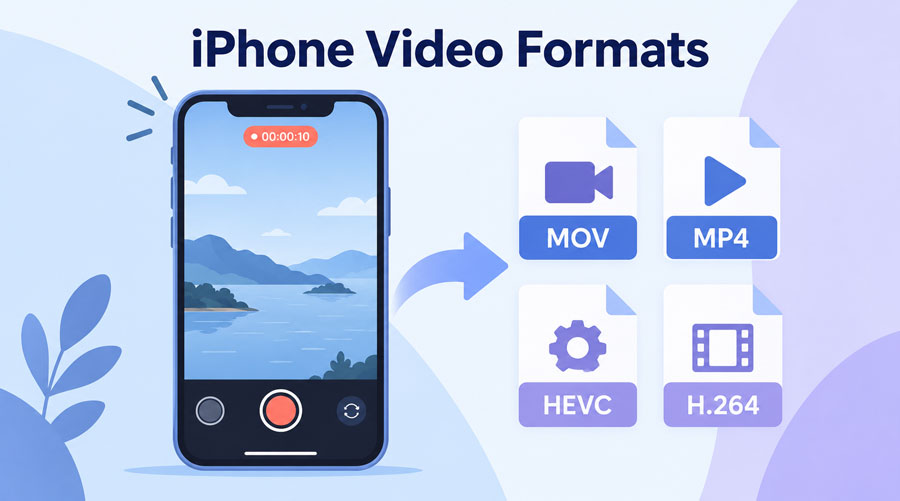
- The iPhone Camera app saves recorded videos in a MOV container, encoded with HEVC by default.
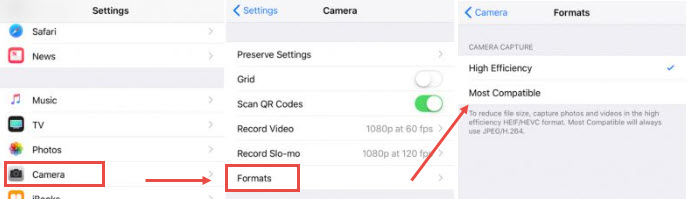
- To change the iPhone recording format to H.264: go to Settings > Camera > Formats, and pick Most Compatible.
- Selecting Most Compatible changes only the video codec used by iPhone camera recording.
- For broad compatibility with Windows, Android, websites, and older apps, MP4 with H.264 video and AAC audio is usually the safest choice.
- If an iPhone video won't play, edit, or upload properly, converting the iPhone video format to standard MP4 will solve the problem immediately.
What Format Does iPhone Record Video In
When you record a video with the native iPhone Camera app, the format is always saved as an Apple QuickTime file (.mov). However, the file extension only tells you the container (the outer wrapper). The actual video codec (how the video is compressed inside that .mov file) varies depending on your selected camera settings and iPhone model. Here is a quick overview of how iPhone camera modes map to each container and codec:
| File format / container | Video codec | When iPhone uses it |
|---|---|---|
MOV (QuickTime) |
HEVC (H.265) |
Standard video when High Efficiency is selected; also used for certain HDR recording features |
MOV (QuickTime) |
H.264 / AVC |
Standard video when Most Compatible is selected |
MOV (QuickTime) |
Apple ProRes |
Used when ProRes recording is enabled on supported iPhone Pro models |
MOV (QuickTime) |
MV-HEVC |
Used for Spatial Video on supported iPhone models |
While the container remains .mov, each codec comes with significant trade-offs in file size, playback compatibility, and video features:
☑️ HEVC (H.265): The default encoding under High Efficiency. It delivers roughly 50% better compression than H.264 without sacrificing detail. More importantly, it is the only codec that supports Apple's high-bandwidth features, including 4K at 60 fps, 10-bit Dolby Vision HDR, and Cinematic mode.
The downside: playing HEVC videos on older PCs or basic video editors often results in a black screen or codec error.
☑️ H.264 (AVC): The format used when you switch to Most Compatible. It is universally supported across virtually every computer, smart TV, and browser built in the last fifteen years.
The downsides: H.264 files take up roughly twice the storage of HEVC, and iOS disables 4K at 60 fps and HDR recording because H.264 can't handle those high data rates efficiently.
☑️ Apple ProRes: Exclusive to iPhone 13 Pro and later Pro models, Apple ProRes is a 10-bit 4:2:2 format built for serious color grading and post-production. Because it skips heavy compression, footage preserves maximum detail and scrubs smoothly on editing timelines without lagging.
The downside: 4K footage burns roughly 6GB/min, requiring an external USB-C SSD on newer Pro models to record at 60 fps.
☑️ MV-HEVC (Multiview HEVC): Introduced for Spatial Video recording on iPhone 15 Pro and iPhone 16 series. It captures stereoscopic 3D video by simultaneously recording synchronized streams from the Main and Ultra Wide cameras. What makes it unique is its backward compatibility: it delivers an immersive 3D experience inside headsets like Apple Vision Pro, but behaves as a standard 2D video when opened on an iPhone, Mac, or regular PC.
For official technical documentation, see Apple's guides to HEIF and HEVC media and Apple ProRes recording on iPhone.
What About Resolution and Frame rate
Resolution and frame rate are separate recording settings. Depending on the iPhone model and camera mode, the Camera app may offer 720p, 1080p, or 4K recording at frame rates such as 24, 25, 30, or 60 fps. Some models and modes support higher frame rates. These settings affect detail, motion, and file size, while Settings > Camera > Formats primarily controls the codec. Some recording modes and higher-quality combinations may require High Efficiency.
Can You Record Video in MP4 on an iPhone
The short answer is no, at least not with the built-in Camera app. The native iPhone Camera app exclusively outputs QuickTime MOV (.mov) files. Even if you switch your settings to "Most Compatible," iOS simply changes the internal codec from HEVC to H.264—the file extension remains .mov. However, you will frequently encounter MP4 files across iOS. Here is where they actually come from and how other formats fit into the iPhone ecosystem:
Built-in Camera Recording (MOV Only): The stock iPhone Camera app exclusively outputs .mov files. Even if you toggle the settings to "Most Compatible", it only turns the codec from HEVC to H.264 and the container remains a .mov file.
Screen Recording (Native MP4): Interestingly, if you use the built-in iOS Screen Recording tool from Control Center, iOS will save the video as a standard .mp4 file rather than a MOV.
Third-Party Camera Apps: If you need your camera to shoot directly in MP4 to skip conversion steps, professional third-party camera apps (such as Blackmagic Cam or Filmic Pro) allow you to set the output container directly to .mp4.
Playback & Ecosystem Support: While the camera app is strict about MOV, iOS natively plays MP4 and M4V files without needing third-party players. Furthermore, when you share a video via Mail, AirDrop, or messaging apps, iOS often automatically repackages the video into an .mp4 behind the scenes to ensure cross-platform compatibility.
How to Check or Change Your iPhone Video Format
You can verify your current recording format or adjust between HEVC and H.264, directly within iOS Settings:
Step 1. Open the Settings app on your iPhone. Scroll down and tap Camera.
Step 2. Tap Formats at the top of the menu.
To check the current iPhone video format: Look at where the blue checkmark is placed:
- High Efficiency (Default): Records in HEVC (.mov). Best for saving storage; keeps file sizes ~50% smaller.
- Most Compatible: Records in H.264 (.mov). Best for older Windows PCs or editing software that can't decode HEVC, but takes up double the space.
To change it: Simply tap the alternative option to switch your recording standard immediately. Keep in mind that this change applies only to new recordings. It does not convert the MOV, HEVC, H.264, HDR, or ProRes videos already in Photos.
Which iPhone Video Format Should You Use for Shooting/Sharing
The easiest way to handle iPhone video format is to separate how you shoot the video from how you send it.
1. When Shooting: MOV H.264 is the Go-to Option
Unless you have a specific reason not to, keep your camera set to High Efficiency. There's no real reason to shoot in "Most Compatible" (H.264) day-to-day. H.264 eats up twice the storage for the exact same image quality, and it locks you out of 4K at 60 fps and HDR. As long as the video stays on your iPhone, Mac, or modern iPad, HEVC runs flawlessly.
The only exception is Apple ProRes on Pro models. Leave it off unless you're actually color-grading a project in Final Cut or Premiere. After all, a ten-minute clip will casually eat up 60 GB of your phone's storage.
2. When Sharing: MP4 H.264 Is the Best Pick
You don't need to convert your .mov files if they're just going to other Apple devices or straight into modern editing software like DaVinci Resolve. MOV is Apple's native home turf.
You only need to worry about MP4 (H.264) when you're stepping outside the Apple bubble:
- Sending clips to Windows or Android users who get black screens with HEVC.
- Uploading to older web portals or forums that reject .mov uploads.
- Handing footage off to clients using legacy editing machines.
How to Convert iPhone Video Format to Fix Common Errors
If you have already recorded videos on your iPhone that refuse to cooperate with your computer, editing timeline, or website upload, the fastest way to solve the problem isn't tinkering with complex system settings, it's transcoding the video into a universally compatible MP4 (H.264 + AAC). This directly resolves the three most notorious iPhone video errors:
- "Missing Codec" or Audio-Only Playback on Windows/Android: Happens when your device can open the .mov container, but lacks the internal decoder for Apple's 10-bit HEVC or HDR video streams.
- "Unsupported File Format" on Web Portals and Legacy Apps: Many older office suites, browser upload forms, and client portals simply reject anything that isn't a standard .mp4file.
- Laggy Scrubbing & Audio Desync in Video Editors: High-efficiency variable frame rate (VFR) HEVC files often cause Premiere Pro, DaVinci Resolve, or CapCut to drop frames and freeze during timeline playback.
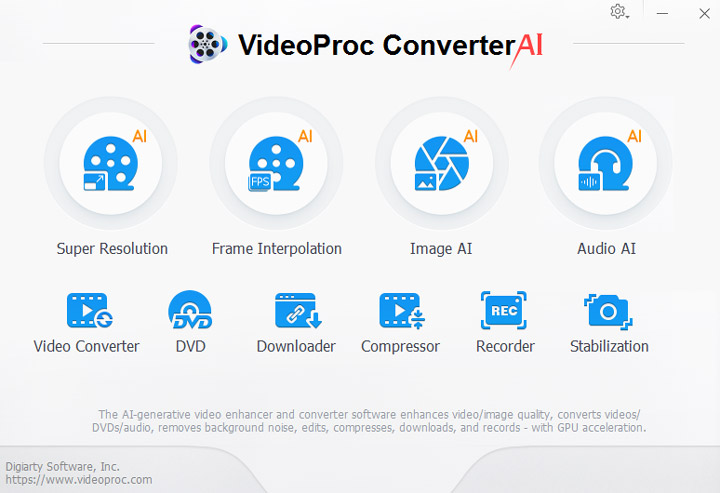
Convert iPhone MOV With VideoProc Converter AI
VideoProc Converter AI is a video processing tool dedicated to 4K and HD videos. It has a large format library of up to 420+ video formats with flexible settings to edit and adjust the videos. Its Level-3 hardware acceleration and high quality engine delivers the No.1 fast speed and high output quality. That's why it's selected as the best tool to convert iPhone video formats.

Step 1. Import the video.
Open VideoProc Converter AI. Select " Video Converter". Then click " +Video" to import the video you want to convert. The iPhone video converter supports the most popular audio and video formats to chew almost all the files you throw.
Step 2. Choose the iPhone supported video formats.
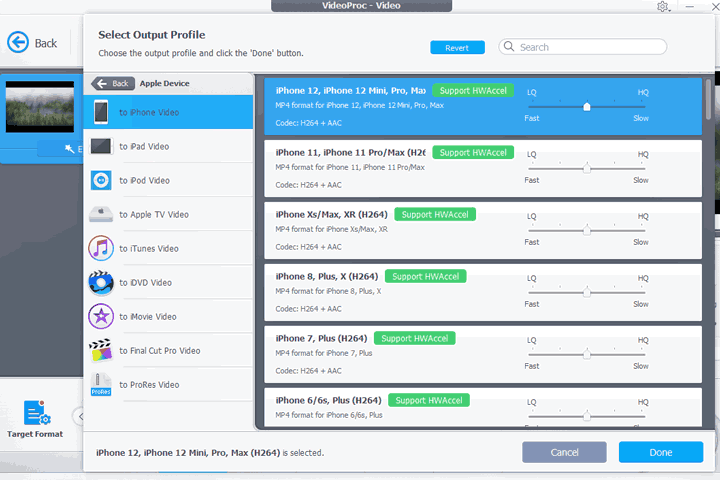
Come over to the Target Format tab, choose MOV H.264 or MP4 H.264 to convert video format for iPhone. Alternatively, click on the gear icon of Target Format > Apple Device > to iPhone Video. Then, you can choose the specific iPhone model (iPhone 16, iPhone 15, or earlier) for smooth playback.
Step 3. Start converting.
Hit "RUN" to convert your video to iPhone supported video formats.
Bonus: One Click to Convert iPhone Video Formats for Sharing
Step 1. Add the iPhone video. Free download VideoProc Converter AI and install it on your PC or Mac, click on "Video", Press "+Video" to import your iPhone video recording to the iPhone video converter.
Step 2. Choose the target format. Navigate to the bottom of the main interface and hit the blue gear icon next to "Target Format". You are going to find the ready set profiles for Huawei, Apple, Samsung, YouTube, Facebook, and a lot more platforms or devices. Choose the proper one.
Note: You can click the gear icon of the "Options" button to adjust the video settings like bitrate and resolution. Then select the Cut button to further edit the iPhone video for a smaller size.
Step 3. Export the video. Click "Done" and hit "Run" to let VideoProc Converter AI convert iPhone video formats.
iPhone Video Format FAQ
1. What Video Format Does iPhone Use by Default?
The iPhone Camera app usually stores video in a MOV container. With High Efficiency selected, the video normally uses HEVC/H.265. With Most Compatible selected, new recordings use H.264.
2. Why Does My iPhone Still Record MOV With Most Compatible Selected?
Most Compatible changes the codec to H.264. It does not necessarily change the container to MP4, so an H.264 video may still have a .mov extension.
3. Can an iPhone Record Directly in MP4?
The built-in Camera app commonly records MOV. Some third-party camera apps may offer different containers, but availability depends on the app and recording mode. If you need a standard H.264 MP4, converting or remuxing the finished MOV is the more predictable method.
4. Is MOV Better Quality Than MP4?
Not by itself. MOV and MP4 are containers, so quality depends on the codec, bitrate, resolution, frame rate, and export settings. The same H.264 stream can have essentially the same quality in either container.
5. Which iPhone Video Format Works Best on Windows?
MP4 with H.264 video and AAC audio is the safest general choice. Recent Windows systems can also handle many HEVC files, but support may depend on the installed apps and codecs.
6. How Can I Tell Whether an iPhone Video Uses HEVC or H.264?
On a Mac, select the video in Finder and open Get Info, or open it in QuickTime Player and choose Window > Show Movie Inspector. On Windows, a media-information utility or the properties shown by your editor can identify the codec. The .mov extension alone cannot tell you which codec is inside.
7. Does Changing the Camera Format Convert Existing Videos?
No. The High Efficiency and Most Compatible settings affect new photos and videos. Existing files remain unchanged until you export or convert them.