New AI features are available

Filmora is free to download and try, but videos exported from its free version come with a large, ugly watermark that covers nearly half the screen, complete with a semi-transparent background. There's also a black watermark screen added to the end of the video. What's more frustrating is that Filmora doesn't make these limitations clear upfront. Many users have complained about spending hours or even days editing a project, only to discover the watermark when they finally export their videos. Naturally, many want to know **how to remove the Filmora watermark without paying.
So, can you remove the Filmora watermark for free? Yes. Filmora offers a one-time watermark-free export for eligible new users, and there are a few other ways to remove or work around the watermark without purchasing a license. In this guide, we'll cover 5 ways to remove the Filmora watermark, including free and paid options. We'll also introduce a completely free Filmora alternative that lets you edit and export videos without watermarks.
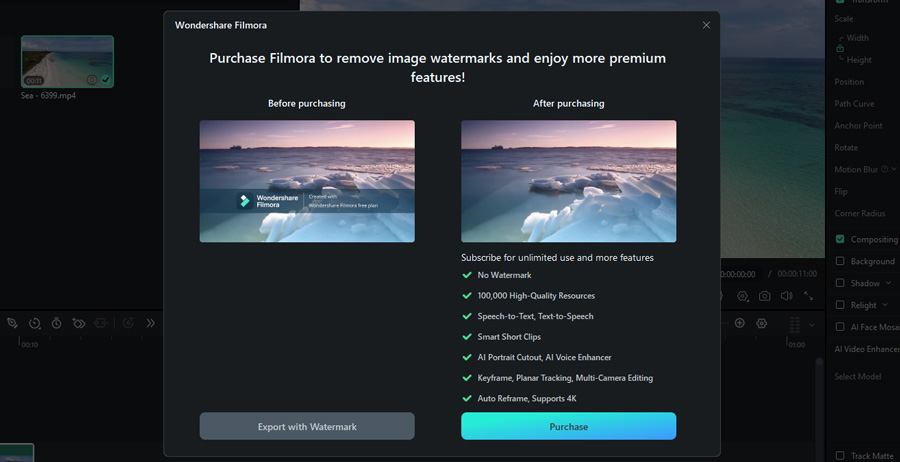
Below, we explain how each method works, which options may be free, and what to expect from the result. Keep your Filmora project and original media files if you still have them: they give you the best chance of getting a clean export without rebuilding your edit.
You can remove the Filmora watermark for free, but not every method works the same way. Here are your options:
- Want a free export? Check if you qualify for Filmora's one-time watermark-free export.
- Already finished editing? Record the video preview
- Want to keep using Filmora? Activate it with a paid license to remove the watermark.
- Already exported with a watermark? Try a video watermark remover or editing tools to hide it.
- Don't want to pay at all? Switch to a free editor like VideoProc Vlogger and export without watermarks.
Can You Remove the Filmora Watermark for Free
Yes, in some cases. An official free-export offer may let eligible users export their Filmora project without a watermark. Check the current offer and your account eligibility before relying on this option. Free editors can also crop or cover a watermark in an exported video, although the result will change the framing or leave a visible replacement.
For a clean export that preserves your composition, start with the original Filmora project. The trial watermark is added during export, so exporting again with eligible access avoids adding it to the new file. Buying a license does not automatically remove the watermark from an MP4 you exported earlier.
If you only have the watermarked video, a video watermark removal tool may help conceal or repair the affected area. Results depend on the watermark size, background detail, and movement in the footage. A large watermark across a face, text, or moving subject is harder to repair convincingly than one over a simple background.
The methods below cover both routes: exporting your existing project without a watermark and editing the watermark area in a finished video.
Method 1. RemoveFilmora Watermark with an Official Free Export
Looking to remove the Filmora watermark without paying? Before trying a third-party watermark remover, check Filmora’s own free-export offer. Wondershare gives eligible new users a chance to export their first video without a watermark. If you qualify, you can keep your existing edits and export directly from your Filmora project without cropping the frame or blurring part of the picture.
Note: This is a limited offer, not a permanently free version of Filmora. The current redemption page lists one free export per Wondershare ID, which must be used within three days of redemption. Check the current terms and your eligibility before redeeming.
Step 1: Redeem Your Free Export
Visit Wondershare's official free-export redemption page and sign in to your Wondershare account. If your account qualifies, follow the instructions to redeem the offer.
Step 2: Open Your Filmora Project
Launch Filmora and sign in with the same Wondershare account. Open the original project you saved while editing, rather than importing the video you already exported with a watermark. If any source files are missing, locate and reconnect them first.
Step 3: Export Without the Filmora Watermark
Click Export, choose your output settings, and check that your free export access is active. Complete the export before the offer expires, then play the saved video to check the result.

Method 2. Remove the Filmora Watermark by Activating Filmora
If you’ve spent hours editing in Filmora, starting over in another app probably isn’t appealing. If the free-export offer isn’t available to you, buying a Filmora license lets you keep those edits and export without the trial watermark. Before paying, check that the plan covers the version and platform you’re using.
Step 1: Save Your Project and Source Files
Save your Filmora project and keep the video clips, images, and audio files used in it. The project file stores your editing instructions, so it still needs access to the original media.
Step 2: Activate Filmora
Click Purchase on Filmora. This will open the purchasing page on your browser. Select an eligible Filmora plan and pay for that. Surely, if you already have a license, check your account status before paying again.
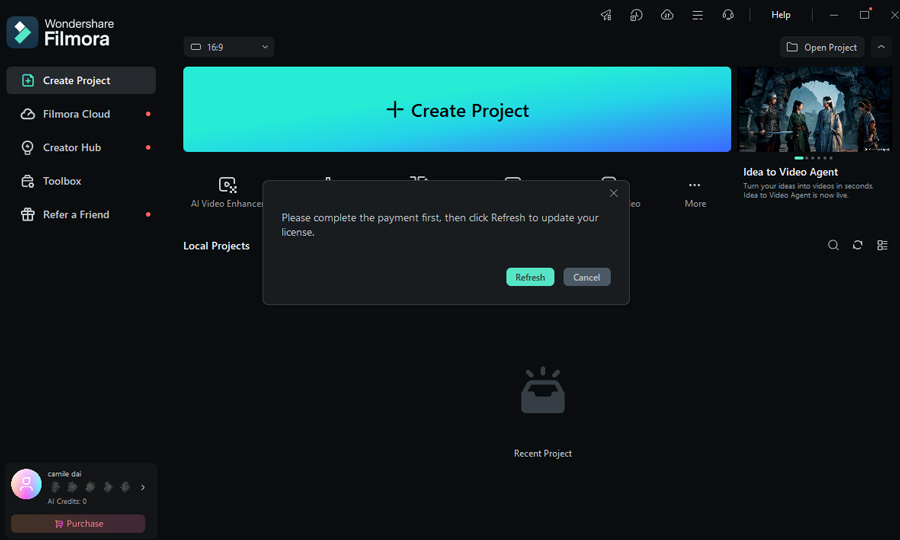
Step 3: Reopen the Project and Export
Open the original project, check the timeline, and click Export to create a new video without the trial watermark.
Note: Activating Filmora won't change an MP4 you exported earlier. The watermark is already embedded in that file. Open the original project and export again instead of re-importing the watermarked video.
Method 3. Record the Filmora Preview with a Screen Recorder
If you don't want to pay or recreate your edits in another app, check whether your Filmora project plays without a watermark in the preview window. If it does, you can try recording that playback instead of exporting the video.
This won't remove a watermark from an MP4 you have already exported. You need to open the original Filmora project and capture its preview. The recording may also look softer or less smooth than a direct export, so test a short section first.
Preparation: Set Up the Filmora Preview
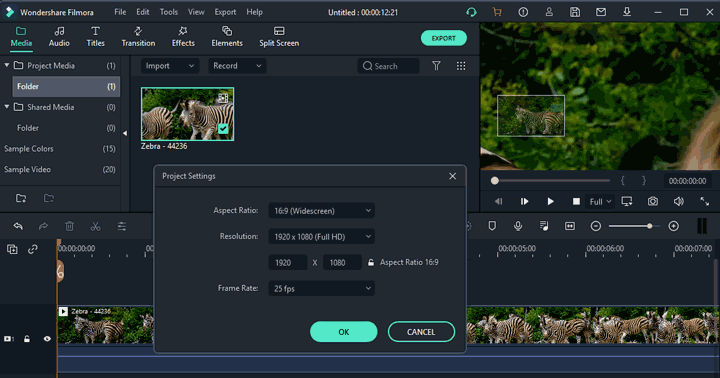
Open your original project and check its resolution, aspect ratio, and frame rate. Play a section with movement, transitions, and audio to make sure the preview runs smoothly. Then switch to full-screen preview and let the playback controls disappear before recording.
Step 1: Open Your Screen Recorder
Open a screen recorder that supports capturing your display and system audio, such as VideoProc Converter AI. Check the current recording limits if you are using a trial version.
Step 2: Select the Recording Area and Audio
In VideoProc Converter AI, open Recorder and choose Screen. Select the display or recording area containing the Filmora preview. Enable system audio to capture the video's sound, and disable the microphone unless you also want to record your voice.
Choose a recording quality and frame rate suitable for your video. Keep in mind that recording at a higher resolution won't recover detail missing from a low-resolution preview.
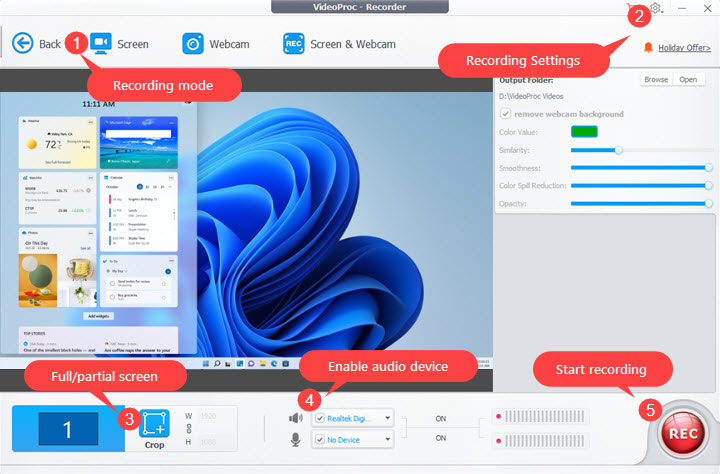
Step 3: Record the Filmora Preview
Start recording, return to Filmora, and play the project in full-screen preview. Keep the pointer away from the picture, avoid switching windows, and silence notifications so they don't appear in the recording. Stop recording after playback finishes.
Step 4: Check and Trim the Recording
Play the saved recording and check for dropped frames, missing audio, playback controls, or notifications. Trim any extra footage at the beginning and end. If the preview stuttered during capture, that interruption may also appear in the recording.
Note: This method only helps when the preview itself is watermark-free. If the watermark appears during playback, the screen recorder will capture it too. For videos that need precise frame timing or the original export quality, use the official export methods above.
Method 4. Use an AI-Driven Video Watermark Remover
Only have the exported video and don't want to crop the frame or cover the watermark? You can try ProPainter, an AI video inpainting tool that fills selected areas using information from the footage. Its online demo lets you test a short clip without installing the software.
In my test, the results weren't as clean as I'd hoped. With a large, semitransparent Filmora watermark covering roughly 40% of the frame, even a black-and-white mask covering the full affected area didn't produce a convincing repair. A simple background may give it a better chance, so it is still worth testing a short sample before ruling it out.
The online demo below uses interactive object selection to create its masks. This differs from preparing a black-and-white PNG mask for a workflow that supports importing one.
Step 1: Upload Your Video
Open the ProPainter online demo, upload your clip, and click Load Video. Start with a three- to five-second sample, preferably one that includes movement behind the watermark.
Step 2: Select the Filmora Watermark
Click the watermark in the preview to create a selection, then click Add Mask. Use the positive and negative selection controls in Model Settings if needed. Check that the selection includes the logo, text, and any semitransparent background bar.
This can be tricky with Filmora's watermark: the tool may select objects behind the lettering or miss parts of the translucent bar. Check the mask carefully rather than assuming one click has selected the whole watermark.
Step 3: Generate and Check the Video Mask
Click Video Segmentation. Review the result across the clip: the mask should cover the watermark without spreading into unrelated areas. If it misses parts or follows a background object instead, revise the selection before continuing. If you cannot get an accurate mask, this online workflow may not suit your clip.
Step 4: Run Video Inpainting
Click Video Inpainting to process the masked region. Play the result and look for remaining letters, smeared details, or flickering. Pay particular attention when a person or object passes through the repaired area. If the result is acceptable, use Download to save it.
Step 5: Restore the Audio
The demo's output does not contain audio. Import the processed clip into a video editor, align it with the original clip's audio, and export. Check the timing before saving your final video.
Note: An accurate mask tells ProPainter where to make repairs, but it doesn't supply the missing picture. A large watermark leaves a substantial area to reconstruct, and a detailed or moving background makes that harder. For a simple background, the repair may be usable; for footage where faces, text, or fine details matter, re-exporting from the original Filmora project is the more reliable option.
ProPainter's code and models are provided for non-commercial use. Check the official license terms before using it for commercial work.
Method 5. Use Object-Removal Tools in Editing Software
Suppose you have a robust build PC, let's say it has 32GB of RAM, i9 processor, and dedicated graphics cards, then you can fiddle with some serious programs like DaVinci Resolve and Adobe After Effects to remove the Filmora watermark.
1. Free Remove Filmora Watermark with DaVinci Resolve
Notice: This trick doesn't guarantee to remove the Filmora watermark clean.
Step 1: Download DaVinci Resolve
Go to the homepage of DaVinci Resolve to find the desired version that matches with your system, hit Download. You will then be asked to fill in some personal information including name, email, phone, and address, etc.
After filling out the form, you can get the installation pack download link, hit this to start the downloading. Follow the instruction guide to install this pro-level video editing software on your machine.
Step 2: Import the Video with the Filmora Watermark
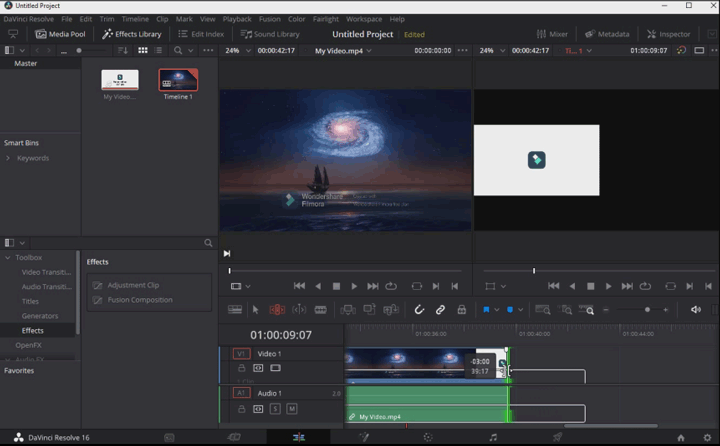
Press Edit to step into the video editing panel. Right-click on the media pool, select Import Media to pick the video with the Filmora watermark to feed into DaVinci Resolve. Add it to your timeline, and then you drag the end of the clip to trim off the Filmora watermark at the end of the video.
Step 3: Create A New Node
Drag the video to the timeline, and then hit Color on the bottom tab menu. This will lead you to the Color tab.
Press the hotkey Alt and S to build a new node.
Step 4: Select the Filmora Watermark
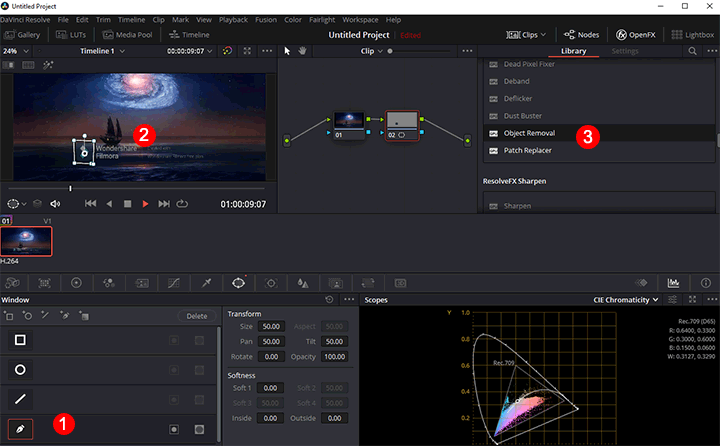
Underneath the preview window, you can find the power window. There you can use shape tools like rectangle, ellipse, or pen tool to draw a mask right around the watermark. Use one of them to select the square Filmora logo.
Step 5: Remove Filmora Watermark
Scroll down the Library tab to find the Object Removal button. Click this and drag it over the first node that we just created. Hit Scene Analysis. Now, DaVinci Resolve starts to analyze each frame of your video. This is a CPU and memory intensive progress that possibly will burst CPU usage to 80% and memory usage to 90%.
Step 6: Clean the Grey Lump
Once it finishes the scene analysis process, go to the setting panel and scroll down to find Build Clean Plate, and click this.
Step 7: Remove the Rest of the Filmora Watermarks
Since the Filmora watermark is made up of a square cyan logo on the left, a big Wondershare Filmora in the middle, an upright straight line, and two lines of words in a smaller size. We need to repeat Step 4, Step 5, and Step 6 to create 4 other nodes and apply the Object Removal command for each node one by one.
Step 8: Export Filmora Video Without Watermark
Hit Delivery, and choose the preferred output formats on the pop-up delivery page. Press Start Render to get the video without the Filmora watermark removed off.
2. Free Remove Filmora Watermark with Adobe After Effects
Adobe After Effects is another widely used video editor for removing the Filmora watermark. Although it isn't free, it offers a 30-day free trial with no watermark restrictions and no functionality limitations. Give a caution, similar to DaVinci Resolve, it demands a high-performance PC for running smoothly.
Step 1: Acquire the Program
Adobe After Effects offers 7 days of the free trial, so you can enjoy the content fill feature for free if this is your first-time use this industry-level video composition program. Otherwise, you need to subscribe to it at a fee of 29USD per month.
Step 2: Trim off the Filmora Watermark at the End
Launch up the program. Right-click on the media pool, choose Import > Files to feed the Filmora video with a watermark to Adobe After Effects. Next, you drag it to the timeline. Move the playhead at your timeline to the position where the Filmora end credits starts. Press Alt + ] on Windows or press Option + ] on Mac to trim off the watermark.
Step 3: Draw the Mask
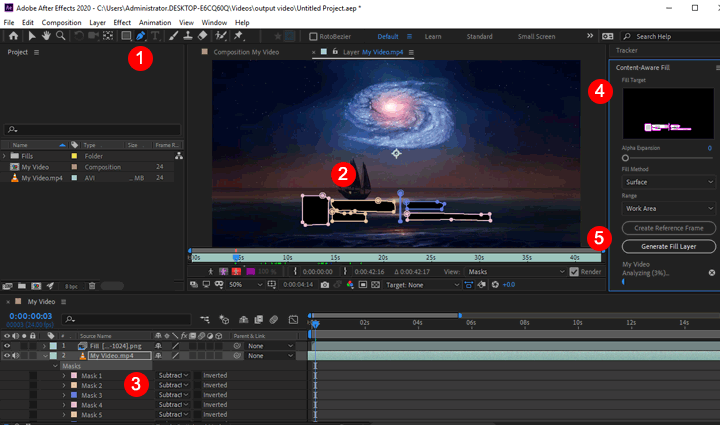
Navigate to the top menu bar and find the pen tool. Just like what we do in Davinci Resolve, you need to use the pen tool to create masks for the Filmora watermark. The difference is, in Adobe After Effects, we can draw 6 masks or more for once. Thus, it's much more efficient.
Step 4: Locate the Content-Aware Fill Tool
Go to the Mask, and select Subtract for each mask we just created. Move to the right panel of Adobe After Effects and scroll down to find the Effects & Preset tab. You can enter Content-Aware Fill on its search bar to locate the content-aware tool.
Step 5: Enable the Content-Aware Fill feature.
Click on the Content-Aware Fill tool. According to your specific demand, choose surface as the content filling ways and choose the working range as the work area. After that, you click on Generate Fill Layer.
Step 6: Analyze and Render the Filmora Watermarked Video
After the above steps, Adobe After Effects starts to analyze your videos frame by frame. This will devour horribly large computer resources. See if your computer isn't robust built, you are meant to encounter stutter and choppy.
DaVinci Resolve and Adobe after Effect take a similar workflow to erase the watermark. They firstly remove the area with the filmora watermark, analyze what's behind the watermark by the surrounding content, and then filling in the area of the removal.
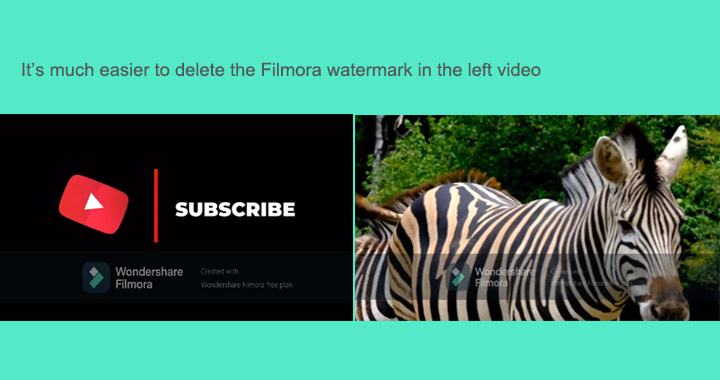
Thus, whether the final video looks consistent or garbled is determined by how DaVinci Resolve or Adobe After Effects can figure out the area behind the Filmora watermark. From my test, they can better "guess" what the footage behind the watermark looks like when:
 The area behind the Filmora watermark doesn't have many details.
- The video is in plain color.
- The gray translucent bar on the bottom of the Filmora watermark is barely invisible.
Alternative: Edit Without Watermarks Using a Free Video Editor
If you'd rather edit without an export watermark from the start, why not try a Filmora alternative like VideoProc Vlogger? This free video editor for Windows and Mac lets you trim, split, speed up, slow down, add music, add text, adjust color, add effects, apply filters, add overlays, and more without adding its own watermark.
Use your original video clips to recreate the edit. Importing a watermarked Filmora export won't erase the watermark already in the picture. This option takes extra editing time, so it makes more sense for a new project or a short edit you are willing to rebuild.