Upgraded AI Performance in V8
An iPhone can record and play high-quality video, but compatibility problems still appear when a file uses an unsupported container, video codec, audio track, or encoding profile. A clip may open on the phone but fail in an editing app, play without sound, or refuse to transfer to another device. In those cases, converting the file to a more widely supported format is usually faster than troubleshooting each playback error separately.
The best tool depends on where you want to do the work. A desktop converter is usually the practical choice for large 4K files and batches. An iPhone app is more convenient for a short clip already stored on the phone. If you only need to watch an MKV or AVI file, a player that supports the format may save you from converting it at all. The seven options below cover those different jobs instead of treating every converter as interchangeable.
- What You Need From an iPhone Video Converter
- Quick Comparison of the Best iPhone Video Converters
- 7 Best iPhone Video Converters (Full Review)
- 1. VideoProc Converter AI
- 2. HandBrake
- 3. PlayerXtreme Media Player
- 4. The Video Converter
- 5. Videc - Any Video Converter
- 6. Online-Convert iPhone Converter
- 7. MConverter
- Which iPhone Video Converter Should You Use
What You Need From an iPhone Video Converter
A useful iPhone video converter should meet five requirements:
1. Comprehensive format support. On the input side, it must handle native iPhone formats seamlessly—including .MOV containers, HEVC (H.265), H.264, ProRes, Dolby Vision HDR, and high-frame-rate slow-motion files. On the output side, it should easily convert unsupported files (like MKV, AVI, WebM, or WMV) into formats that iPhone apps and QuickTime can play natively.
2. Granular output control. Quick device presets are great for convenience, but you should still have manual control over the container, video/audio codecs, resolution, frame rate, and bitrate. Exporting to MP4 with H.264 and AAC remains the gold standard for universal compatibility, while HEVC is ideal when you need to save storage without sacrificing fidelity.
3. Lossless quality preservation and color accuracy. Converting high-resolution footage shouldn't ruin the shot. A solid converter preserves the native aspect ratio, frame rate, and audio sync—especially when handling iPhone's Variable Frame Rate (VFR) footage. It should also support proper HDR-to-SDR tone mapping to prevent colors from looking washed out on standard displays.
4. Fast processing with hardware acceleration. Converting 4K 60fps clips or massive multi-gigabyte ProRes files takes a heavy toll on your system. Look for tools that support GPU hardware acceleration (like Apple Silicon, NVIDIA NVENC, or Intel QSV) and batch processing. Built-in trimming and compression are also huge pluses for cutting file sizes before export.
5. The right platform: Desktop iPhone video converters are best for large files and detailed control, mobile apps for quick on-phone conversions, and online converters for simple one-off tasks with some limitations.
Quick Comparison of the Best iPhone Video Converters
| Tool | Best for | Main advantage | Important limitation |
|---|---|---|---|
Large, high-resolution videos and batch conversion on a computer |
Support 420+ formats; rich iPhone presets; no visible quality loss; Up to 47x faster speed; All-in-one |
Cannot run on iPhone |
|
Free with detailed controls |
Open source; Many useful presets |
Cannot run on iPhone; exports only in MP4/MKV/WebM |
|
Play unsupported files without conversion |
Stream from network storage |
It's not a general-purpose converter |
|
Converting directly on an iPhone or iPad |
Simple workflow with many output choices |
Some conversions use a cloud server; premium features require a subscription |
|
Basic conversion and playback in one iOS app |
Includes format and output controls |
Availability may vary by App Store region |
|
No need extra installation |
Works in a browser; offers device-oriented settings |
Not for large or length video files |
|
Small batches and less common file types |
Handles video, audio, images, documents, and other formats |
The free plan limits file size and daily conversions |
7 Best iPhone Video Converters (Full Review)
With the key criteria and top picks covered, let's move on to the full reviews of each iPhone video converter.
1. VideoProc Converter AI
VideoProc Converter AI is the strongest fit here for people who regularly move footage between an iPhone and a Windows PC or Mac. It supports more than 370 containers and codecs, and it can convert, compress, trim, crop, merge, and adjust common video parameters in the same program. Its iPhone-oriented presets reduce setup when you simply need a playable file, while the manual controls remain available for frame rate, resolution, codec, aspect ratio, and audio settings.
Hardware acceleration is the practical reason to choose it over a phone app or browser converter. Compatible Intel, AMD, NVIDIA, and Apple Silicon hardware can assist decoding, processing, and encoding, which matters with long 4K clips and batches. The program also keeps the source file on your computer during conversion. That is useful for private footage or large files that would take a long time to upload. It is less compelling for someone who has one short clip on an iPhone and does not want to move it to a computer first.

How to Convert a Video for iPhone
Step 1. Add the source video. Open VideoProc Converter AI, select Video Converter, and click Video to import one file. Use Video Folder when several clips need the same output settings.
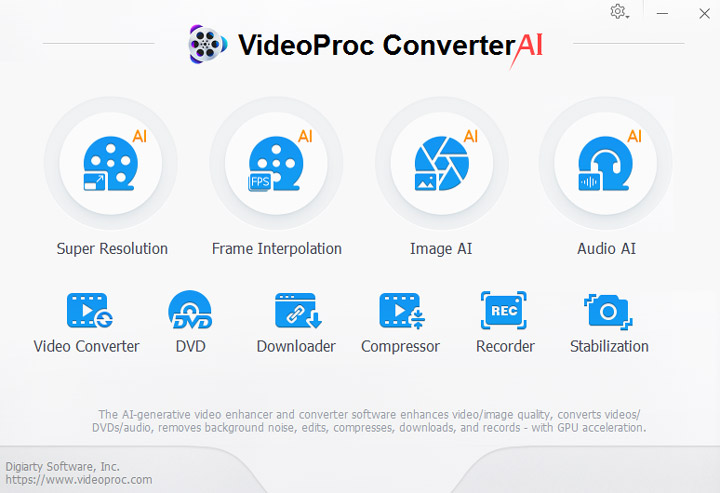
Step 2. Choose an iPhone-friendly output. MP4 H.264 is the safest general choice. MOV H.264 is also suitable, and an Apple Device preset can save time when you want settings prepared for an iPhone.

Step 3. Check the video settings. Open Codec Options if you need to keep the original resolution and frame rate, reduce the file size, or change the video and audio codecs. Avoid lowering the frame rate of slow-motion footage unless a smaller file matters more than preserving motion.

Step 4. Start the conversion. Enable hardware acceleration when compatible hardware is available, choose the output folder, and click Run. Check the finished file before deleting the source, particularly when the original contains HDR, multiple audio tracks, or subtitles.
2. HandBrake
HandBrake is the best completely free desktop option in this list. It runs on Windows, macOS, and Linux, opens most common video files, and includes presets that make its large settings panel easier to manage. It is especially useful when you want to convert a file locally, control quality with constant quality settings, or process a queue without paying for a commercial program.

HandBrake is a transcoder rather than a full media toolbox. It can create MP4, MKV, and WebM containers, so it is a good match for an MP4 H.264 or MP4 HEVC file intended for iPhone playback. It does not export to every format it can open, and it is not designed for general video editing. New users also need to take care with frame rate, cropping, and subtitle settings. Choose HandBrake when free local conversion matters more than a short learning curve or a wide choice of output containers.
3. PlayerXtreme Media Player
PlayerXtreme solves a different problem. It is a media player for iPhone, iPad, Apple TV, and other platforms, and it can open formats such as MKV, AVI, WMV, WebM, and VOB without creating a second copy. It can also stream from services and protocols including SMB, FTP, and UPnP, which makes it useful for a video library stored on a computer or NAS.

This is the better choice when playback is the only goal. You avoid conversion time and keep the original file untouched. It does not solve every compatibility problem outside the app, however. A file that plays in PlayerXtreme may still fail in Photos, iMovie, a messaging app, or a social platform. Convert the video instead if it needs to work across several iPhone apps or be shared with other people.
4. The Video Converter
The Video Converter is convenient when the source file is already on an iPhone or iPad. You select a file, choose an output such as MP4, MOV, MP3, AVI, or WebM, then save the result or open it in another app. The workflow is easier than moving a short clip to a computer, and the app includes a browser for earlier conversions.

The App Store description says many conversions are processed on a secure cloud server, while an expanding set can run locally. That distinction matters. Cloud processing requires an internet connection and means the file leaves the device during conversion, even though the developer says uploaded files are deleted after the job. The app also offers a subscription. It is sensible for occasional, non-sensitive clips, but a desktop converter is usually more practical for long 4K videos or repeated work.
5. Videc - Any Video Converter
Videc combines conversion with a built-in media player. It has been listed with support for common formats including MP4, MOV, MKV, MPEG, AVI, WebM, WMV, and FLV, along with controls for output settings. That makes it more flexible than a one-button converter when you need to change bitrate or prepare audio as well as video.

Videc belongs lower on this list because its current App Store availability is difficult to confirm consistently across regions. Check that the app is available, recently updated, and compatible with your version of iOS before paying for it. If the listing is missing or looks abandoned, use a maintained alternative instead. An old feature list is not enough reason to install software that may no longer receive fixes.
6. Online-Convert iPhone Converter
The Online-Convert iPhone Converter is useful when you need one file in an iPhone-friendly format and cannot install an app. It runs in a browser, accepts many common source formats, and provides optional settings for video size, bitrate, frame rate, rotation, and trimming. Files can be selected from local storage or supported cloud services.

The upload is the main constraint. A large 4K file can take longer to upload and download than it takes a desktop program to convert locally. A browser service is also a poor place for confidential footage unless its privacy and retention terms meet your requirements. Use Online-Convert for a small, occasional file. For batches, private recordings, or an unreliable connection, local software is the safer workflow.
7. MConverter
MConverter is broader than an iPhone video converter. It handles video, audio, images, subtitles, documents, archives, and other file types, and it can process several files in one batch. This makes it useful when a project contains mixed assets, such as a WebM clip, a WAV recording, and subtitle files, and you want one browser-based service for all of them.

At the time of this update, the free plan allows files up to 100 MB, up to eight files in one batch, and a limited number of daily conversions. Paid tiers raise the file-size and batch limits. MConverter says transferred files use encrypted connections and that conversion history files are automatically deleted from its servers after four hours. Those policies are helpful, but the same basic trade-off remains: online conversion is convenient for small jobs, while local conversion is more efficient for large or sensitive video.
Which iPhone Video Converter Should You Choose
For frequent 4K conversion, large batches, or private footage, VideoProc Converter AI is the most capable all-in-one choice, while HandBrake is the stronger option when you want a free, open-source transcoder and do not mind its narrower output range. PlayerXtreme is preferable when the file only needs to play on the iPhone, since conversion may be unnecessary.
The Video Converter is convenient for a short clip already on an iPhone. Online-Convert and MConverter work well for occasional browser-based jobs, though upload time, file limits, and privacy deserve attention. Videc may still suit some users, but its availability should be checked before it is treated as a dependable long-term option. In every case, keep the source file until you have checked video, audio, subtitles, frame rate, and color in the converted copy.