
 VideoProc Converter AI
 New AI features are available




 Listed in
 A sharp video looks clearer, more detailed, and easier to watch. But in real footage, sharpness is not always easy to keep. Videos can look soft because of slight focus errors, low-quality lenses, low resolution, compression, flat lighting, or weak contrast. Older clips from phones, cameras, websites, or DVD sources may also lack enough detail to look crisp on modern screens.
This is where a video sharpener can help. Its primary job is to enhance edges, improve local contrast, and bring out recoverable details, making soft footage appear clearer. Many modern AI video sharpeners can also combine sharpening with features such as AI upscaling, denoising, or artifact reduction, providing a more complete enhancement workflow when sharpening alone is not enough.
To find out which tools actually work,I tested dozens of video sharpeners and curated this list of the 8 best video sharpener tools available right now. I cover traditional video editors, AI-powered video sharpeners, online services, and mobile apps, making it easier to find the right option for your footage and workflow.
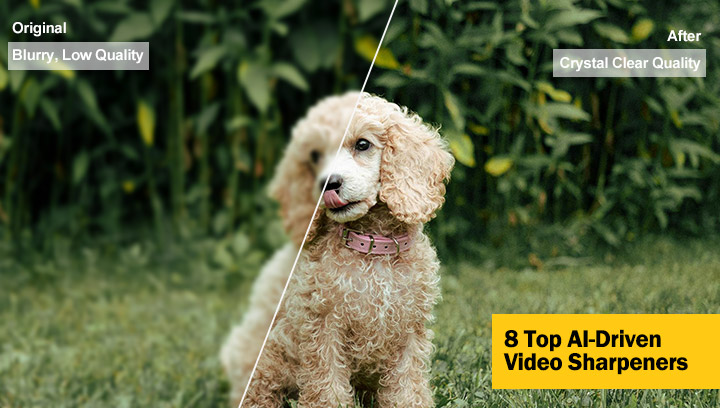
What a Video Sharpener Can Fix
A video sharpener is mainly designed to make existing edges, textures, and fine details look more defined. It works best when the footage is slightly soft but still contains usable visual information. So, what a video sharpener can usually improve?
1. Slightly soft footage: If the video looks a little out of focus or lacks crisp edges, sharpening can help make faces, objects, text, and background details appear clearer.
2. Weak edge definition: Some videos look unclear because edges are too soft or blended into the background. A good video sharpener can increase edge contrast and make the subject stand out more naturally.
3. Flat or low-contrast footage: When a video looks soft because of dull lighting or weak tonal separation, sharpening often works better when combined with contrast, brightness, or color adjustment.
4. Mild compression softness: If a video looks slightly muddy after being converted, downloaded, or compressed, sharpening may help bring back some edge clarity. But for heavy pixelation, blockiness, or noise, AI upscaling, denoising, or artifact reduction is usually needed together with sharpening.

Note: It is also worth setting realistic expectations. Many video sharpening tools promise dramatic improvements, claiming they can turn extremely blurry footage into crystal-clear video with little effort. In practice, our tests tell a different story. A video sharpener can only enhance details that still exist in the source footage. If a video is severely out of focus, heavily compressed, or simply lacks recoverable detail, the result may look cleaner and slightly sharper, but it will not look as if it were originally captured in high quality.
Quick Picks: Best Video Sharpeners at a Glance
Here is a quick overview of the best video sharpeners I tested. If you want the most balanced option, start with VideoProc Converter AI. If you need professional restoration and do not mind the high price, Topaz Video is worth considering. For quick online or mobile fixes, Cutout.pro, Wink.AI, HiQuality, and VN may be more convenient, but they come with more limits.
| Tool | Best for | AI | Platform | Main downside |
|---|---|---|---|---|
Best overall for most users |
Yes |
Windows, macOS |
Needs installation |
|
Professional video restoration |
Yes |
Windows, macOS |
Very expensive ($299/year) |
|
Human-face enhancement |
Yes |
Windows, macOS |
Mixed results and slow processing |
|
Manual editing workflow |
Limited / manual |
Windows, macOS |
Steep learning curve |
|
Quick online AI sharpening |
Yes |
Online |
Expensive for larger tasks; may lose detail |
|
Online and mobile AI enhancement |
Yes |
Online, iOS, Android |
Rigid edges in some results |
|
Mobile face and video enhancement |
Yes |
iOS, Android |
Expensive per second |
|
Free manual adjustment |
No / limited |
iOS, Android, macOS |
Not a true AI video sharpener |
How I Tested These AI Video Sharpeners
To make the comparison more practical, I tested each video sharpener with several types of footage that commonly look soft, low-detail, or unclear in real use. I did not rely on one perfect demo clip, because a tool that works well on portraits may not perform the same on compressed, low-contrast, or text-heavy footage.
My Test Setup
- PC Build: Intel Core i5-11400F | 16GB DDR4 RAM | NVIDIA GeForce RTX 3060 (12GB VRAM)
- OS: Windows 11 Pro (Build 22H2)
- Driver: NVIDIA Studio Driver, optimized for creative and AI workloads
Test Footage
I tested a set of footage that needed sharpening for different reasons, instead of relying on one perfect demo clip. This helped me see how each tool handled common problems such as soft focus, low detail, compression softness, weak contrast, and unclear edges. Some of my tested clips are:
- Test Clip 1: A portrait clip downloaded from Pexels, with a resolution of 540x960.
- Test Clip 2: A horizontal crop from vertical drone footage that appeared soft and lacked fine detail.
- Test Clip 3: A compressed low-bitrate clip that looked muddy and slightly blocky.
- Test Clip 4: A low-contrast indoor clip that looked flat and unclear.
How I Evaluated the Results
For each video sharpener, I checked the exported result at full resolution whenever possible. The main things I looked for were edge clarity, texture preservation, and natural detail recovery. A good one should make faces, objects, text, and background details more defined without creating harsh outlines, crunchy edges, or a fake AI look. I also paid attention to side effects. These included halos, ringing artifacts, extra noise, flicker, temporal inconsistency, jelly-like motion, plastic-looking skin, and visible texture loss. Processing speed, watermark limits, file size limits, and resolution limits were also considered, especially for online and mobile tools.
💡 Traditional vs. AI Video Sharpening
Traditional video sharpening mainly adjusts edges, contrast, and sharpness manually. It can help with lightly soft or low-contrast footage, but strong settings may create halos, extra noise, or harsh edges. AI video sharpening is usually more useful for low-detail, compressed, or older footage because it can combine sharpening with upscaling, denoising, and artifact cleanup. For these reasons, this post will focus on AI-based video sharpening methods.
Best (AI) Video Sharpener Programs for Windows and Mac
Let's start by exploring the top 4 best video sharpening tools compatible with Windows and Mac. These programs offer users great custom controls, enhanced stability, and the freedom to work with videos of any size, type, or source, setting them apart from their online or mobile counterparts.
1. VideoProc Converter AI
- AI-Powered: Yes
- Limits: No
- Pricing: Free trial available; 1-Year subscription: $34.95; Lifetime license: $54.95
- Rating: 4.8/5
 by One Hour Professor
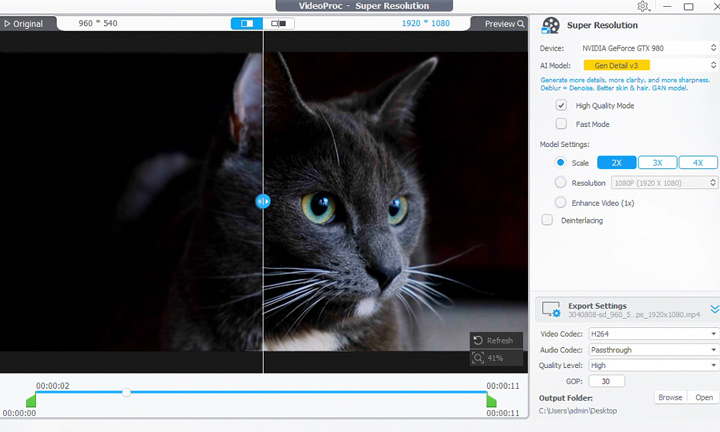
VideoProc Converter AI keeps things simple on the surface, but it handles video upscaling, sharpening, and enhancement surprisingly well.
Trained on a wide range of video data, it can identify different types of blur and areas where detail has been lost. Rather than just sharpening edges, it addresses the underlying issues, such as reducing noise, cleaning up compression artifacts, and restoring finer details. The result looks natural, without the plastic or over-sharpened effect.
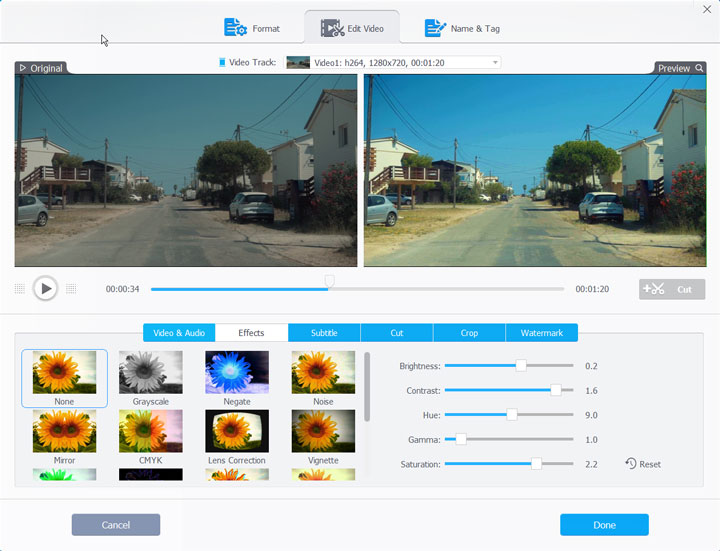
It also includes basic color adjustments like brightness, contrast, and saturation. These are useful when a video looks flat due to poor lighting, which can often make it feel blurry. With a few tweaks, you can bring back depth and clarity without overprocessing the image.

Pros:
- AI Super Resolution to sharpen video quality automatically in one click
- Remove noise, blur, and artifacts while enhancing details for a polished look
- Includes color adjustment tools to improve flat or low-contrast footage
- Rich AI tools: Frame Interpolation, Stabilization, Image AI, Audio AI, etc.
- All-in-one: compress, convert, edit, download, and record video files
- Lightweight, minimal hardware requirements, and lightning-fast speed
Cons:
- Requires installation, not browser-based
How It Performed in Practice
Overall, the video sharpening process is straightforward, and the results are solid. It offers four AI models and supports upscaling up to 4K resolution. I tested several clips, mainly using Real Smooth v3 and Gen Detail v3. For resolution, I did not stick to a fixed setting. Instead, I switched between different options depending on the footage to see what worked best. In most cases, the improvements were clearly noticeable, with a cleaner overall look. There were no harsh edges or halo artifacts, and details were well preserved and naturally enhanced.
[Test 1] Sharpen video with Real Smooth v3, 4X upscale.
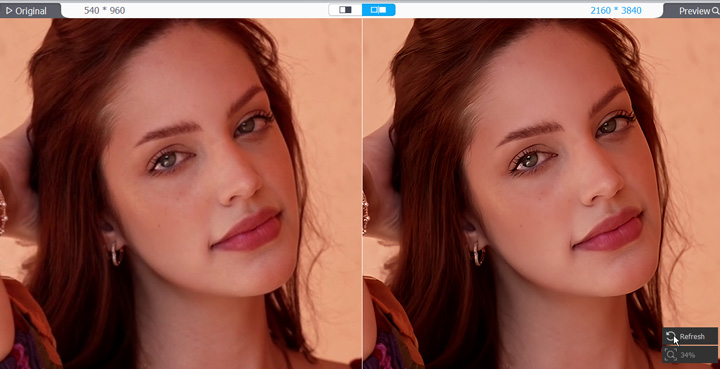
[Test 2] Sharpen video with Gen Detail v3, 3X upscale.
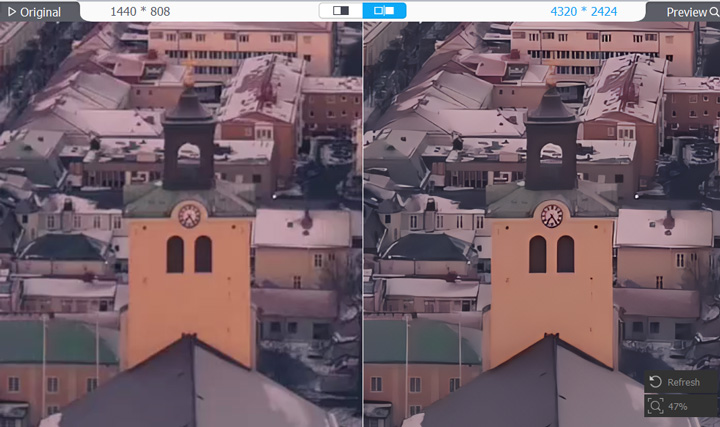
[Test 3] Sharpen video with color adjustment settings.
2. Topaz Video
- AI-Powered: Yes
- Limits: No
- Pricing: $299.99 per year (or $399/year under Topaz Studio plan)
- Rating: 4.5/5
 by Trustpilot
Topaz Video is one of the leading solutions for sharpening video files from a variety of sources. This AI video sharpener employs a comprehensive set of deep-learning modes tailored to address imperfections in your videos caused by various reasons, such as camera shake and wrong focus, thereby sharpening your videos without noticeable distracting artifacts or halos around the edges. Beyond sharpening videos, it boasts AI-powered features such as frame interpolation, seamlessly converting between 24fps and 60fps while preserving smoothness and minimizing motion blur or jelly effects. Moreover, this industry-level video sharpener offers a deshake feature, enabling you to stabilize videos captured on handheld devices and smartphones, and guaranteeing a smooth, professional viewing experience. However, it is not the best fit for most casual users. It works best when you have valuable old footage, low-resolution clips, or restoration projects that justify the high price and heavier workflow.

Pros:
- Upscale video solution up to 8K
- Support popular video formats
- Can produce cleaner and more detailed results on suitable footage
Cons:
- More expensive compared to other AI video sharpeners
- Long or high-resolution videos can take a long time to process and may be demanding on system resources
- Resource-intensive. Extremely slow on old computers
- Can't work on Windows 7, Windows 8/8.1
How It Performed in Practice
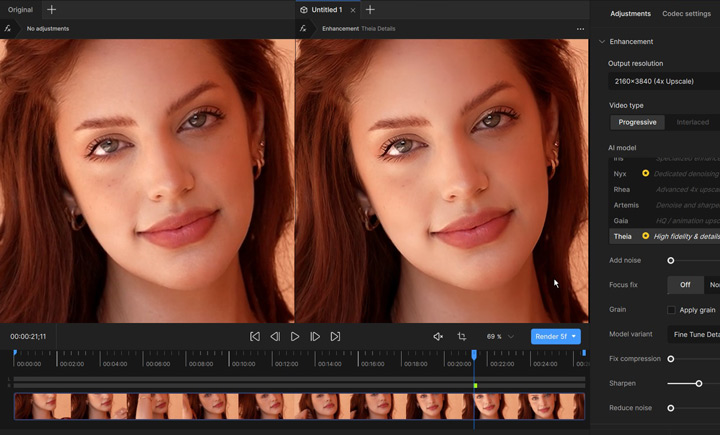
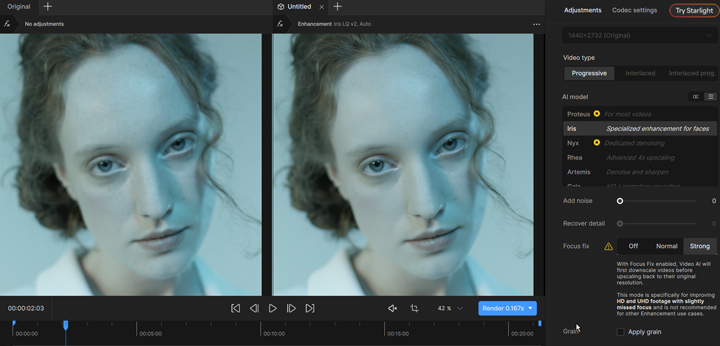
What I like most about Topaz Video is how well it handles soft focus footage. It offers Normal and Strong options, so we can adjust the intensity based on how soft the footage is. In my tests, it was able to restore clarity while keeping the results natural. By natural, I mean it avoids harsh edges and unwanted artifacts like haloing. It also comes with a wide range of options for fine tuning the results, which I see as a big advantage. That said, we do need some time to get familiar with all the settings, especially as beginners. When using the Theia model, we get a Sharpen slider that gives us more control over how much detail to bring back. This makes it easier to fine tune the balance between clarity and realism. Here are a few examples of the results I got with this AI video sharpener.
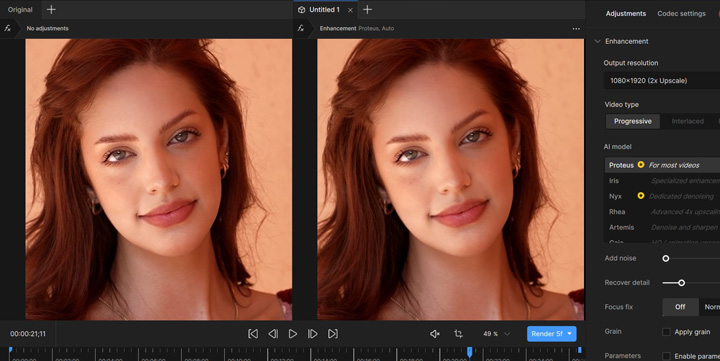
[Test 1] Sharpen video with Proteus, 2x upscale.
[Test 2] Sharpen video with Theia, 4x upscale, Sharpen slider set to 35.
[Test 3] Sharpen video with Iris at original resolution, using Focus Fix set to Strong level.
3. AVCLabs Video Enhancer AI
- AI-Powered: Yes
- Limits: No
- Pricing: $119.95/year
- Rating: 4.5/5 by Trustpilot
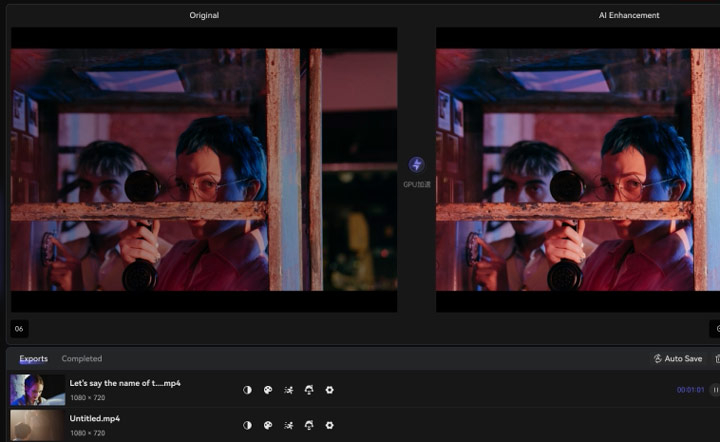
AVCLabs Video Enhancer AI is another decent piece of AI video sharpener that uses neural networks (a method in artificial intelligence that teaches computers to process data in a way that is inspired by the human brain) to sharpen your videos, so you can easily turn a fuzzy and blurry video into a crispy one. By leveraging this technology, it effortlessly transforms blurry and fuzzy videos into crisp, clear productions. Another major plus of this AI video sharpener is it supports upscaling the video resolutions, from 720P to 1080P or 4K while preserving the clarity and integrity of essential details, thanks to the application of the advanced Super Resolution algorithm.
Pros:
- No complicated setting options
- Support most prevalent video formats
- Allow processing multiple videos in batch
Cons:
- High price tag
- Slow response on less robust machines
- Can't work on Windows 7, Windows 8/8.1
How It Performed in Practice
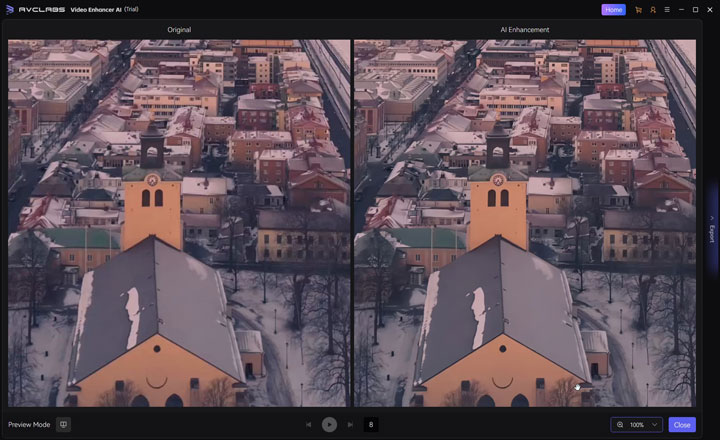
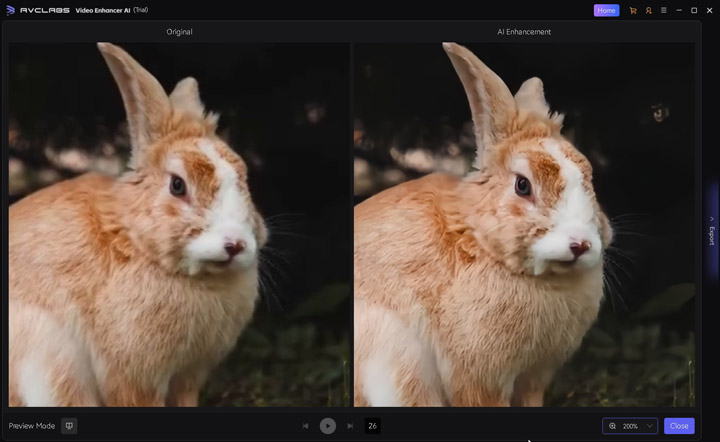
Honestly speaking, when I first tested this product last year, I had a pretty good impression of it. But looking at it now, I feel the performance and overall experience are just average. The AI models are not updated frequently, and the preview window is inconvenient. It does not support custom zoom levels, which can be misleading during evaluation. In “fit to window” mode, results may look good, but at 200% zoom the quality drops noticeably. Since real viewing usually falls between these two levels, this limitation becomes quite obvious in practice. From a quality standpoint, this AI video sharpener is also fairly underwhelming. The video sharpening effect is not very noticeable, and it often fails to deliver a clear improvement in fine details. In some cases, small artifacts or imperfections are still visible, which makes the results less consistent than expected.
[Test 1] Sharpen video via AVCLabs Ultra AI model, with Detail Balance set to 100% and Face Enhancement at 65.
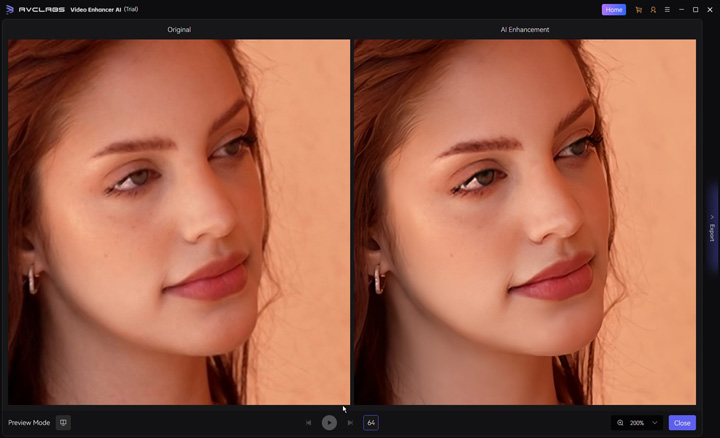
[Test 2] Sharpen a building clip via AVCLabs Ultra AI model, with Detail Balance set to 100%.
[Test 3] Sharpen an animal recording via AVCLabs Ultra AI model, with Detail Balance set to 100%.
4. Adobe Premiere Pro
- AI-Powered: Yes
- Limits: Premiere Pro can't sharpen MKV files
- Pricing: Starting from $20.99/month
- Rating: 4.5/5 by PCMag
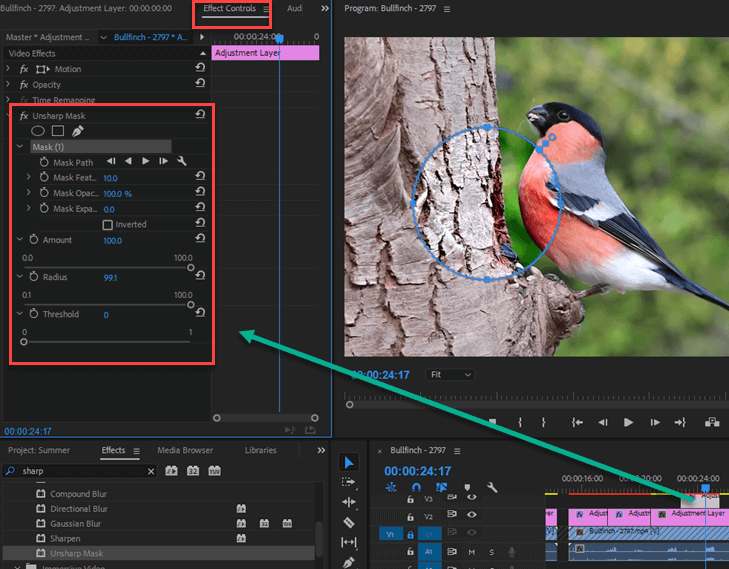
Adobe Premiere Pro comes equipped with a comprehensive array of both basic and advanced editing tools, making it a favored choice among filmmakers, advertisers, and social media influencers alike. While it may not offer a quick fix for sharpening video quality or built-in support for AI-driven video enhancement, it provides a valuable asset in the form of the Unsharp Mask feature. With a willingness to explore and fine-tune your footage through experimentation, you can significantly enhance the clarity of your previously blurry or hazy videos. Additionally, it offers compatibility with third-party plugins like Intonation SuperResolution which can enhance the sharpness of pixelated and blurry videos, adding more high-frequency details to improve overall visual quality.
Pros:
- A comprehensive range of video editing tools
- Abundance of tutorials available for learning and mastering the software
Cons:
- A steep learning curve, particularly challenging for beginners
- High cost ($20.99/month)
- Resource-intensive; may freeze lower-end computers
- Lack of native AI-powered video sharpening feature
How It Performed in Practice
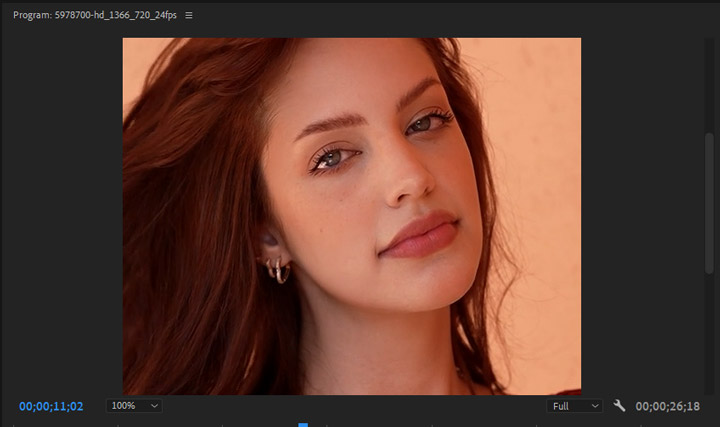
I see many YouTubers share impressive results when sharpening footage with Premiere Pro. However, it has a steep learning curve and requires a lot of manual tweaking to achieve the right balance between sharpening blurry or soft-focus footage while still preserving details. At my current level, the results below are the best I can achieve.
[Test 1] Sharpen video with Premiere Pro's Sharpen video effect.
Best Online Video Sharpeners for Quick Fixes
If sharpening video quality is a one-time task for you, and you don't want to bother yourself with downloading additional video sharpener software, then an online video sharpener might be your good pick. The best part is that there're numerous options available, including both AI-driven and non-AI-driven video sharpening tools. Most of them allow you to sharpen blurry, pixelated, or hazy videos with just a few simple clicks. The downsides? They usually come with upload limits, pricing restrictions, preview limitations, and less control over the final result. In my opinion, they are better for short clips or casual use, not serious quality restoration.
5. Cutout.pro
- AI-Powered: Yes
- Limits: Cutout.pro imposes limits on file size, resolution, and frame rate
- Pricing: The pricing structure varies based on usage, offering options such as $299 for 45 minutes of processing time and $69.00 for 1200 credits
- Rating: 2.5/5
 by Trustpilot
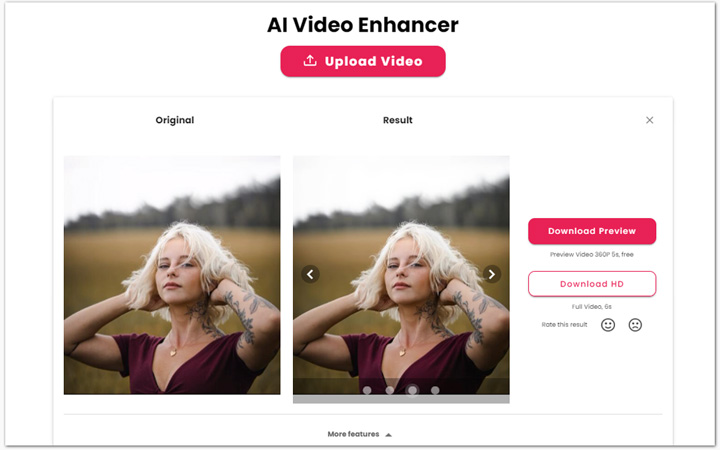
Cutout.pro is an AI-powered video sharpening tool, accessible both online, directly through your browsers like Safari and Chrome, and offline on various platforms including Windows, Mac, iOS, and Android. It's capable of handling video files with a maximum size of 2GB and provides a few features to enhance your videos, including sharpening, background removal, frame rate enhancement, and the ability to boost video quality up to 2K, 30fps, or even 4K. However, it's worth noting that this online video sharpener does have some limitations, such as potentially expensive subscription fees for larger projects and support for specific video file formats like MP4, WebM, and MOV.
Pros:
- User-friendly interface for hassle-free operation
- Cross-platform compatibility for versatile use
Cons:
- Subscription fees may be costly for larger projects
- Limited file format support (MP4, WebM, MOV)
How It Performed in Practice
Overall, the performance is just acceptable. The results may look good when viewed in a small preview window. However, at full resolution, without scaling down, it becomes clear that some details are lost. For example:
[Test 1] Sharpen video online with CutoutPro. The skin texture becomes overly smoothed, and facial features show slightly rigid edges.

[Test 2] In a small preview window, the result looks fine. However, upon closer inspection, visible distortion appears in certain areas, such as the clock details.

6. Wink.AI
AI-Powered: Yes
Pricing: starting from 14.9USD/month.
Rating: 4.5/5 by Softnic.com
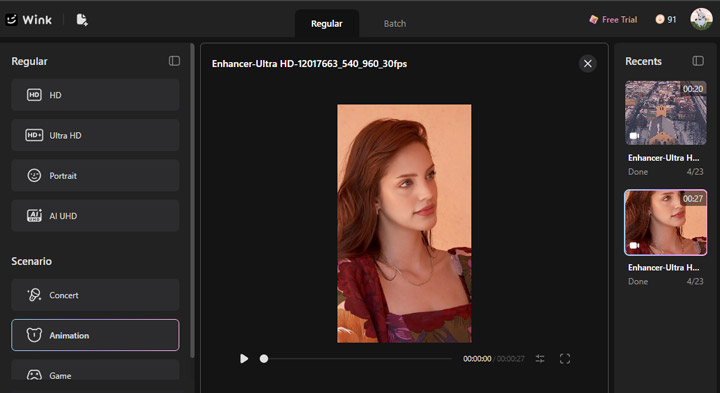
Wink AI, which I categorize as an online video sharpener, also offers Android and iOS versions, and both have gained good reputations. However, I find the online version more impressive, especially for beginners or users who only need to sharpen videos occasionally. It has a very straightforward UI with a clean and well-organized layout. Even though it includes many features, users can quickly find what they need and adjust settings without hassle. The sharpening capability is part of the Video Enhancer feature. When we use it, the tool automatically reduces unwanted visual issues such as noise, grain, blur, and pixelation that make footage look unclear, and then improves overall clarity and sharpness. In addition, it supports watermark removal, upscaling, video noise reduction, and many other AI-powered features.
Pros:
- No learning curve
- A raft of video/image enhancement features
- Allow sharpen multiple videos simultaneously
- A relatively generous free plan, offering 100 free credits
Cons:
- No advanced customization options for fine-tuning results
- Lack a side-by-side comparison window
- Sometimes it brings noticeable quality loss
How It Performed in Practice
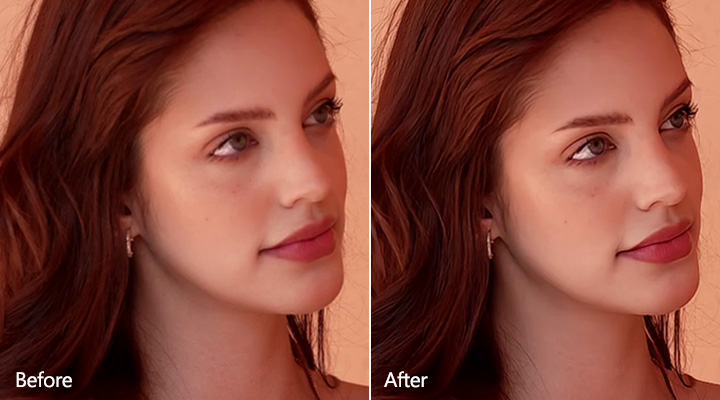
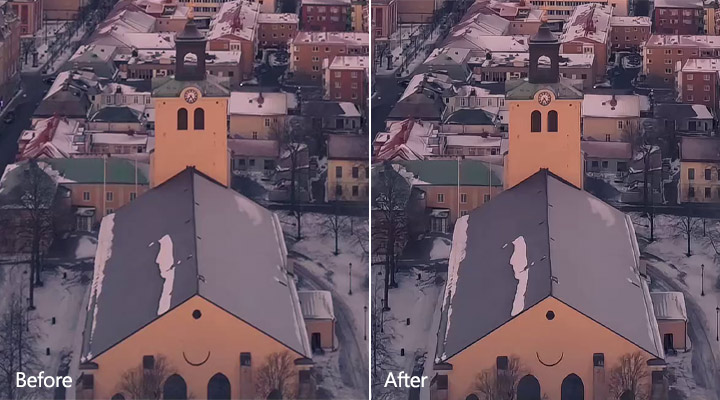
The rigid edges in footage sharpened with Wink AI are more noticeable than in most of the other video sharpener tools I listed in this post. Since it does not offer a real-time side-by-side preview window, I downloaded the sharpened footage and compared the first frame of the original and sharpened videos offline.
[Test 1] Sharpen video with Wink AI, Ultra HD model
[Test 2] Sharpen video with Wink.AI, Ultra HD model
Best (AI) Video Sharpener Apps for iOS and Android
Below, we've selected two of the best video sharpening tools for iOS and Android, perfect for mobile users seeking to transform blurry videos into crystal-clear quality directly on their iPhone or Android devices.
7. HiQuality
- AI-Powered: Yes
- Limits: No
- Pricing: Charge one "pro card" for every second of video you work with
- Rating: 4.5/5 by Google Play Store users
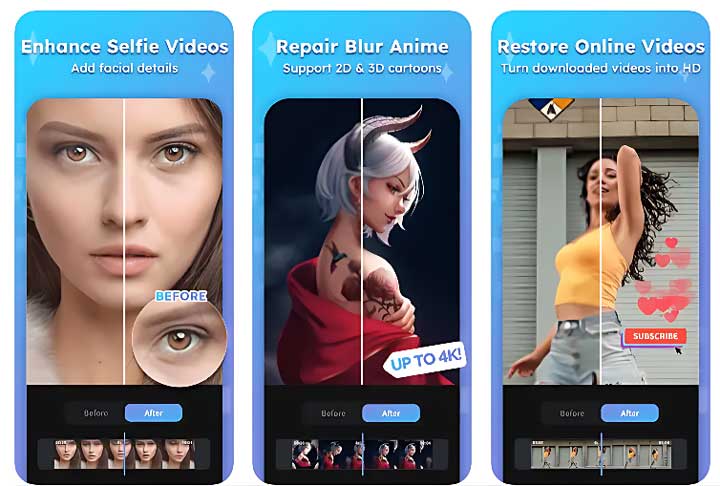
HiQuality utilizes AI algorithms to address various video and photo enhancement needs. It effectively corrects pixel blurriness, enhances facial features, and improves video quality. Whether you're working with selfies, animations, cartoons, vintage films, or screen recordings, HiQuality is versatile. It also supports video resolution upscaling, from 720P to 1080P and even 4K. In addition to sharpening your videos, HiQuality can make your photos look more crispy by increasing pixel count and overall quality. HiQuality's rating in the App Store is particularly low, and the ratings on the Google Play Store are quite polarized, mainly due to unstable output quality and high cost. This browser-based AI video sharpener charges one "pro card" for every second of video you enhance. To put it in perspective, the cost for sharpening a 30-second short video is $5.
Pros:
- Sharpen both videos and photos
- Plenty of video enhancement tools to choose from
Cons:
- Sometimes makes the video quality worse
- Slow when sharpening large video files
- High price tag and does not allow for a free trial
8. VN Video Editor
- AI-Powered: Yes
- Limits: No
- Pricing: Free
- Rating: 3/5
 by Alternativeto
VN Video Editor is available for iPhone, Android, and Mac, and it's free to use without watermarks or any hidden catches. It's quite handy for a wide range of video editing needs in today's content creation landscape. It enables you to sharpen videos by adjusting settings like contrast, brightness, and sharpen levels. However, achieving the desired result may require some experimentation with different parameters. Worse still, this traditional video sharpener lacks advanced AI algorithms, making this video sharpener challenging to sharpen low-resolution videos or address issues like blurriness, artifacts, noise, or mosaic patterns. Most of the time, using VN Video Editor for video sharpening yields unsatisfactory results with noticeable imperfections such as excessively sharp edges and increased noise levels.
Pros:
- Abundance of video editing features
- No additional cost or watermarks
- User-friendly interface tailored for beginners
Cons:
- Limited selection of stickers, filters, and transitions
- Not a one-click solution for video sharpening
- Can't upscale video resolution with satisfactory quality
How to Sharpen Video Quality with AI (Easy Steps)
Now that we've gone through eight video sharpening tools, let's take a look at how the process actually works. In general, most video sharpeners follow a similar workflow. The main difference is that some tools are more complex, while others are easier to use. VideoProc is one of the more beginner-friendly options. Thus, I'll use VideoProc Converter AI for demonstrating the process of sharpen video quality with AI.
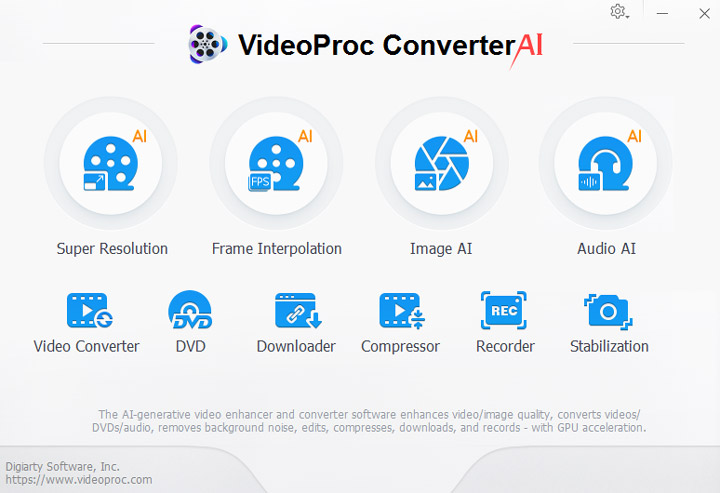
Step 1. Download and install VideoProc Converter AI, then launch the program.
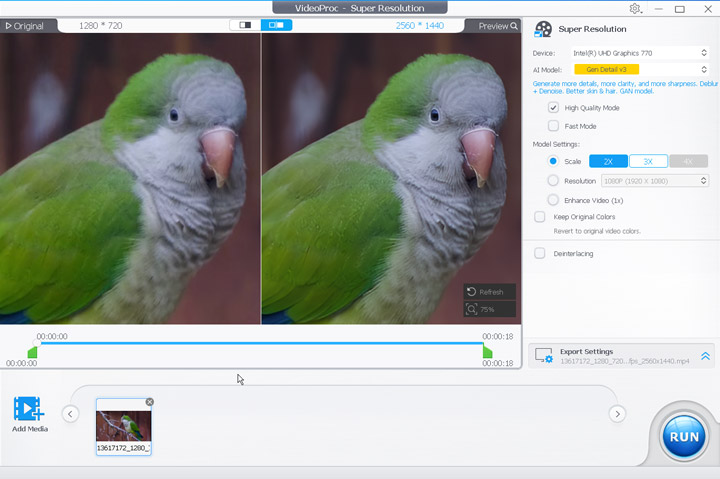
Step 2. Drag and drop the videos you want to sharpen using AI. Select an AI model. Gen Detail v3 and Real Smooth v3 are two of the most recommended models for sharpening video quality.
Tips:
Set your desired resolution by adjusting the upscale ratio or choosing a target resolution like 2K and 4K. If the original footage is already at the desired resolution, you can simply choose 'Enhance Video (1x)' to keep it at the same resolution.
You can drag the green knobs under the preview window to choose the specific segments of the video for sharpening.
Step 3. Hit RUN to export the sharpened video. The result will have noticeably improved clarity and a crisp, detailed look. Besides sharpening videos, this AI video sharpener can deblur and sharpen images.
Tips:
If needed, adjust the video encoding settings to fine-tune the output. For example, choose H.264 for the most compatible format, AV1 for the smallest file size at the same quality (though it's not as widely supported), or ProRes for easier editing later on.
You can also adjust the brightness, hue, saturation, and more to make a video look sharper. Learn how >
Video Tutorial: AI Sharpen Video Quality with VideoProc Converter AI