
 New AI features are available
 Listed in
 Looking for the best video stabilization software to fix shaky footage? Nothing makes a great video look more amateurish than camera jitter. Whether you're shooting handheld vlogs or fast-paced sports, you need a tool that delivers professional smoothness in minutes. For this 2026 guide, we tested dozens of video stabilization tools and selected the 7 best options. We provide an honest breakdown of their features, pricing, and real-world performance to help you find the right video stabilization solution.
Quick Comparison of the Best Video Stabilization Software
| Software | Best For | AI Stabilization | Ease of Use | Platform | Free Version |
|---|---|---|---|---|---|
Overall best & beginners |
Yes |
Very Easy |
Windows/macOS |
Free trial |
|
Professional editing |
Yes |
Advanced |
Windows/macOS |
No |
|
Free professional workflow |
Yes |
Moderate |
Windows/macOS/Linux |
Yes |
|
Mac beginners |
Basic |
Very Easy |
macOS/iOS |
Yes |
|
Free open-source editing |
Basic |
Moderate |
Windows/macOS/Linux |
Yes |
|
Action camera footage |
Yes |
Moderate |
Windows/macOS |
Yes |
|
Legacy stabilization workflows |
No |
Advanced |
Windows |
Yes |
💡 How We Test
To ensure a fair and practical comparison, we tested each video stabilization software using the same set of real-world footage, including handheld walking videos, GoPro action clips, drone shots, and low-light recordings. This helps us evaluate how each tool performs under different types of camera shake and motion conditions.
Our evaluation focuses on several key factors: stabilization quality, cropping or loss of frame, rendering speed, ease of use, and overall output consistency. We also pay attention to whether the software uses AI-based stabilization, and how well it preserves natural motion without creating unnatural warping or distortion.
In addition, we consider how accessible each tool is for everyday users, from beginners looking for one-click solutions to professionals needing more advanced controls. Pricing and system performance are also taken into account to reflect real-world usage scenarios.
Best 7 Video Stabilization Software: Tested & Reviewed
#1. VideoProc Converter AI - The Overall Best Video Stabilization Software
Platform: Windows/macOS
VideoProc Converter AI strikes the ideal balance between functionality and user-friendliness for video stabilization. It enables you stabilize GoPro videos, walking videos, drone footage… and whatever other types of videos, all within a simple click. What sets VideoProc Converter AI apart from its competitors is it's ability to stabilize videos with complex motion and substantial displacement while preserving the original video resolution, without any visible cropping or loss of detail. This is made possible by its robust AI deshake module, which can accurately detect and track key points within video frames and then computes a smooth camera trajectory that minimizes the motion between the points. Check some of the highlight features of this best video stabilization software.
- AI-powered! Auto eliminate wobbling for tripod-like video stability
- A range of user-friendly stabilization setting options for optimal outcome
- Handle 370+ video and audio formats. Stabilize footage from any source
- An all-in-one: edit, convert, compress, download, and record videos
- Super Resolution, Frame Interpolation, and more incredible AI features

#2. Adobe Premiere Pro – Advanced Video Stabilization for Professionals
Platform: Windows and macOS
Adobe Premiere Pro is a reliable industry standard for handling shaky footage. Using its powerful built-in Warp Stabilizer effect, you can easily smooth out camera jitter or completely remove camera motion to achieve a steady, professional look.
During our testing, we noted a few practical details to keep in mind. Stabilizing long video clips can be highly demanding on your hardware. Because the Warp Stabilizer effect analyzes footage frame-by-frame and compares each image to adjacent frames, it is very CPU and GPU-intensive. On longer high-resolution files, this process can sometimes result in prolonged analysis times.
You might wonder if enabling Proxies can speed up this process. Unfortunately, Warp Stabilizer is an effect that bypasses active proxies during the analysis phase, meaning Premiere Pro will always analyze and process the full-resolution source files directly.
Pros:
- High-quality stabilization using the industry-standard Warp Stabilizer.
- Highly customizable settings (Smoothness, Method, and Framing).
- Seamless integration with the Adobe Creative Cloud ecosystem.
Cons:
- Heavy CPU/GPU load; rendering can take a long time on longer clips.
- Bypasses proxies, requiring full-resolution files for analysis.
- Requires a paid, subscription-based license.
#3. DaVinci Resolve – All-in-One Professional Video Editing & Stabilization
Platform: Windows, macOS, and Linux
DaVinci Resolve has established itself as an incredibly powerful, all-in-one post-production suite. Beyond industry-leading color grading and audio editing, Resolve features a robust, dedicated video stabilization engine directly within its Edit and Color pages.
Resolve provides three main stabilization modes to handle different types of camera jitter: Perspective, Similarity, and Translation. Depending on the movement in your video, you can toggle between these algorithms to find the smoothest look. If standard stabilization isn't enough, enabling the Camera Lock feature can completely freeze camera movement—though keep in mind this often requires a significant crop/zoom to mask the shifting edges.
Pros:
- The powerful free version offers full access to standard stabilization features.
- Three distinct stabilization algorithms to match varying camera movements.
- Highly precise tracking data and manual OFX tracker adjustment options.
Cons:
- High hardware requirements (demands a decent GPU to run smoothly).
- Steep learning curve for beginners due to the feature-rich, multi-page interface.
- Camera Lock and heavy stabilization can result in substantial image cropping.
#4. iMovie – Best Entry-Level Video Stabilization for Apple Users
Platform: macOS
iMovie is a solid, accessible starting point if you're using a Mac. The automatic stabilization handles camera shake well, and I like how easy it is to tweak rolling shutter distortion with just a slider.
However, because it works by cropping and zooming, you'll definitely lose some of the original edges of your shot. Also, watch out for the speed. It sat there for over 10 minutes just to finish a 2-minute 4K export from my Insta360. That's way too slow if you're in a rush.
Pros:
- Completely free and pre-installed for macOS and iOS users.
- Extremely simple, one-click stabilization with automatic crop adjustment.
- Includes built-in rolling shutter correction to eliminate "jello" artifacts.
Cons:
- Exclusive to the Apple ecosystem (no Windows or Linux support).
- Lacks advanced manual controls or fine-tuning parameters.
- Requires significant zooming and cropping for heavily shaken videos, leading to resolution loss.
#5. Shotcut – Open-Source and Free Video Stabilization
Platform: Windows, Linux, and macOS
Shotcut is another highly capable option, especially if you prefer open-source video stabilization software. It can tame severely shaky footage and turn otherwise unusable clips into relatively smooth shots. The stabilization filter in Shotcut offers four main adjustable parameters: Shakiness, Accuracy, Zoom, and Smoothing. By adjusting these sliders, you can find the right balance for your specific clip.
While having manual controls is beneficial, pushing all sliders to their limits is generally not recommended. Doing so can cause significant cropping along the borders of your video and substantially increase the time required for the software to analyze and export your project.
Pros:
- 100% free, open-source, and entirely free of watermarks or paywalls.
- Cross-platform compatibility across Windows, macOS, and Linux.
- Provides manual sliders for granular control over stabilization strength and zoom.
Cons:
- Requires a two-step process (Analyze then Apply), which can feel less intuitive.
- Lacks modern AI-assisted border-filling features to mitigate heavy cropping.
- The user interface can feel slightly dated or utilitarian for beginners.
#6. CapCut - Free & AI-Powered Video Stabilization
Platform: Windows, macOS, Android, iOS, and Web
CapCut has rapidly evolved from a mobile editing app into a powerful, cross-platform video editor widely used by vloggers and social media creators. One of its standout features is the built-in, AI-powered video stabilizer. Rather than requiring complex manual keyframing, CapCut's stabilizer automatically tracks the background movement in your footage and recalculates a smooth camera path with a single click.
The stabilization settings in CapCut are incredibly straightforward. Once applied, you can choose from three main stabilization levels: Minimal Cropping (perfect for light handheld jitter), Recommended (the default setting that handles most casual walking shots), and Most Stable (designed to smooth out aggressive running or action-cam motion). This simplicity makes CapCut an incredibly efficient tool when you need platform-ready, stabilized footage on a tight schedule.
Pros:
- Completely free, beginner-friendly, and accessible across mobile, desktop, and web browsers.
- AI-powered stabilization operates in real-time with instant previews.
- Simple, user-friendly presets remove the guesswork from choosing crop ratios manually.
Cons:
- Lacks advanced controls for fine-tuning specific axes or rotation values manually.
- Heavy stabilization can sometimes result in a "jello" warp effect on clips with extreme camera shake.
- Some premium features and higher-resolution export options require a CapCut Pro subscription.
#7. Gyroflow - Best Gyro & FPV Video Stabilization Software
Platform: Windows, macOS, and Linux
Gyroflow is another decent piece of video stabilization software. Most people use it as a faster, more flexible alternative to Sony's Catalyst Browse. The reason it works so well is that it doesn't just 'guess' movement based on pixels—it uses the actual gyro data recorded by your camera (whether it's a Sony, GoPro, DJI, or even a RED). This gives you that smooth, gimbal-like look in post without the usual artifacts. The best part? It's surprisingly fast. It handles batch processing and horizon locking with ease, and there's even an OpenFX plugin for DaVinci Resolve. This is a game-changer because you can stabilize your FPV or handheld footage right on your timeline without having to jump back and forth between different apps.
Pros:
- 100% free and open-source, with support for highly efficient batch processing.
- Incredibly fast calculation and rendering speeds compared to official camera apps.
- Highly versatile, supporting gyro data from Sony, GoPro, DJI, RED, and many custom FPV drone setups.
Cons:
- Steep learning curve due to complex parameters like synchronization points and optical low-pass filters.
- Requires specific camera/lens calibration profiles to achieve the most accurate results.
- Only works if your camera records and exports internal gyroscope metadata during shooting.
How to Stabilize a Video with AI
While each of the video stabilization tools listed above has its own strengths, AI-powered stabilization is easiest to demonstrate with software that's accessible, runs smoothly on standard computers, and features a dedicated, timeline-free stabilization module. For this tutorial, we'll use VideoProc Converter AI as our example. As mentioned above, it can intelligently analyze motion and reduce camera shake without the complexity or steep learning curve of professional editing software, making it suitable for users of all skill levels to eliminate shakiness and improve overall footage quality. Here's how to stabilize your footage in just a few simple steps:
Step 1. Once VideoProc Converter AI is downloaded and installed, launch it on your Windows PC.
Step 2. Hit the Stabilization icon on the main interface. Drag the shaky footage to the program.
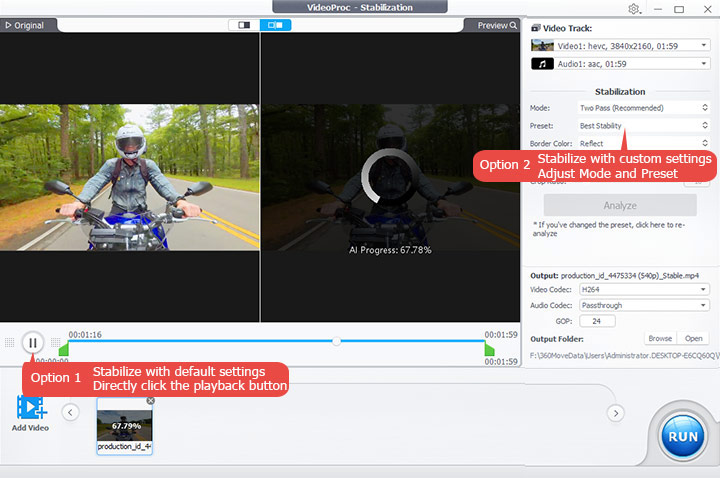
Step 3. Click the playback icon under the preview window to enable VideoProc Converter AI stabilize your footage with the default stabilization settings.
Tips:
You can also custom the stabilization settings by adjust the stabilization mode and stabilization preset. Click Analyze to confirm the adjustments and start the stabilization process.
- Mode: Two Pass is always recommended.
- Preset: Best stability will bring the most stable outcome. Fastest lets you get your output as fast as possible. Balance is a good option if you want to get balance on stabilization, crop ratio, and speed. Minimum Crop helps you stabilize video with minimum cropping.
Step 4. (Optional) If you're not satisfied with the stabilized footage, just keep adjusting the Stabilize Preset, Border Color, and Type. Border color decides what's gonna be used to fill the cropping edge. The choice of the Crop Type should be determined how shaky the original footage. For example, if your video shows significant and varying shake, choose Dynamic (Auto).
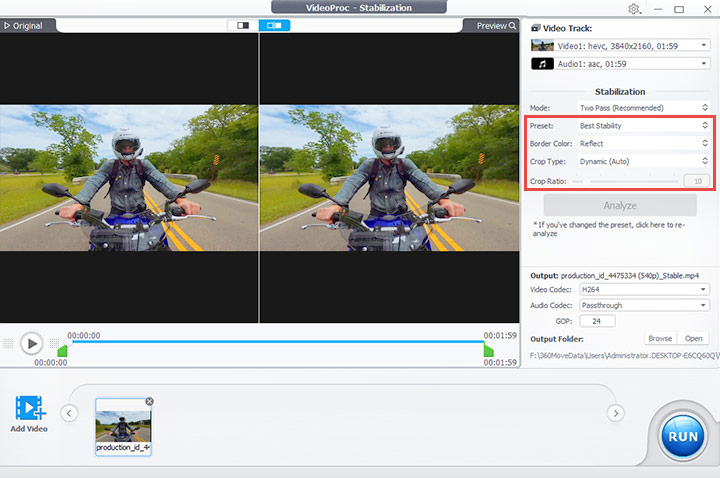
Step 5. Click the playback icon again to preview the stabilized video. Hit RUN to start rendering the stabilized footage.
Last Words
Video stabilization software is not a panacea, not something you should always depend on during creation. And it should always be a last resort, after tripods, monopods, gimbals and DIS. But let say you didn't have any gear attached when shooting, video stabilization software can make your usable clip usable.