
 Upgraded AI Performance in V8
Can't play H.265/HEVC video files smoothly in VLC?
VLC media player is a widely used multiple media player that supports a wide range of video and audio formats. However, when playing H.265 video files on VLC media player, very chances we'll encounter problems. Below are some of the most common issues:
- Codec not supported: VLC could not decode the format "hevc" (mpeg-h part2/hevc (h.265)).
- Can't play MP4/HEVC 4K videos in VLC smoothly.
- VLC refuses to play HEVC or it can only play the audio stream.
- The MP4 H.265 video gets pixelated when playing on VLC.
- VLC goes crashes or it freezes the computer when playing the HEVC file.
- Random lags and freezes problems when viewing x265 in VLC.
- VLC stops playing HEVC files at a certain point.

Why HEVC Not Playing in VLC
Here is the quick answer: VLC does support H.265 (HEVC) videos out of the box. As long as you are running VLC version 2.1.1 or newer, the player has the built-in tools to read the file.
If your video still isn't playing, the problem usually isn't VLC itself. The reasons why VLC cannot play H.265 videos may be a hardware bottleneck from an older CPU or graphics card, a settings mismatch with your hardware acceleration, a lack of necessary codecs, an outdated version of VLC, or simply a corrupt video file.
To fix this, update to the latest version, toggle hardware acceleration, increase file caching, or install necessary plugins. If issues persist, convert the files to H.264 or try a different player.
VideoProc Converter AI - Convert H.265 for Smooth Playback

- Convert HEVC to a more compatible format like H.264
- Compress to fix stuttering, dropped frames, crashes, or choppy playback
- High quality engine: no visible quality loss after transcoding
- Low system requirements, fast processing speed, hardware acceleration

1. Check Your Hardware
H.265 is a beast of a video format. It achieves those incredibly small file sizes by relying on massive amounts of complex, real-time math. If you are trying to play a high-resolution HEVC video on an older laptop, your processor might just be choking on the workload. No amount of tweaking inside VLC will magically give an aging chip the raw horsepower it needs.
- Play your HEVC video in VLC, even if it's stuttering or black.
- Open Task Manager > Performance on Windows or Activity Monitor > CPU on Mac.
- Keep an eye on your total CPU (and GPU) percentage as the video struggles to play.
If you see your CPU or GPU usage pegged at 95% to 100% while the video struggles, you have found your problem. Your hardware physically cannot decode the video fast enough to keep up. If this is happening, your best bet is to jump straight to the "Transcoding" workaround at the end of this guide to convert the video into a lighter format.
If your CPU is cruising comfortably at 20% or 30% and the video still looks like a black screen or a glitched-out mess, your hardware is totally fine. The issue is a settings miscommunication inside VLC itself.
2. Upgrade VLC Media Player
The latest release of VLC media player should have no problem playing HEVC videos on recent computers. So first upgrading our VLC to the latest version can fix the VLC can't play HEVC error. And in case that you may encounter other potential VLC errors, please make sure that your VLC is always the latest version.
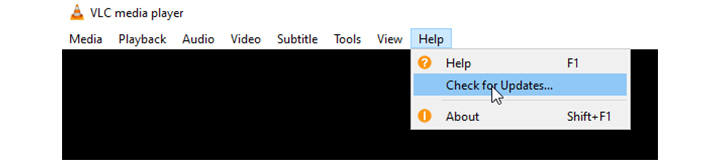
- Open up VLC media player. On the top menu bar, click on Help.
- Hit Check for Updates. VLC starts to check the latest available version.
- Follow the pop-up wizard to download and install the most recent version of VLC.
Windows and Mac users can skip steps 3 and 4 below to adjust the settings inside VLC. Linux users, however, may need to install the missing codecs.
3. Download the VLC Codec Pack and Plugins
If you're encountering the error message "Codec 'hevc' (MPEG-H Part2/HEVC (H.265)) is not supported." on an old VLC media player (version 2.2 or earlier version), or if you are running an older version of Ubuntu, then downloading and installing the libde265 codec pack might help you play HEVC videos on VLC correctly.
Here is how to set it up:
- Open your Terminal.
- Add the repository:
sudo add-apt-repository ppa:strukturag/libde265 - Refresh your local repository index:
sudo apt update - Install the plugin directly into VLC:
sudo apt install vlc-plugin-libde265 - Hit Enter, type your password if prompted, and let the installation finish.
However, what's worth noting is, this adds a specific PPA to your system and feeds the H.265 decoder directly, and only, to VLC. The playback problem may still happen next time when you run into another incompatible codec issue.
4. Install the Full FFmpeg Package
If you are running a Linux distribution like Ubuntu or Fedora, the most foolproof way to fix this system-wide is to bypass the restricted defaults and install the full, unrestricted FFmpeg package. This drops the missing tools right into your system, allowing VLC (and any other media player or video editor you use) to read H.265 files flawlessly.
For Ubuntu, Linux Mint, and Debian Users
Ubuntu makes this relatively painless. You just need to pull in the unrestricted FFmpeg libraries and extra codecs from the official repositories.
- Open your Terminal.
- Run the following command to update your package list:
sudo apt update - Install the full FFmpeg package and extra codecs by pasting this command:
sudo apt install ffmpeg libavcodec-extra - Hit Enter, type your password, and let it install. Restart VLC and play your video.
For Fedora Users
Fedora is incredibly strict about proprietary software, so it ships with a crippled package called ffmpeg-free. You need to delete that and replace it with the real deal.
- Open your Terminal.
- Enable the RPM Fusion repository by pasting this command:
sudo dnf install https://mirrors.rpmfusion.org/free/fedora/rpmfusion-free-release-$(rpm -E %fedora).noarch.rpm - Swap out the restricted package for the full FFmpeg toolbox:
sudo dnf swap ffmpeg-free ffmpeg --allowerasing - Hit Enter, confirm the installation, and restart your computer. Your H.265 videos will now play perfectly in VLC.
5. Upgrade Graphics Driver
An out-of-date hardware card driver might render your HEVC videos cannot play in VLC media player. To fix the playback error caused by this, we can go to the official site of the graphics card manufacturer and follow the guide to download and install the right driver. Alternatively, follow the below steps to auto-detect, download, and install the latest available driver for your graphics card.
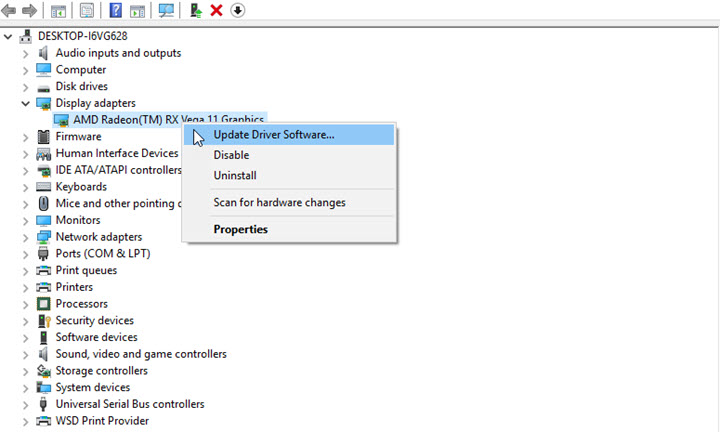
Step 1. Press Windows and R and input devmgmt.msc on the pop-up window. Hit OK to proceed.
Step 2. Go to Display adapters, right-click on your graphics card, and then select Update Driver Software.
Step 3. Restart the computer. Have a check whether the HEVC videos can play on your VLC media player or not.
6. Disable VLC Hardware Decoding
Sometimes, hardware-accelerated decoding does more harm than good, especially if your graphics card or chipset doesn't fully support HEVC playback. When this happens, VLC might stutter, show odd colors, or simply crash the moment you try to play an H.265 video. Fortunately, switching off hardware acceleration often does the trick:
- Open VLC media player.
- At the top menu, click on Tools and select Preferences.
- In the preferences window, select the Input / Codecs tab.
- Find the option labeled Hardware-accelerated decoding and set it to Disable from the dropdown.
- Save your settings and restart VLC.
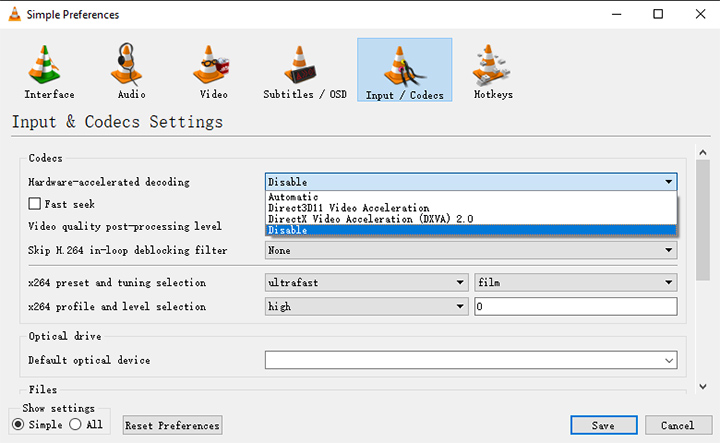
Disabling this setting forces VLC to use software decoding, which is usually much more reliable—even if it puts a tiny bit more load on your CPU. For users with newer, more powerful hardware, you can always re-enable hardware decoding to test if the problem is resolved in future VLC versions.
7. Increase the File Caching Setting in VLC
If your HEVC files are large or stored over a network (for example, on a NAS or an external USB drive), playback might stutter or pause because VLC doesn't buffer enough data ahead of time. Increasing the file caching value (the amount of video VLC loads before playing) can result in much smoother playback, especially with demanding 4K HEVC files.
Here's how to increase file caching:
- Launch VLC and head to Tools > Preferences.
- At the bottom left of the window, switch to All settings (instead of Simple).
- In the sidebar, expand Input / Codecs and then scroll to the Advanced section.
- Look for File caching (ms). The default is usually 300 milliseconds (0.3 seconds). Increase this value, for example, to 1000 or 2000 ms (1–2 seconds).
- Click Save and restart VLC.
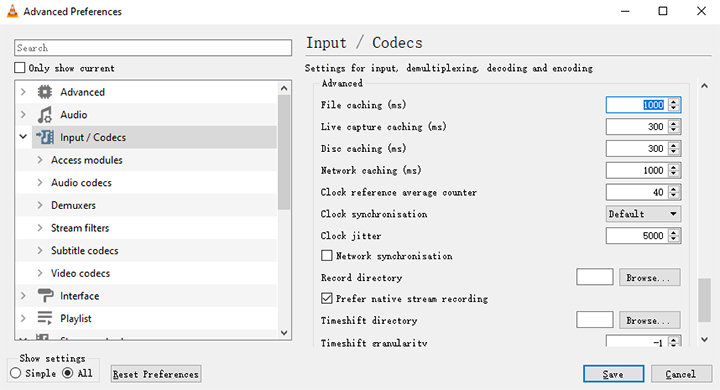
You might have to experiment with the exact value that works best for your files and system. Try increasing it gradually until you find that sweet spot where playback is smooth but startup time before the video begins isn't too long.
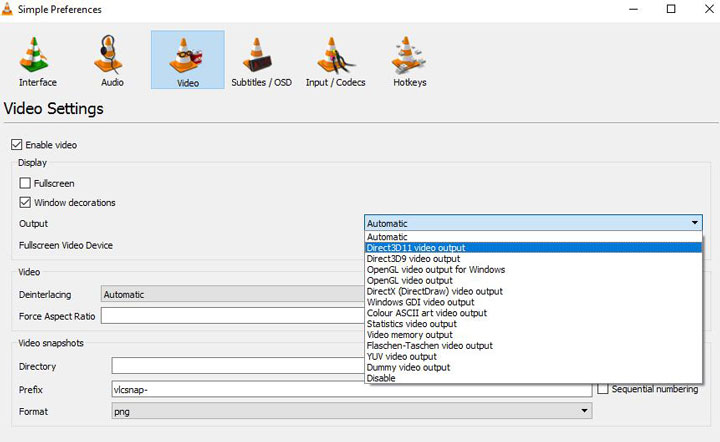
8. Select the Direct3d9 Output
If the VLC media player can play most of your HEVC videos, except for some high bit-depth ones (such as 16 bit and 32 bit), then changing the output to Direct3d9 might make sense. Sadly, some users report Direct3d9 will cause new issues. One of the most annoying issues happens when users play a different video, VLC plays the audio of the new video but it still shows the image of the last frame of the initial played HEVC video.
Step 1. Launch up VLC media player. Hit Tools and choose Preference.
Step 2. Select Video on the pop-up Simple Preferences panel.
Step 3. Go to Output and select Direct3d9. Hit Save.
Step 4. Restart the program. Now you might be able to play H.265 files in VLC smoothly.
9. Select Another Video Track
If you have some HEVC video files encoded by MKV container format playing on VLC and you can only hear the audio, then switching to another video track might help you out.
Step 1. Play the HEVC video on VLC. Right-click on the screen and choose Video.
Step 2. Select Track and choose a new Track.
10. Use Alternative Media Players
If all the solutions above do not work, this one would be the last choice, i.e. switching to a VLC laternative media player. There are many great options that you can go for, for example 5KPlayer.
5KPlayer is highly recommended for HEVC playback due to its GPU acceleration, which ensures smooth playback of 4K and 8K HEVC videos without needing additional codec packs. It supports a wide range of formats, including 8-bit, 10-bit, and 12-bit HEVC videos.
11. Change Color Formats
Rare rendering bugs or hardware compatibility issues can sometimes produce washed-out colors, posterization, or just plain weird visuals, especially with HEVC files. If you notice color issues, tweaking the color output module can help.
To change the color format:
- Open VLC and click on Tools > Preferences.
- Choose the Video tab at the top.
- Scroll down to Output—if unsure, set this to DirectX (DirectDraw) Video Output or OpenGL video output.
- If you see an option for YUV -> RGB conversion, toggle this setting or experiment with different color output modules like Automatic, Direct3D11, or OpenGL.
- Click Save and restart VLC.
Changing these settings can resolve issues where HEVC videos display with incorrect colors, washed out blacks, or visual artifacts. Play around with the available output modules and color settings until your video looks right again.
12. Convert H.265 to H.264 for VLC
The once for all solution to fix the H.265 not playing in VLC is converting HEVC to H.264 or any formats well-supported by VLC with VideoProc Converter AI - an all-in-one video processing, converting, and editing software. To be specific, you can convert MP4/H.265 to MP4/H.264, AVI, MKV, MOV, 3GP, FLV, VOB, DVD-Video, etc, which you'll find under the 'Target Format' tab in VideoProc Converter AI.
VideoProc Converter AI - One Click to Fix H.265 Not Playing in VLC
- Convert x265 to x264, AVI, MKV, MOV, FLV, etc and vice versa.
- High quality engine: no visible quality loss after transcoding.
- Full GPU acceleration ensures fast video processing speed.
- Multi-purpose: media converter, video editor, recorder, etc.
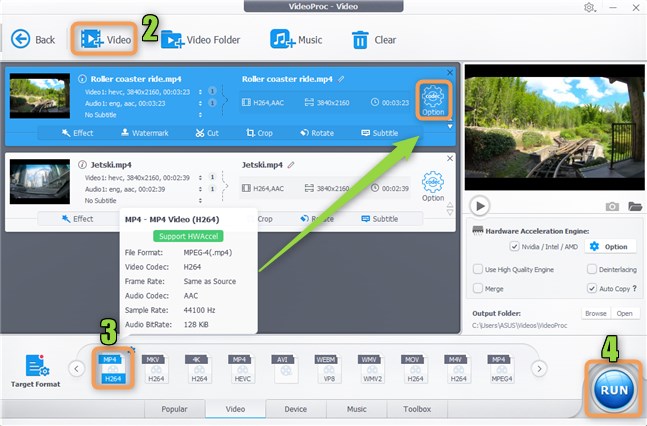
Step 1. Add x265 Files
After you download and install VideoProc Converter AI, launch it up. Hit +Video and select the H.265 video(s) that you can't play on VLC for adding to the program. Alternatively, directly drag the target H.265 files from computer to VideoProc Converter AI.
Step 2. Convert x265 to x264
Choose MP4 H.264 under the Target Format section. Hit Run. VideoProc Converter AI starts to convert H.265 to H.264 format.
13. Compress 4K HEVC to 1080P/HD
It might be the 4K UHD resolution that causes your VLC can't play HEVC videos. 4K videos are everywhere, but it's still a challenge for VLC media player and most video players decoding the enormous amount of visual information involved by 4K videos. After all, a 4K HEVC video contains 4 times of the data compared to an HD HEVC video.
The lucky things, saving or playing videos in 4K resolution is not always necessary as HD videos still give us good picture quality. Most importantly, HD requires much less resources for computer and media players to work with. Thus, it's a good idea to compress 4K HEVC files to HD HEVC or HD H.264 files for playing HEVC 4K files on VLC without error. To get there, we can use VideoProc Converter AI. This all-in-one 4K to 1080P converter supports level-3 GPU acceleration, ensuring you can enjoy 47X faster conversion speed than the real-time play, even on a less-robust machine.
Step 1. Download and install VideoProc Converter AI. Hit Video. Drag the target 4K HEVC video that you'd like to play on VLC to VideoProc Converter AI.
Step 2. Select MP4 HEVC or MP4 H.264. Hit the gear icon to open the Format setting panel. Locate Resolution. Select 1920X1080 from the drop-down options.
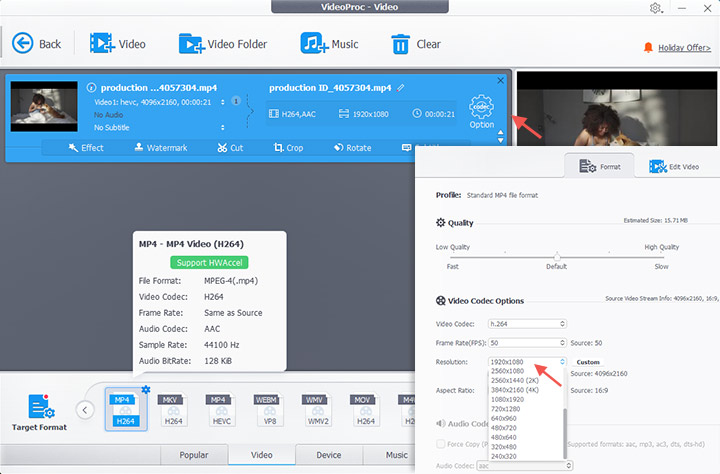
Step 3. Hit Done to confirm the change. After that, click on Run. Now, you should be able to play your 4K HEVC videos on VLC media player.
FAQs about VLC HEVC Playback
1. What is HEVC and why do I need it?
HEVC stands for High Efficiency Video Coding, also known as H.265. It is a video compression standard that can achieve higher quality and smaller file size than the previous standard, H.264. You need HEVC to play some of the latest videos that are encoded with this format, such as 4K and HDR videos.
2. How can I play HEVC videos with VLC?
VLC supports HEVC playback since version 2.1.1. You can download the latest version of VLC from its official website. To play HEVC videos, you just need to open them with VLC as usual. However, some HEVC videos may not play smoothly or cause VLC to crash due to various reasons. In that case, you can try the following solutions.
3. What are the common reasons and solutions for VLC HEVC playback issues?
There are several possible reasons and solutions for VLC HEVC playback issues, such as:
- Your hardware is not capable of VLC HEVC playback. HEVC videos require more CPU and GPU power than H.264 videos. If your hardware is too old or weak, you may experience choppy, laggy, or stuttering playback. To solve this problem, you can either upgrade your hardware or convert the HEVC videos to a more compatible format, such as H.264, with a video converter.
- Your VLC settings are not optimal for HEVC playback. Some VLC settings may interfere with HEVC decoding and cause playback issues. To solve this problem, you can try to change the VLC demux module option, disable hardware-accelerated decoding, or adjust the video settings.
- Your HEVC files are corrupted or incompatible. Some HEVC files may be damaged or encoded with a non-standard codec that VLC cannot recognize. To solve this problem, you can try to repair the HEVC files with a video repair tool or convert them to a standard HEVC format with a video converter.
4. Are there any other media players that can play HEVC videos?
Yes, there are some other media players that can play HEVC videos, such as:
- PotPlayer: A powerful and versatile media player that supports various formats, codecs, and features, including HEVC.
- 5KPlayer: A lightweight and user-friendly media player that can play HEVC videos smoothly and also download online videos.
- KMPlayer: A popular and multifunctional media player that can play HEVC videos and also edit, capture, and stream videos.
5. How can I convert HEVC videos to other formats?
You can use a video converter to convert HEVC videos to other formats, such as H.264, MP4, MKV, AVI, etc. There are many video converters available online, both free and paid, such as:
- Leawo Video Converter: A professional and reliable video converter that can convert HEVC videos to over 180 formats and also edit, enhance, and compress videos.
- DumboFab Video Converter: A powerful and versatile video converter that can convert HEVC videos to any format and also download, edit, and record videos.
Final Words
If you have been scratching your head for being incapable of making your MP4/ H.265 video running on the VLC media player, try it with our EASY-TO-USE and profound editing software—VideoProc Converter AI! This short user manual will offer you a satisfactory answer to make your MP4/H.265 video applicable to the VLC media player.