New AI features are available
 Listed in
Commercial DVDs often use copy protection such as CSS, Sony ARccOS, and Disney 99-title structures. When ripping these DVDs with standard software, you may encounter errors like &read error& or © protection 0x8003030&, missing scenes, or video files that won't play properly.
To remove copy protection from DVD discs, you need a ripper that can handle these protections. After testing a range of free and paid DVD copy protection removal software, I selected five for this guide. Below, you'll find step-by-step instructions, test results, and practical tips for each tool.

You can remove DVD copy protection during ripping by using software that can read the protected disc and extract its video content.
- Insert the DVD into your computer's DVD drive.
- Open a compatible DVD ripper, such as VideoProc Converter AI or MakeMKV, and load the disc.
- Select the main movie title, audio tracks, and subtitles you want to keep.
- Choose an output format, such as MP4 or MKV, and start ripping.
- Play the exported file to check that the movie, audio, and subtitles were copied correctly.
Note: This guide is intended for personal backups, format shifting, and troubleshooting DVDs you own. Do not use these methods to copy, sell, upload, or distribute DVDs that you do not have the right to back up.
At a Glance: 5 DVD Copy Protection Removers Compared
Compare five DVD copy protection removers by their DVD support, output options, and practical limitations. The support information below is not a claim that every protection type was independently verified on each test DVD.
| Software | Supported DVD Protections | Best For | Pros & Cons |
|---|---|---|---|
CSS, Region Codes, RCE, Sony ARccOS, Disney 99-title structures, and more (disc-dependent) |
Automatic ripping and flexible output formats on Windows/Mac |
Pros: Hardware-accelerated conversion; MP4/MKV and backup options. |
|
Common DVD encryption and supported structural protections |
Free, lossless DVD-to-MKV backup |
Pros: No re-encoding; retains tracks and chapters. |
|
HandBrake (+ libdvdcss) |
Basic CSS with an external libdvdcss library |
Free DVD-to-MP4/MKV conversion |
Pros: Free; flexible encoding settings. |
Basic CSS, depending on DVD-reading libraries |
Occasional playback and conversion |
Pros: Free; multiple platforms. |
|
DVD Shrink (Classic) |
Basic CSS and region restrictions on some older DVDs |
DVD9-to-DVD5 compression |
Pros: Free; compression controls. |
How We Tested These DVD Copy Protection Removers
We evaluated five DVD ripping tools using commercial movie DVDs of different release years and protection complexity, focusing on four key aspects:
- Decryption reliability: Disc recognition, main-title detection, and successful ripping.
- Output integrity: Video playback, audio/subtitle preservation, and output quality.
- Performance & usability: Ripping speed, setup requirements, and ease of use.
- Compatibility & limitations: Support for protected DVDs, software restrictions, and common failures.
Key finding: Successfully scanning a DVD doesn't guarantee a successful rip. In my tests, HandBrake with libdvdcss could recognize some protected discs but failed during conversion; VLC sometimes produced files with missing audio or subtitles; and DVD Shrink worked well with older DVDs but failed on one released in 2016. VideoProc Converter AI successfully ripped all five DVDs I tested, correctly identifying the main movie titles and preserving my selected audio and subtitle tracks.
📌Test limitation: Although the discs showed signs of copy protection, their exact protection schemes could not be independently verified. Results therefore reflect observed performance rather than comprehensive support for every DRM type.
Method 1. Remove DVD Copy Protection with VideoProc
- Operating System: Microsoft Windows 11, 10, 8/8.1, 7; macOS 10.13 or later.
- Best for: Easy DVD ripping, automatic title detection, and conversion to different output formats.
VideoProc Converter AI was the easiest of the five programs for me to use. It handled the DVD-reading process without requiring a separate decryption library or manual setup.
All five DVDs I tested were ripped successfully. VideoProc picked the correct main movie titles, and the finished files included the audio and subtitle tracks I had selected. I did not run into the incomplete conversions or missing tracks I saw with some of the other DVD copy protection removal software.
One of the discs was a Disney DVD showing a 99-title structure. This powerful DVD ripper found the correct main movie almost instantly, with no manual trial and error. For a two-hour movie on a protected DVD, the process of breaking the copy protection, ripping, and converting it to MP4 took about five minutes with hardware acceleration enabled. Overall, VideoProc offered the smoothest and most reliable experience in my tests, combining automatic DVD decryption, accurate track selection, and fast processing without extra setup.
Break DVD Copy Protection: Why I Recommend VideoProc Converter AI Most
- Automatically remove DVD copy protection with minimal setup
- Supports CSS, RCE, Sony ARccOS, UOPs, X-project DRM, and more
- Full GPU hardware acceleration for faster ripping
- Rip encrypted DVDs to MP4, MKV, ISO, and other popular formats
- Create 1:1 backups to MKV, VIDEO_TS folder, or ISO image
- AI upscale 480P DVD to 1080p/4K with more, better details.
- All-in-one: edit/convert/download videos; rip and backup DVDs.

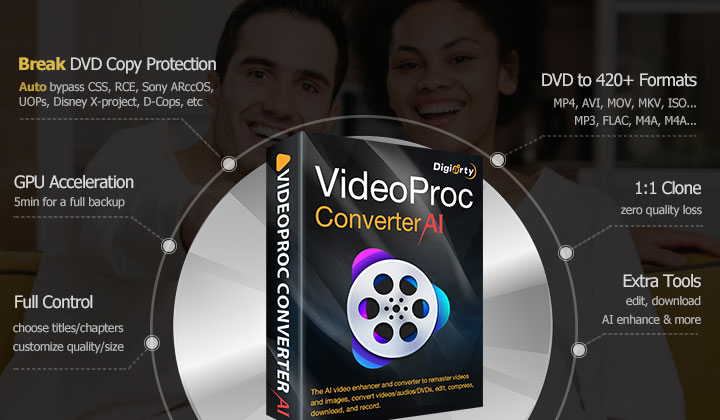
Download and install VideoProc Converter AI on Windows or Mac, then follow these steps to bypass DVD copy protection.
Step 1. Import the Copy Protected DVD.
Download and install this DVD copy protection removal software on your Windows or Mac. Launch it up, choose DVD to enter the DVD ripping panel. Hit Disc to open up the Select the source disc panel. VideoProc Converter AI will auto recognize the installed DVD. Next, you hit Done.
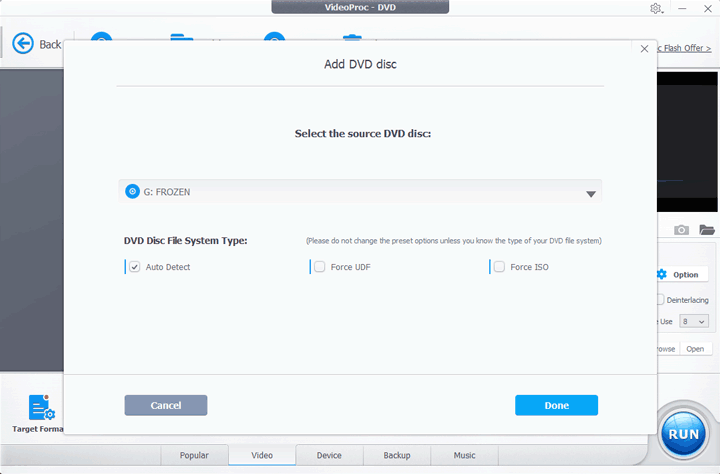
Step 2. Choose the Output Format.
Navigate to the Target Format panel to pick up MP4, MKV, AVI, MOV, or any other digital format as the wanted output format. You can also hit the Backup button to get options like ISO, VIDEO_TS, Main Copy, and Title Copy, etc.
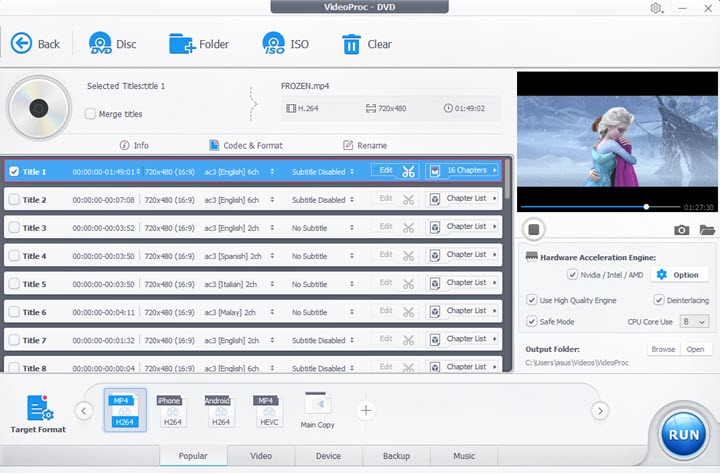
Step 3. Remove Copy Protection from DVD.
Hit RUN to start removing the copy protection from DVD. To remove strong DVD encryption, simple select Safe Mode.
Learn More about the DVD Converter in VideoProc Converter AI
Pros:
- Automatic DVD handling without third-party decryption libraries
- support for multiple digital formats and backup options
- hardware-accelerated conversion
- main-title detection worked on all five DVDs in my test.
Cons:
- The free trial has conversion restrictions
- a paid license is required for full-length ripping and other full features.
My Real-World Hands-on Tips:
Use Safe Mode for stubborn discs: On a few heavily scratched or tricky DVDs, I found the software would sometimes stall during processing. Enabling "Safe Mode" in the bottom-right helped it get past bad sectors and problematic structures more smoothly.
Check hardware acceleration: Before starting the rip, it's worth making sure the hardware acceleration option is enabled on the right panel. Without it, everything falls back to CPU, and the process takes noticeably longer.
Method 2. Remove DVD Copy Protection with HandBrake Libdvdcss
- Operating systems: Windows 11, Windows 10 (deprecated), recent macOS versions, and Linux. Check the official system requirements for version-specific compatibility.
- Best for: Free DVD-to-MP4/MKV conversion, particularly unprotected DVDs and some CSS-protected discs with libdvdcss.
HandBrake is a free, open-source video transcoder that converts DVDs to MP4, MKV, and WebM. As stated in its official documentation, HandBrake doesn't bypass DVD copy protection on its own. However, pairing it with the third-party libdvdcss library can help it read and rip some CSS-protected DVDs.
This makes HandBrake + libdvdcss a practical free option for basic DVD copy protection removal, though it remains less reliable with more complex protections. In my tests, it successfully handled some protected DVDs but failed to complete the conversion on others, even when the discs could be scanned and previewed normally. Here's how to set it up and rip a DVD with HandBrake and libdvdcss.
Step 1. Install HandBrake
Download the latest compatible version from the official HandBrake website and install it on your Windows PC or Mac.
Step 2. Install libdvdcss
For Windows users:
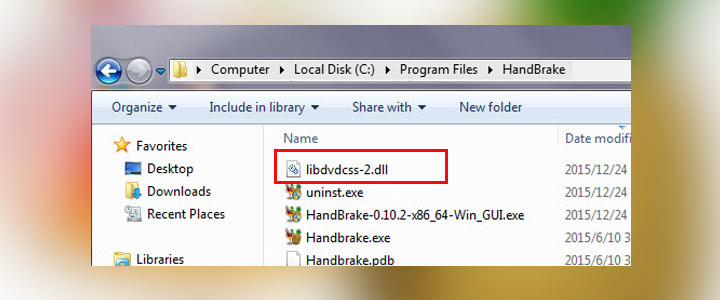
Download the appropriate 32-bit or 64-bit libdvdcss.dll file. See our HandBrake libdvdcss guide for details.
Copy the DLL into your HandBrake installation folder, typically C:\Program Files\HandBrake for a standard installation. Restart HandBrake to see whether it can access your CSS-protected DVD.
Note: libdvdcss is not an official HandBrake component. Download DLL files only from sources you trust, and make sure the architecture matches your installation. Compatibility is not guaranteed across HandBrake versions.
For Mac users:
You can install libdvdcss using Homebrew:
Install Homebrew if it isn't already available on your Mac. Open Terminal and run: brew install libdvdcss. Restart HandBrake and try opening your DVD again.
Note: Installing libdvdcss doesn't guarantee that HandBrake will recognize or use it, particularly with newer versions of macOS or HandBrake. See our detailed libdvdcss guide for additional troubleshooting.
Step 3. Import the DVD
Insert your DVD into the optical drive and launch HandBrake. Select the DVD from the Source Selection window and allow HandBrake to scan it. If the scan succeeds, check whether the correct movie title, duration, chapters, and audio tracks have been detected.
Important: A successful scan or preview doesn't necessarily mean the DVD can be ripped successfully, especially if it uses more complex copy protection.
Step 4. Choose the Output Format and Settings
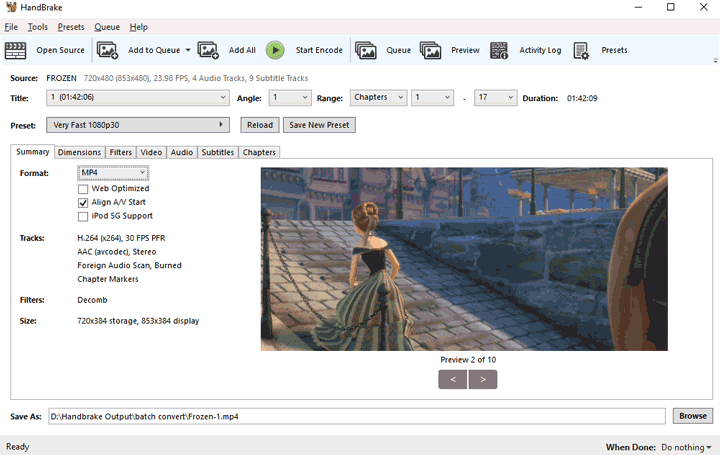
Select an encoding preset that suits your needs, then choose MP4, MKV, or WebM as the output format. You can also adjust the video quality, audio tracks, subtitles, and other settings using the corresponding tabs.
Step 5. Start Ripping the DVD
Click Browse to select the output destination, then hit Start Encode to begin converting the DVD. Once the process finishes, play the output file to check its duration, video, audio, and subtitles. If encoding stops unexpectedly or produces only a tiny file, HandBrake may have failed to process the DVD correctly.
Pros:
- Completely free and open-source, with no watermarks or paid feature restrictions.
- Supports MP4, MKV, and WebM, with flexible encoding options such as H.264, H.265, and AV1.
- Offers extensive presets and controls for video quality, audio, and subtitles.
- Supports batch encoding and hardware-accelerated encoding on compatible systems.
Cons:
- Cannot bypass DVD copy protection natively; accessing some CSS-protected DVDs requires additional components such as libdvdcss.
- May scan or preview a protected DVD successfully but fail during the actual ripping process.
- Limited compatibility with more complex DVD protection schemes, even with libdvdcss installed.
- Cannot create lossless ISO or VIDEO_TS backups; video is always re-encoded.
Real-World Tips from My Testing:
Without libdvdcss, protected DVDs may fail in different ways: Some DVDs weren't recognized properly, while others could be scanned and previewed but stopped encoding after just a few seconds. Installing libdvdcss improved compatibility with some discs, but didn't resolve every issue.
A successful DVD scan doesn't guarantee a successful rip: With libdvdcss installed, HandBrake could read and scan a Sony movie DVD in my test, but the conversion failed and left an output file of only a few KB. The exact protection scheme wasn't verified, so I couldn't attribute the failure to a specific DRM type.
Try MakeMKV when HandBrake fails: For some DVDs that HandBrake couldn't process directly, I used MakeMKV to create an MKV file first, then imported it into HandBrake for MP4 conversion. This avoided further troubleshooting of the original disc in HandBrake.
Method 3. Remove Copy Protection from DVD with MakeMKV
- Operating systems: Windows XP or later (x86/x64); macOS 10.7 or later (x64/ARM64); Linux.
- Best for: Free, lossless DVD decryption and backup to MKV.
MakeMKV is a free DVD decrypter and MKV converter that can rip many copy-protected DVDs without re-encoding the video or audio. Unlike traditional DVD converters, it preserves the original video quality, audio tracks, subtitles, and chapters, making it a good choice for lossless DVD backups.
DVD ripping with MakeMKV is free, even outside its beta period. Blu-ray decryption, on the other hand, is a shareware feature currently available for free during beta with a valid beta key. The main trade-off is that MakeMKV only outputs MKV files, which can take up considerable storage space.
Step 1. Download and Install MakeMKV
Download the latest version from the official MakeMKV website. Install and launch the program. No paid license is required for DVD ripping. If you also want to use its Blu-ray features beyond the trial period, check the official beta key thread for the current registration key.
Step 2. Import the Copy-Protected DVD
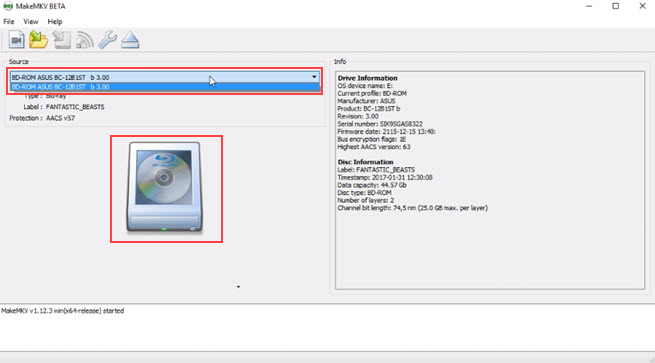
Insert your DVD into the optical drive and open MakeMKV. Click the large optical drive icon to scan the disc and display its available titles.
Step 3. Select the Movie and Tracks
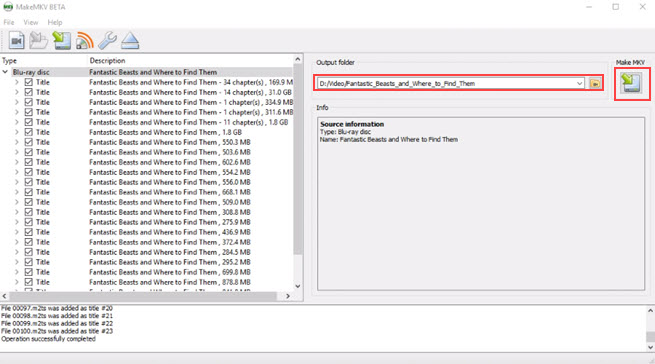
Choose the main movie title and select the audio tracks and subtitles you want to keep. MakeMKV allows you to preserve multiple audio and subtitle tracks without re-encoding.
Step 4. Rip the DVD to MKV
Choose an output folder, then click Make MKV to start ripping. MakeMKV will extract the selected content into an unencrypted MKV file without altering the original video or audio streams.
Pros:
- Free DVD ripping, with no paid license required.
- Preserves original video and audio quality without re-encoding.
- Retains multiple audio tracks, subtitles, and chapter information.
- Supports many protected DVDs without additional decryption libraries.
Cons:
- MKV-only output; requires another converter for MP4 or other formats.
- Large output files, often several GB for a full-length DVD.
- Limited video customization, with no built-in compression or enhancement during ripping.
Real-World Tips from My Testing:
Watch out for FAT32 storage limits: I ran into problems when saving a large MKV file to an older external drive formatted as FAT32. Since FAT32 has a 4 GB maximum file size, use NTFS or exFAT when saving large DVD backups.
Use MakeMKV with HandBrake for smaller MP4 files: If you need MP4 instead of a large MKV file, first rip the DVD with MakeMKV, then import the resulting MKV into HandBrake for compression and conversion. This also worked as a useful alternative when HandBrake couldn't process certain protected DVDs directly.
Beta key tip: If you use MakeMKV for Blu-ray ripping, the official MakeMKV forum provides beta registration keys. These may expire and need to be updated. DVD ripping itself remains free.
Method 4. Remove Copy Protection from Older DVDs with DVD Shrink
- Operating system: Windows; DVD Shrink is an older, discontinued application.
- Best for: Backing up older DVDs and compressing DVD9 content to fit a DVD5 disc.
If you're digitizing a DVD collection from the late '90s or early 2000s, DVD Shrink is still a useful option for removing basic DVD copy protection and creating smaller backups. It can decrypt CSS-protected DVDs and compress a dual-layer DVD9 (8.5 GB) to fit onto a single-layer DVD5 (4.7 GB). However, DVD Shrink hasn't been updated since 2004, leaving it with limited support for newer DVD protection schemes.
⚠️ Heads Up on Compatibility
In my testing, DVD Shrink handled some older DVDs without issues, but failed to process a DVD released in 2016. With more complex DVD structures or protections, you may encounter errors such as "Invalid File Structure" or "CRC Error". If you're working with a more recent commercial DVD, a regularly updated DVD ripper may be a more reliable option.
Step 1. Download and Install DVD Shrink
Visit the official DVD Shrink site to download and install the latest stable version (3.2.0.15 for English, 3.2.0.16 for German) on your Windows PC. Give it a caution that Versions with additional words like DVD Shrink 2014 or newer are likely scams.
Step 2. Add the Copy Protected DVD
Insert the DVD into your computer's disc drive. Click Open Disc and select the DVD you just inserted as the source. DVD Shrink will analyze the disc, and once complete, you'll see the DVD structure on the upper left: Menus, Main Movie, and Extras.

Step 3. Specify Compression Settings
Navigate to the Compression Settings section and select your preferred compression ratio. If you want to compress the content in the copy-protected DVDs to fit on a DVD5 disc, then choose Automatic. By default, all audio tracks and subtitles are selected. You can uncheck any tracks you do not need to make the output file smaller in size.
Step 4. Remove Copy Protection from DVD
Go to the top center to locate and click Backup. Select the backup target and target folder of the DVD output files. Click OK to start removing copy protection from DVD via DVD Shrink.

Pros:
- 100% free with great compression and re-authoring controls.
- Successfully bypasses basic CSS, User Operation Prohibitions (UOPs), and Region Codes on older discs.
Cons:
- Fails completely on modern ARccOS and Disney 99-title copy protections due to the lack of updates since 2004.
- No native macOS version.
- My Real-World Hands-on Tips:
Real-World Tips from My Testing:
Best for older DVDs: DVD Shrink worked well with some older discs in my tests, particularly for basic DVD backup and DVD9-to-DVD5 compression.
Even a 2016 DVD failed: When I tested a DVD released in 2016, DVD Shrink returned an error and couldn't complete the backup. This shows that its compatibility limitations aren't restricted to the latest DVD releases.
Avoid unofficial updated versions: DVD Shrink hasn't received an official update since 2004. Be cautious of downloads advertised as newer editions or requiring unexpected payments.
Method 5. Remove Basic DVD Copy Protection with VLC
- Operating systems: Microsoft Windows XP SP3 and above, Mac OS X Lion (version 10.7.5) and above, etc.
- Best for: Free DVD playback and basic conversion of some CSS-protected DVDs.
VLC media player is a free, open-source media player that can also convert DVDs to digital video files. With its DVD-reading capabilities, VLC can handle some basic CSS-protected DVDs, making it a convenient option for occasional DVD ripping without installing a dedicated DVD ripper.
However, VLC is primarily a media player, not a full-featured DVD decrypter. Its compatibility with complex DVD protections is limited, and successfully converting a disc doesn't always guarantee a complete, usable output. In my tests, VLC could process some protected DVDs, but audio and subtitle tracks were not always preserved correctly.
Step 1. Download and Install VLC
Download the latest stable version of VLC media player from the official VideoLAN website and install it on your computer.
Step 2. Load Your DVD
Insert your DVD into the optical drive and launch VLC. On Windows, go to Media > Convert / Save, open the Disc tab, and select DVD. Under Disc Device, choose the drive containing your DVD.
Step 3. Select the DVD Content
Check No disc menus if you want to skip DVD menus during conversion. You can also specify the title, chapter, audio track, and subtitle track where the corresponding options are available. Make sure you've selected the correct content before proceeding, as VLC doesn't always handle multiple DVD titles and tracks reliably during conversion.
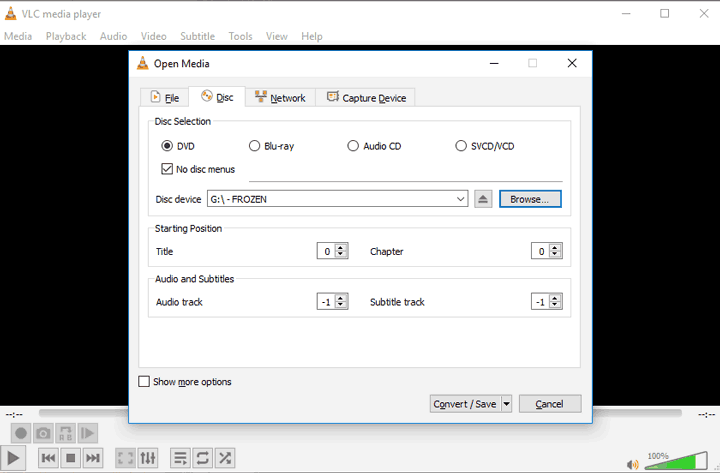
Step 4. Convert the DVD to a Digital File
Click Convert / Save, choose an output profile such as Video - H.264 + MP3 (MP4), and specify the destination file. Click Start to begin converting the DVD. VLC will read and encode the selected content into the chosen format.
Important: After conversion, check the output file for video playback, audio, and subtitles. In my tests, some conversions completed but the resulting files were missing selected audio or subtitle tracks.
Pros:
- Completely free and open-source, with no paid features.
- Available for Windows, macOS, and Linux.
- Can handle some basic CSS-protected DVDs and convert them to common video formats.
- Useful for occasional DVD conversion without installing additional ripping software.
Cons:
- Limited support for complex DVD copy protection schemes.
- DVD ripping can be slow and less reliable than with dedicated DVD rippers.
- Audio or subtitle tracks may be missing from the output, even when selected correctly.
- DVD title and track selection can be confusing for beginners.
Real-World Tips from My Testing:
Don't rely on the track settings alone: VLC was able to process some CSS-protected DVDs in my tests, but the results weren't consistent. Even after I selected the desired audio and subtitle tracks, the exported files sometimes lacked those tracks. I checked community discussions but couldn't find a consistently reliable solution. If preserving multiple audio tracks and subtitles is important, a dedicated DVD ripper may be a better choice.
Skip DVD menus to avoid conversion issues: VLC sometimes got stuck processing DVD menus instead of the main movie. Enabling No disc menus helped avoid this problem in my tests.
Always verify the final output: A completed conversion doesn't necessarily mean everything was copied correctly. Check the movie's duration, audio, and subtitles before deleting or archiving any source files.
8 Common DVD Copy Protection Types Explained
Commercial DVDs can come with different types of copy protection, such as CSS, region codes, Sony ARccOS, and Disney's 99-title protection. Knowing how these protections work can help you understand why some DVDs are harder to rip than others.
1. CSS (Content Scramble System)
CSS, introduced in 1996, is one of the most widely used copy protection systems for commercial DVDs. It uses a 40-bit stream cipher to encrypt DVD video data and prevent unauthorized copying.
CSS works with a set of encryption keys, including player keys, disc keys, and title keys. Licensed DVD players use these keys to decrypt the content during playback. Without the necessary decryption support, simply copying the DVD's VOB files to a computer won't produce usable, unencrypted video.
2. DVD Region Code
DVD region coding was introduced to let movie studios control DVD distribution and release schedules across different geographical markets.There are six main DVD regions. For example, Region 1 covers the United States and Canada, while Region 2 includes Japan, Europe, and several other markets. A DVD marked for one region may not play on a DVD player or computer drive configured for another.
Region codes aren't a form of video encryption like CSS. They restrict where a DVD can be played rather than encrypting the movie content itself.

3. RCE (Region Code Enhanced)
Region Code Enhanced (RCE) was designed to prevent certain region-free DVD players from playing region-restricted discs. It uses DVD navigation commands to check the player's region configuration during playback and can block playback if the expected region settings aren't detected.
4. UOPs (User Operation Prohibitions)
UOPs are restrictions built into a DVD's navigation data to control what viewers can do during playback. They can prevent users from skipping copyright warnings, fast-forwarding through advertisements, or changing audio and subtitle tracks in certain sections of the DVD.
5. Sony ARccOS
Sony ARccOS is a DVD copy protection system developed by Sony. It works by adding deliberately corrupted sectors to the DVD, usually in areas that regular DVD players are instructed to skip during playback. DVD ripping software that attempts to read these sectors may encounter repeated read errors, get stuck during scanning, or fail to copy the disc. ARccOS is commonly used alongside CSS encryption to provide additional copy protection.
6. APS (Analog Protection System)
APS, also known as Macrovision analog copy protection, was developed to interfere with analog video recording, particularly DVD-to-VHS copying. It works by modifying the analog video output signal, including pulses that interfere with a recording device's Automatic Gain Control (AGC) circuitry. A recording made through the affected analog connection may show unstable brightness, distorted colors, or other picture problems. It doesn't encrypt the digital video stored on the DVD. Its protection takes effect when the video is sent through an analog output.
7. RipGuard
RipGuard is a DVD copy protection technology developed by Macrovision. Like Sony ARccOS, it uses deliberately problematic sectors and DVD structures to interfere with copying software. These sectors are placed outside the normal playback path, so compatible DVD players can generally play the movie without accessing them. DVD copying programs that attempt to read the entire disc, including unused or deliberately corrupted areas, can encounter errors or spend excessive time trying to read them.
8. Disney X-Project (99-Title Protection)
Disney X-Project is a DVD copy protection system associated with Disney movie releases. It can combine structural protection with misleading DVD title information, making it difficult for ripping software to identify the actual main movie. One well-known characteristic is the appearance of dozens of titles, sometimes as many as 99. Some ripping programs may report a total content size far beyond the physical capacity of the DVD because they count multiple overlapping or misleading titles.
Choosing the wrong title can result in missing scenes, incorrect playback order, repeated segments, or an incomplete movie. The number of titles alone, however, isn't enough to confirm that a DVD uses Disney X-Project protection.
FAQs About DVD Copy Protection Removal
1. Can You Remove DVD Copy Protection for Free?
Yes. MakeMKV offers free DVD ripping and can save many protected DVDs as MKV files without re-encoding. HandBrake with libdvdcss is another option for some CSS-protected DVDs, though it has more limited decryption capabilities. DVD Shrink and VLC can also handle certain older or less complex DVDs.
2. Can HandBrake Remove DVD Copy Protection?
HandBrake doesn't support DVD decryption on its own. Installing libdvdcss can help it read some CSS-protected discs, but it isn't a reliable solution for all commercial DVDs. In my tests, HandBrake could scan and preview certain DVDs but failed to complete the conversion.
3. Why Can't I Rip a Copy-Protected DVD?
Common reasons include unsupported encryption, deliberately corrupted sectors, misleading movie titles, and physical disc damage. A DVD may play normally but fail during ripping because the software attempts to read areas that the DVD player skips. If your ripper reports read errors, stops unexpectedly, or produces an incomplete file, check the disc's condition and try a tool with better support for commercial DVD structures.
4. Does DVD Shrink Still Remove DVD Copy Protection?
Yes, but mainly on older DVDs with basic protections such as CSS. DVD Shrink hasn't been updated since 2004, so its decryption capabilities are limited. In my testing, it handled some older DVDs but failed on a DVD released in 2016.
5. What Is the Best Software for Removing DVD Copy Protection?
Based on my tests, VideoProc Converter AI offered the most reliable experience among the five tools reviewed. It successfully ripped all five DVDs I tested, correctly identified the main movie titles, and preserved my selected audio and subtitle tracks. For free, lossless DVD-to-MKV backups, MakeMKV is also a strong choice.