
 New AI features are available
 Listed in
 Whether you're trying to fit a 720p clip onto a larger screen or use it in a 1080p project, simply increasing the resolution rarely improves how the video actually looks. In many cases, it just stretches the image, making it appear softer or even more pixelated.
That's because video resolution converters don't add real detail — they only resize what's already there. So while the output may say "1080p", the visual quality often stays the same or gets worse.
The good news is that not all methods work this way. Some newer approaches, especially AI-based upscaling, can go beyond simple resizing and actually improve clarity. We have tested and rounded up 4 feasible ways to convert 720p to 1080p without quality loss. Below, we'll walk through a few practical options and explain which ones are worth using depending on your needs.
1. How to Convert 720p to 1080p in VideoProc Converter AI
VideoProc Converter AI is a practical option if you're looking for a noticeable improvement rather than just a resolution change. Instead of simply enlarging a 720p video, it uses AI-based super resolution to enhance textures, reduce noise, and recover details that are often lost in low-resolution footage. In real-world tests, AI-based upscaling produces noticeably sharper results compared to traditional resizing methods, especially for older videos, compressed clips, or content recorded on lower-end devices. In practice, the result isn't just a "bigger" video - it's a cleaner and more refined one that holds up better on modern screens.
VideoProc specializes in changing video resolution and enhancing video quality up to 4K. With four advanced AI Super Resolution models trained with millions of data, it can upscale 720p videos and images to HD and UHD 4K, ensuring the highest visual quality. Additionally, it can fix common video issues, e.g. noise, blurriness, pixelation, and shakiness using AI Super Resolution, AI Frame Interpolation, and AI Stabilization.
Meanwhile, it has a full set of video dimensions and aspect ratio settings to convert 720p videos to 1080p for TV, iPad, Xbox, YouTube, Vimeo, Facebook, and so forth, in the best form. Born as the best video converter, VideoProc Converter AI supports 420+ video formats and codecs, MP4, MKV, MOV, AVI, FLV, 4K, HDR, 3D, 360-degree, DVDs, etc., so you can load any video to it to process withou hassle.
Now download VideoProc Converter AI and follow the steps to upscale 720p to 1080p with best quality!

The Super Resolution feature in VideoProc can scale up your images or videos by 200%, 300%, and 400% without requiring technical skill or experience. It's a significant improvement from the original. The enhanced video is much clearer and easier to watch.
Method 1: Upscale 720p Videos with AI (Recommended)
Step 1. Run VideoProc Converter AI on your computer. Open the "Super Resolution" module in it.

Step 2. Drag and drop your 720p video to its interface. You can add multiple files at a time as well.

Step 3. Choose an AI model according to your source file:
- Real Smooth (recommended): An evolved AI model for video super resolution that delivers clearer, smoother, and more vibrant outputs. It automatically deblurs and denoises your footage.
- Gen Detail (recommended): An advanced AI model designed to enhance clarity and sharpness while faithfully preserving original details. It also features automatic deblurring and denoising.
- Anime: Specifically designed to upscale anime videos by 2x, 3x, or 4x. This model is optimized for computers with average GPU/CPU power.
- Zyxt: Ideal for upscaling real-world footage by 2x, 3x, or 4x. It is a resource-friendly option for users with standard hardware configurations.
Step 4. Under "Model Settings", find Resolution, then choose "1080P (1920 X 1080)" to upscale your 720p video to 1080p directly.
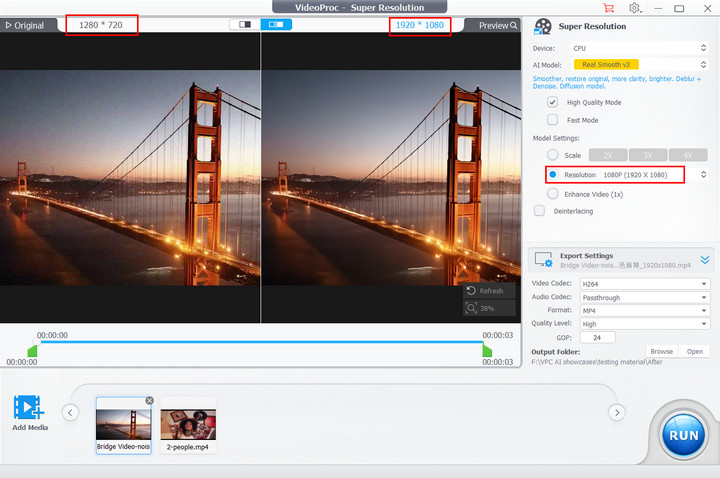
Or, you can set the Scale. Choose 2x to upscale the 720p video to 1440p.
Both options can convert the 720p video to a higher quality effectively. In Super Resolution of VideoProc Converter AI, the maximum output resolution is 4K (up to 4000×4000px).
Step 5. Browse to select an output folder. Click the "RUN" button to export.
Method 2: Convert 720p to 1080p without AI
Step 1. Open the software and click "Video Converter" on the main interface. Click "+Video" to add one or more 720 videos from your computer.
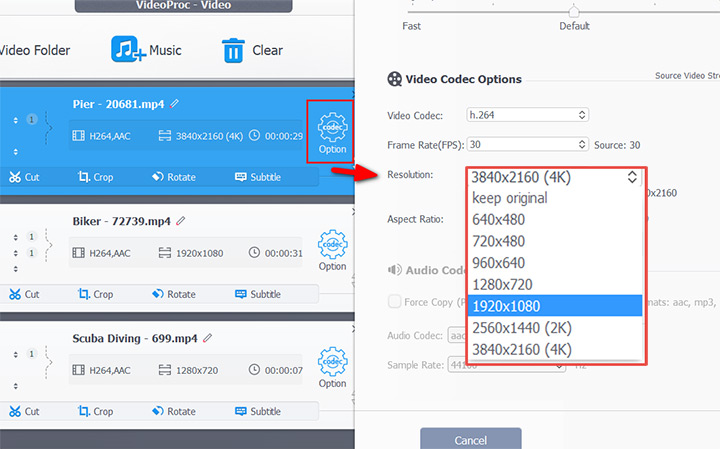
Step 2. Select an output format in "Video" at the bottom, e.g. MP4 H264. Click "Codec Option" button on the right and find Resolution under Video Codec Options. Click the drop-down menu and choose 1920x1080 or 2560x1080.
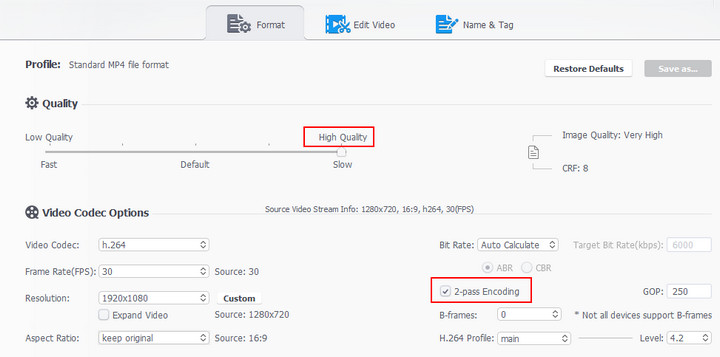
Step 3. Optionally, under "Quality", you can drag the control bar to the rightest to keep High Quality. You can also opt for "2-pass Encoding" to guarantee the high quality after encoding. But the two options will make the whole conversion process slower than normal.
Tips:
1. To convert a 720p video to 1080p with the best quality, we suggest you not make other changes of the source video, such as the format, codec, frame rate, bitrate and aspect ratio.
2. If necassary, tap Effect in the edit bar. You can apply an effect (filter), or adjust contrast, brightness, saturation and so on to make the video image look better.
Step 4. Click the "RUN" button on the bottom right and let VideoProc Converter AI start converting video to HD 1080p.
*The result also depends largely on the source video, for example, how was it shot, what the bitrates and frame rates are (which are related to quality).
 Learn More about the Resolution Upscaling Tech in VideoProc Converter AI
- AI models: VideoProc Converter AI applies the Super-Resolution Model, GAN (Generative Adversarial Network) Model, and other models to process reality videos, AI-generated videos, animations, and other common videos respectively. So the image quality and details can be enhanced during the upscaling process with the most pleasing result.
- Nearest neighbor interpolation: To sum up, it is to add and to guess. First it adds a heap of "blank" pixels to an image, and tries to guess what each blank pixel should be filled with based on its 4 adjacent pixels.
- Bicubic interpolation: It is to add pixels to an image and take on a color based on the 16 nearby pixels. The main purpose is to smooth the color and make the added pixels look as soft as possible.
- Bilinear interpolation: Differently, it only checks the two neighboring blocks. The main purpose is to make the image look sharp.
2. How to Convert 720p to 1080p Online
If you prefer not to install any software, online video converters can be a convenient alternative. Tools like HDconvert allow you to upscale videos directly in your browser, making them a quick option for simple tasks or one-time use.
However, it's important to understand that most online converters focus on resizing rather than enhancing. This means the output may meet the 1080p format requirement, but the actual visual quality often doesn’t improve significantly.
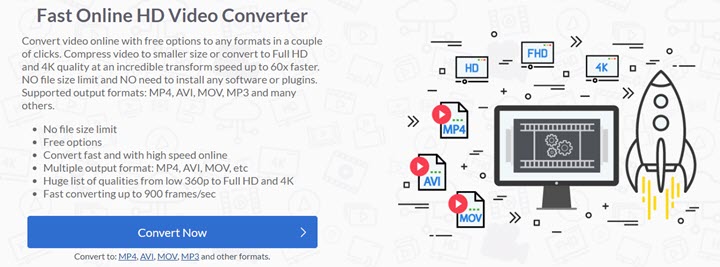
How to use HDconvert:
Step 1. Go to the HDconvert website and choose to convert a file.
Step 2. Upload your video and select the output format (e.g., MP4).
Step 3. Choose 1080p as the target resolution (note: this option requires a premium plan).
Step 4. Start the conversion and download the file once it’s ready (the download link may expire after a limited time).
Limitations of online converters:
- No real quality enhancement: Most tools simply upscale resolution without improving detail.
- Free version restrictions: 1080p output and watermark removal often require payment.
- Slower processing: Without GPU acceleration, large files can take significantly longer to process.
- Upload/download required: Not ideal for large or sensitive video files.
3. How to Convert 720p to 1080p Free with HandBrake
If you're looking for a completely free solution, HandBrake is a widely used open-source video converter. It allows you to manually change video resolution, making it possible to convert a 720p video into a 1080p file.
However, it's important to understand that HandBrake does not enhance video quality. It simply resizes the video by stretching the original pixels, which means the output may appear no sharper than the source - and sometimes even slightly softer.
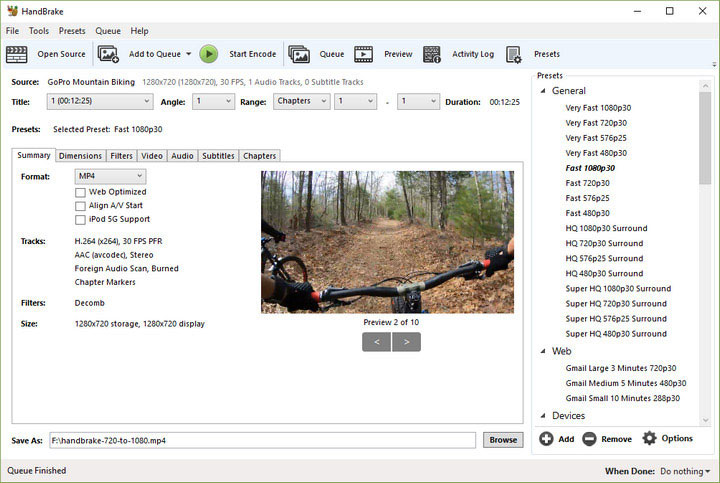
How to use HandBrake:
Step 1. Download and install HandBrake from its official website.
Step 2. Open the program and import your 720p video.
Step 3. Go to the Dimensions tab and manually change the resolution from 1280×720 to 1920×1080.
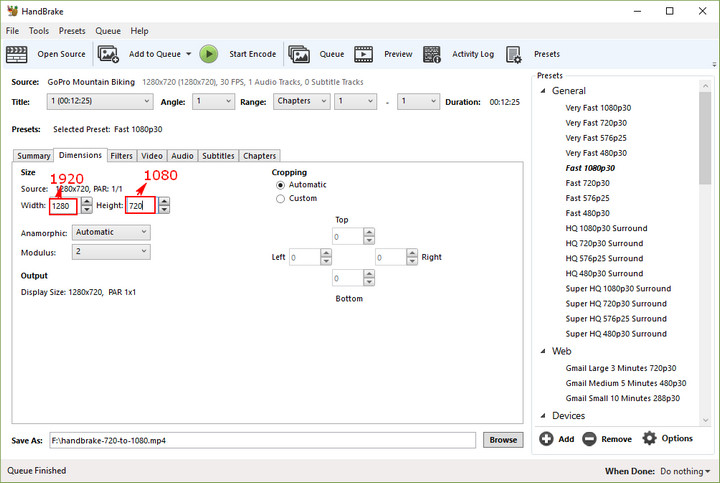
Step 4. Choose the output location and file name.
Step 5. Start encoding to export the 1080p video.
Limitations of this method:
- No real quality improvement: The video is resized, not enhanced, so details remain the same.
- Time-consuming: Encoding can take longer, especially for large files.
- Limited formats: Output options are mainly MP4 and MKV.
4. How to Convert 720p to 1080p in Adobe Premiere
For users already working in professional editing software like Adobe Premiere Pro, upscaling can be done directly within the project workflow. This makes it a convenient option when you’re editing and exporting videos in one place.
However, Premiere Pro is not designed specifically for video enhancement. Its built-in scaling relies on standard interpolation, which resizes the image but does not significantly improve detail or clarity. As a result, the upscaled video may still look soft, especially when viewed on larger screens.
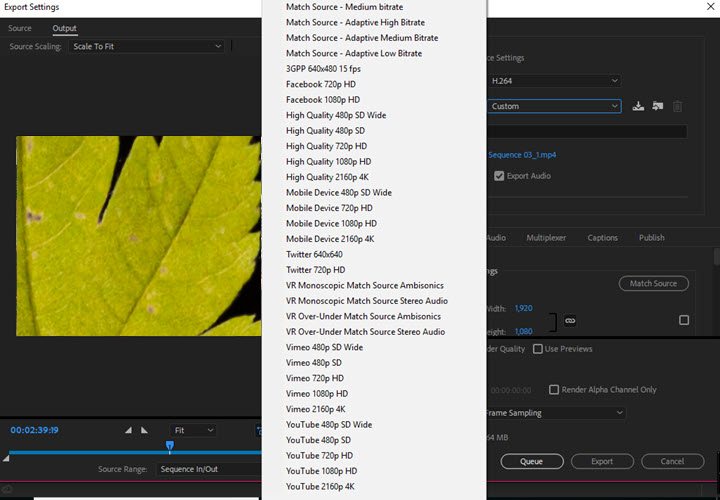
How to upscale in Premiere Pro:
Step 1. Create a new project and set up a 1080p sequence (e.g., 1920×1080, matching your source frame rate).
Step 2. Import your 720p video and drag it onto the timeline.
Step 3. Right-click the clip and select “Set to Frame Size” or adjust scaling manually.
Step 4. Apply additional edits if needed, then export the video in 1080p.
Limitations of this method:
- No true detail enhancement: Scaling increases resolution but does not recover lost details.
- May appear soft or slightly blurry: Especially noticeable on larger or high-resolution displays.
- Not optimized for upscaling: Designed for editing workflows rather than quality restoration.
Quick Comparison: 720p to 1080p Conversion Methods
| Method | Quality Improvement | Ease of Use | Speed | Best For |
|---|---|---|---|---|
| AI Video Upscaling (VideoProc Converter AI) | ★★★★★ (Best – enhances details) | Easy | Fast (GPU accelerated) | Best overall quality improvement |
| Online Converters (HDconvert) | ★★☆☆☆ (No real enhancement) | Very Easy | Medium | Quick format conversion |
| HandBrake | ★★☆☆☆ (Resizing only) | Moderate | Slow | Free desktop conversion |
| Adobe Premiere Pro | ★★★☆☆ (Basic interpolation) | Advanced | Medium | Professional editing workflow |
Which Method Should You Choose
Different tools serve different purposes, so the best choice depends on your goal:
- For best visual quality improvement: AI-based tools like VideoProc Converter AI are the most effective, as they can enhance details instead of just resizing.
- For quick and simple online use: Online converters are convenient but mainly suitable for basic format conversion.
- For free desktop editing: HandBrake works well if you only need format or resolution adjustment without quality enhancement.
- For professional editing workflows: Adobe Premiere Pro is ideal for editing, but not optimized for improving video clarity.
Frequently Asked Questions
Can You Convert 720p to 1080p Without Losing Quality?
Yes, but the results depend entirely on the method you use. Traditional converters (like HandBrake or Premiere Pro) only resize the video, which means the output remains visually similar or slightly softer. Online tools offer convenience, but they usually do not improve actual video detail. If you want a noticeable improvement in clarity, AI-based upscaling tools are the only option that can reconstruct missing details rather than just stretching pixels.
Can I convert 720p to 1080p in iMovie?
No. To edit a video easily on Mac, iMovie is the best free choice. But it does not allow you to export a 720p file into a 1080p one or higher. If you import a 720p video, the 1080p and 4K options will be grayed out.
How do I change from 480p to 1080p?
The way of changing from 480p to 1080p is similar to from converting 720p to 1080p. But please note that the bigger gap between the resolutions of source and final video files, the more pixels will be added and more guess works will be needed. It means the output image quality will then not as expected.