
 New AI features are available
 Listed in
 Copying a DVD to your computer means different things depending on the type of disc and your usage. For an unprotected DVD, you can simply copy its files, such as the VIDEO_TS folder, to your computer. If you want to turn the DVD, especially copy-protected DVD, into an easy-to-play digital video like MP4 or MKV, you'll need DVD ripping software instead. For a full backup that preserves the DVD structure, an ISO image or DVD folder is a better choice.
In this guide, we'll show you 6 ways to copy a DVD to a computer on Windows 11/10 and Mac, including free methods and dedicated DVD rippers. You'll also learn which method and output format to choose for different needs, how to deal with copy-protected DVDs where applicable, and what to do if your computer doesn't have a built-in DVD drive.
Which DVD Copy Method Should You Choose
| Method | Best for | Free? | Output Formats | Why Choose |
|---|---|---|---|---|
| All-around DVD copying, conversion, and processing | Free trial & paid |
420+ video/audio formats, ISO, VIDEO_TS folder, presets for popular devices |
Professional & fast: 5-minute fast copy, full GPU acceleration; lossless ISO copy; All-in-one & budget-friendly |
|
WinX DVD Ripper Platinum |
Fast copy-protected DVD ripping |
Free trial & paid |
MP4, MOV, AVI, ISO, DVD folder, MP3, AAC, and the like |
A professional DVD ripping software for even copy-protected DVDs. |
MakeMKV |
Preserving original DVD quality |
Yes |
MKV |
Free and open source; lossless backup; copy protection removal |
HandBrake |
Free conversion of unprotected DVDs |
Yes |
MP4, MKV, WebM, H.264, H.265; MP3, AAC, AC3, etc. |
Free video transcoder for copying home DVDs on your computer |
VLC media player |
Basic DVD conversion and playback |
Yes |
MP4, MKV, AVI, and the like |
A free multimedia player that can handle non-protected DVD copying. |
File Explorer / Finder |
Copying unprotected DVD files without software |
Yes |
Limited: VIDEO_TS folder (VOB files) |
Copy unprotected DVD content (VIDEO_TS folder or VOB files) to your computer. |
To ensure practical and reproducible results, all methods in this guide were tested on a Windows PC equipped with a built-in DVD-ROM drive.
For encrypted disc testing, we used a commercially purchased, copy-protected movie DVD (CSS-encrypted) to evaluate how each method handles protected content. All ripping tests were performed using default settings unless otherwise specified.
Below, we'll walk you through each method step by step, starting with the easiest all-around option.
How to Copy a DVD to Your Computer with VideoProc Converter AI
Best for: all-around DVD copying, conversion, and processing; one-stop toolkit
VideoProc Converter AI is all-in-one AI video/image enhancer and converter that includes a dedicated DVD copying and ripping module. It can help you copy a DVD to your computer, transfer DVD content to a PC, or save a DVD as a digital copy for easier playback and storage. You can either preserve the DVD structure or rip the DVD to your computer as MP4, AVI, WMV, FLV, MPEG, MKV, MOV, ISO, and other formats. The software supports homemade and commercial DVDs, as well as NTSC and PAL discs from different regions. For DVDs with copy protection, it can handle commonly encountered protections such as CSS, Region Code, and 99-title protection, depending on the disc.
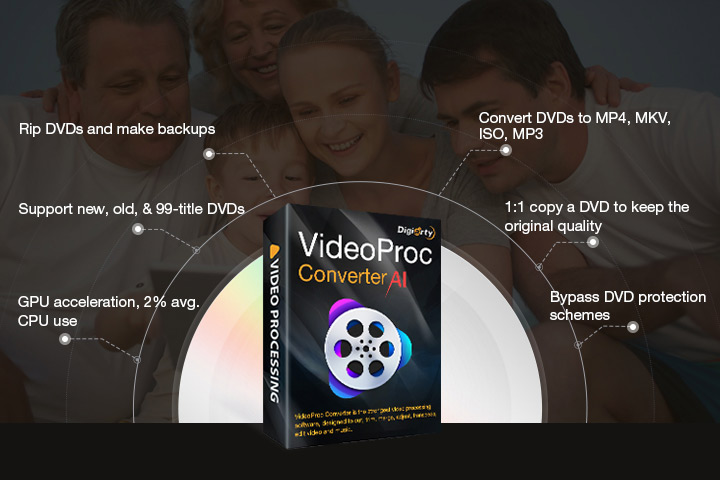
Speed is one of the edges of VideoProc Converter AI. It only needs 5 minutes or so to rip a whole movie DVD by making use of software and hardware accelerations. (But note that the conversion speed is also related to your computer conditions.)
Pros:
- All for one price: DVD ripper, video/audio converter, downloader, recorder, editor, and AI enhancer.
- 47x Fast Conversion: Leverages full GPU acceleration for significantly faster ripping speeds.
- Versatile Output Formats: Convert DVDs to MP4, MKV, AVI, ISO Image, and more, ensuring compatibility with all your devices.
- AI-Enhanced Quality: Experience AI Super Resolution to upscale old DVD footage to stunning 1080p or even 4K, breathing new life into your classics.
- Built-in Editing Tools: Trim, crop, merge, and add subtitles directly within the software.
Cons:
- It does not copy Blu-rays and CDs.
- It does not support DVD burning.
Now follow the instructions to copy a video from DVD to computer with VideoProc.
Step 1. Download VideoProc Converter AI on your Windows or Mac by clicking on either of the green buttons.

Step 2. Install and open the program. Tap DVD button and go to the VideoProc Converter AI – DVD interface.
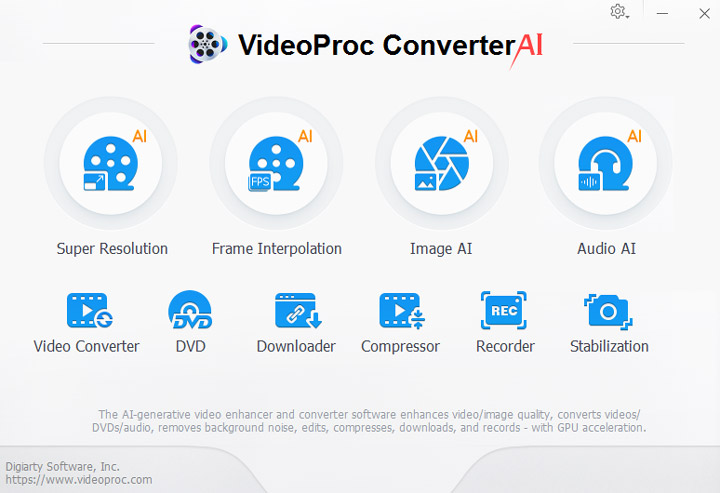
Step 3. Insert your source DVD in your DVD-ROM of your computer, and tap DVD Disc to load it. You can also add a DVD folder or a DVD ISO image file.
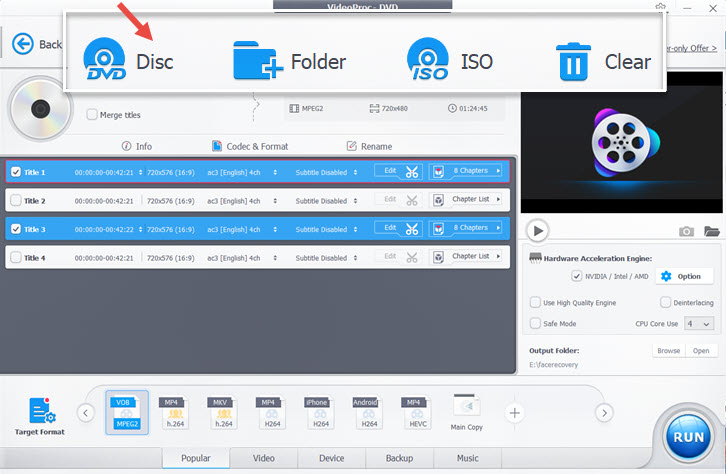
Step 4. Choose a target format listed in Popular, Video, Device, Backup or Music.
- If you want a 100% original duplicate, choose 'Backup' tab on the bottom, and you can clone the DVD to an ISO, VIDEO_TS, MKV, H264 MKV, or copy the full content of the main title, or only copy the selected video/audio/subtitle track without losing quality.
- If you need a better compatibility or smaller file size, choose a profile in Video or Device tab on the bottom, for example, MP4 H264, MP4 HEVC, MKV H264, WebM VP8, 4K, iPhone, iPad, HUAWEI, Samsung, PS4, Xbox.
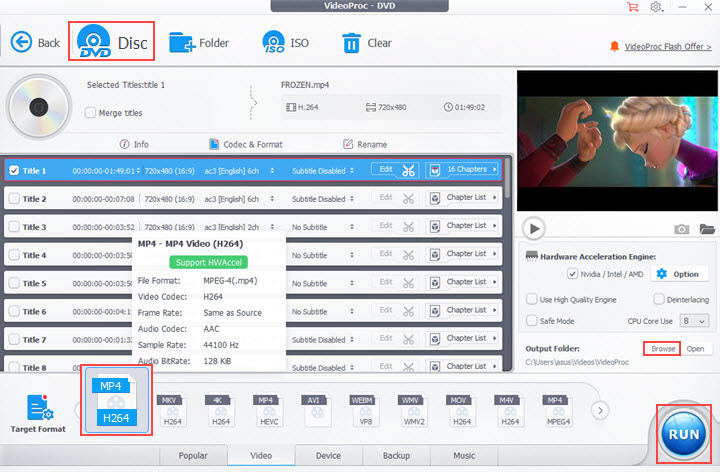
Step 5 (optional). If necessary, you can adjust the parameters in Codec & Format, customize the Name & Tag, and set media cover on the best DVD ripper.
Step 6. Run and save the DVD video to your computer.
How to Save DVD to Computer with WinX DVD Ripper Platinum
Best for: dealing with copy-protected DVDs on a PC
Like VideoProc Converter AI, WinX DVD Ripper Platinum is another brilliant way (although not a free way) to save even the copy-protected DVDs to computer without hassle.
It has 350+ profiles, so it can 1:1 copy a DVD to ISO or MPEG2, and convert a DVD to AVI, WMV, MP4, as well as iPhone, iPad, Android, Xbox, PSP, YouTube formats.
Pros:
- Broad DVD compatibility – Supports homemade discs and most commercial DVDs, including region-locked and copy-protected titles.
- Built-in decryption engine – Can handle common protections such as CSS and region codes without requiring external tools like libdvdcss.
- Multiple output formats – Converts DVDs to widely supported formats including MP4, MKV, AVI, and MOV for playback on Windows, Mac, mobile devices, and media players.
- Beginner-friendly interface – Clean layout with straightforward workflow suitable for non-technical users.
- Hardware acceleration support – Utilizes GPU acceleration (where available) to improve ripping speed and reduce CPU load.
Cons:
- Does not support CDs, Blu-rays, videos, and audio as the inputs.
- Not a versatile tool, so it does not support video conversion and editing.
Here's how you can rip a DVD to computer using WinX DVD Ripper Platinum:
Step 1. Head to the official site of WinX DVD Ripper Platinum to download and install it.
Step 2. Insert your DVD, click DVD Disc button on the interface of WinX and load the DVD content.
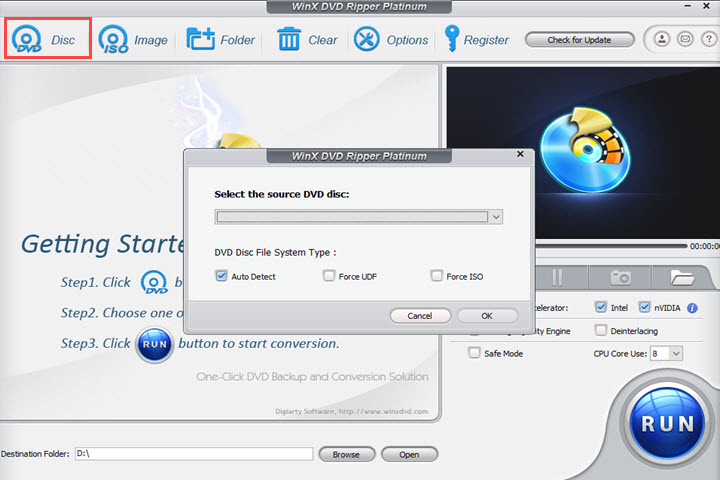
Step 3. Choose a main title to proceed. You can also choose more titles and tick Merge titles.
Step 4. Click the profile icon that is next to the gear icon, and select an output format in the Output Profile Category.
Step 5 (Optional): Tap the gear icon and set the video options or audio options to customize the output quality and file size. Click Edit button to adjust the audio volume, choose a specific subtitle track, crop the image to change the aspect ratio, or trim the video clip. Click Browse on the lower left to change the Destination Folder to save the output video file.
Step 6. Click the RUN button on the bottom right.
How to Copy a DVD to Computer with MakeMKV
Best for: preserving DVD video and audio quality in MKV
MakeMKV is a dedicated DVD and Blu-ray converter designed to extract the content of a disc into MKV files without re-encoding the video. This makes it a good and free choice when you want to copy a DVD to your computer while keeping the original video and audio streams, along with chapters, subtitles, and other track information.
Unlike tools that mainly convert DVDs to smaller MP4 files, MakeMKV focuses on preservation. After you rip a DVD to your PC, hard drive or USB, you can keep the resulting MKV files as a high-quality digital copy or compress them later with another video converter if you need smaller files. Note that MakeMKV creates MKV files for individual DVD titles rather than an exact disc clone with the original DVD menus and folder structure.
Pros:
- Lossless video extraction – Copies the video stream without re-encoding it, so the source quality is preserved.
- Keeps more than just the movie – You can retain multiple audio tracks, subtitles, chapters, and related track information in the MKV output.
- Simple workflow – Load the DVD, select the titles and tracks you want, choose an output folder, and start the MKV conversion.
- Good for long-term digital storage – MKV is more convenient to manage on a computer than a collection of DVD folders and VOB files, while retaining much of the disc's original content.
Cons:
- MKV only – MakeMKV is built around MKV output, so you'll need another tool if you want MP4 or another format with wider device compatibility.
- Larger files – Because the video is not re-encoded, the resulting MKV can still take several gigabytes for a feature-length DVD.
- Not a 1:1 DVD clone – MakeMKV extracts DVD titles into MKV files rather than preserving the original DVD menus and disc structure.
Here's how to copy a DVD to your computer with MakeMKV:
Step 1. Download the latest version of MakeMKV from its official website. Launch the program and input an MakeMKV beta license key.
Make sure your computer has a DVD drive or an external USB DVD drive.
Step 2. Insert the DVD into the drive. On the main screen, select the optical drive containing your disc and click the disc icon to open it. MakeMKV will scan the DVD and display its available titles.
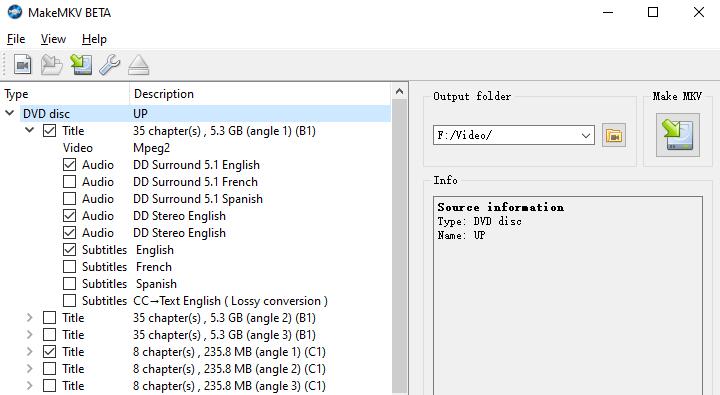
Step 3. Review the titles and expand the one you want to save. For a movie DVD, the main feature is usually the longest title, while shorter titles may contain trailers, extras, or other clips. Select the video, audio, subtitle, and chapter tracks you want to keep.
Step 4. Click the folder icon to choose where you want to save the DVD to your computer. MakeMKV will create an MKV file for each selected title, so make sure the destination has enough free space.
Step 5. Click Make MKV to start ripping the DVD. Since MakeMKV does not re-encode the video, the process mainly depends on how quickly your optical drive can read the disc. When finished, open the destination folder and play the MKV file with a compatible media player.
Tip: If your goal is to make the DVD files significantly smaller or convert them to MP4, use HandBrake or another video converter to encode the resulting MKV after the initial rip. This two-step workflow lets you preserve the original DVD source first and decide on compression later.
How to Rip a DVD to a Computer Free with HandBrake
Best for: ripping homemade DVDs to a Mac for free
Everyone likes freebies! HandBrake is a well-known free DVD and video transcoding software application developed in 2003.
HandBrake is a popular, free, and open-source video transcoder perfect for copying homemade DVDs to your computer, particularly favored by Mac users. It offers great flexibility for customizing output settings.
The interface is old, but it does not hamper the common DVD copy work. If you plan to rip your homemade DVDs, HandBrake would be the best free option. But if you have a lot of movie DVDs to back up, I recommend you to turn to other options.
Pros:
- Free and open-source – Completely free, with active community development.
- High-quality encoding – Supports modern codecs including H.264, H.265 (HEVC), AV1, and VP9.
- Cross-platform – Available on Windows, macOS, and Linux.
- Best for homemade DVDs – Works reliably with non-encrypted and self-authored discs.
Cons:
- Limited DRM Support: HandBrake does not natively support encrypted commercial DVDs. Ripping protected discs requires installing additional third-party libraries (like libdvdcss), which adds complexity and potential legal grey areas.
- No Direct Disc Cloning: Unlike dedicated DVD rippers, HandBrake focuses on DVD ripping (that would compress the video) and doesn't offer direct options for creating exact 1:1 copies of your DVDs.
- Steeper Learning Curve: Its extensive settings can be overwhelming for beginners.
- Mac computer has schemes (System Integrity Protection) to make your installing of libdvdcss harder.
Steps on how to rip a non-copy protected DVD on Mac:
Step 1. Go to the homepage of HandBrake and get the software and launch it.
Step 2. Insert a disc in your optical drive of computer, and wait until HandBrake reads the DVD and scan the titles.
Step 3. Select a DVD title in the Title menu to copy and Add to Queue.
Step 4. Choose an option in the Presets. If you don't know which one to choose, we suggest you choose MP4 (H264) that has a good compatibility and 480p that would be enough for the output DVD video quality.

Step 5 (optional). Set Dimensions, Filters, tweak parameters like codec, FPS and Bitrate, specify audio track, customize subtitles and more.
Step 6. Click Start and let HandBrake copy your selected DVD titles to the computer.
How to Copy DVD to Computer with VLC Media Player
Best for: converting and copying a DVD in Windows 10 easily
VLC media player provides you with a straightforward and free way to copy and transfer a DVD to computer.
Pros:
- Free and open-source – Completely free with no ads or bundled software.
- Basic decryption support – May read some CSS-protected DVDs, depending on system configuration.
- Cross-platform compatibility – Available on Windows, macOS, and Linux.
- Lightweight and widely trusted – Well-established media player with a long development history.
Cons:
- It is too limited to support more copy protections and advanced features.
- It does not offer more detailed settings for quality, format, file size, editing, etc.
- Not always smooth.
VLC is nothing difficult, and you don't have to fiddle with codecs and video parameters, so let's head to the steps directly:
Step 1. Make sure you have downloaded and installed VLC on your computer, and also make sure that your computer has a DVD drive or external DVD drive.
Step 2. Open the software. Insert the DVD and load it.
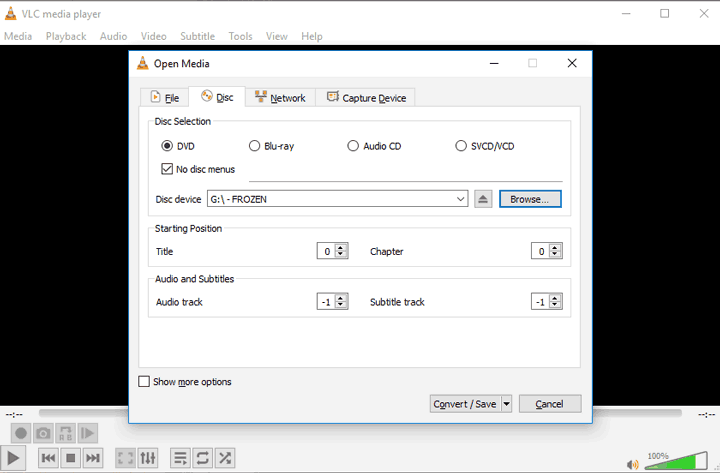
Step 3. Tap the Media tab on the leftmost, and click Open Disc on the drop-down menu.
Step 4. On the pop-up window, check the 'No disc menus' box.
- You can choose Disc device if your computer has several DVD layers.
- You can also set the Starting Position (the number of Title), the Chapter, Audio track and Subtitle track.
Step 5. Click the drop-down menu of Play button and choose Convert.
Step 6. On the pop-up window, you can choose an output format in Profile, browse to set the Destination file, and make some other settings.
Step 7. After all your settings, hit Start. After the DVD copy completes, you can double-click the file to play back it directly with the same software.
How to Copy DVD to Computer without Software
Can we download a DVD to computer without using some software? The answer is YES, even though copying a DVD to a computer generally requires some type of software to read the DVD and transfer the data to the computer's hard drive. The software can range from media players that have ripping capabilities to dedicated DVD ripping programs.
However, if you're referring to copying non-protected home videos or data DVDs, you could technically just copy and paste the files from the DVD to your computer if your operating system recognizes the DVD's file system. This method won't work for commercial DVDs or those protected by digital rights management (DRM), as these require special software to decrypt and copy the content. Anyway, here is how:
Step 1. Insert the DVD into your computer's DVD drive.
Step 2. Open 'This PC' on Windows or 'Finder' on Mac.
Step 3. Navigate to the DVD drive, which should appear under 'Devices and drives' on Windows or 'Devices' on Mac.
Step 4. Open the DVD to view its contents. If it's a non-protected DVD, you should see folders like 'VIDEO_TS' and 'AUDIO_TS'.
Step 5. Select the files or folders you want to copy.
Step 6. Drag and drop them to a location on your computer, such as your desktop or a specific folder.
Disadvantages of the Method:
- Only work on Windows computers obviously.
- only work for DVDs that do not have copy protection. Most commercial DVDs, especially movies and TV shows, have DRM and cannot be copied this way..
Which DVD Format Should You Choose
The best format depends on what you want to do with the copied DVD. If you want to keep the disc as a complete backup, ISO or the original DVD folder structure is the better choice. If you mainly want to watch the movie on a computer, TV, phone, or other device, MP4 or MKV is usually more convenient.
| Format | Best for | What it keeps | Main advantage |
|---|---|---|---|
| MP4 | Easy playback and smaller files | Main video and selected audio/subtitles | Broad device and software compatibility |
| MKV | High-quality digital copies and media libraries | Video, multiple audio tracks, subtitles, chapters | Preserves more of the DVD content without re-encoding when using MakeMKV |
| ISO | Full DVD backup | The complete disc image, including DVD structure | Closest to keeping the DVD as a single digital copy |
| VIDEO_TS | Preserving the original DVD folder structure | DVD folders and VOB/IFO files | Keeps the DVD files in their original structure |
Common Problems When Copying a DVD to Computer
DVD copying is usually straightforward, but a few common issues can prevent a disc from being copied or ripped successfully. Here are some common problems you may encounter and how to deal with them.
DVD Is Not Recognized by Your Computer
First, make sure the DVD is inserted correctly and that the disc appears in File Explorer on Windows or Finder on Mac. If the computer does not detect the disc at all, try another DVD, clean the disc, or reconnect the optical drive. If your laptop or desktop does not have a built-in DVD drive, use an external USB DVD drive.
The DVD Copy or Ripping Process Fails
A failed copy can be caused by a damaged or scratched disc, an unreliable optical drive, or copy protection on the DVD. Try another disc or optical drive first. For commercial DVDs with copy protection, a dedicated DVD ripping program may be needed instead of simply copying the files from the disc.
The Ripper Shows Many Titles
DVDs often contain multiple titles for the main movie, trailers, bonus features, menus, and other content. The longest title is often the main feature, but this is not always the case. The professional DVD ripper like VideoProc and WinX DVD Ripper can automatically check and tick the correct main title. Otherwise, you should check the title duration and preview the content when your DVD software provides that option before starting the copy.
Audio or Subtitles Are Missing
When ripping a DVD to MKV or another digital format, make sure the audio tracks and subtitles you want are selected before starting. A DVD may contain multiple language tracks, commentary, or subtitle streams, and some ripping tools do not select every track by default.
You End Up with Multiple VOB Files
This is normal when you copy an unprotected DVD without converting it. DVD-Video content is typically stored inside the VIDEO_TS folder across several VOB files, so the movie may not appear as one convenient video file. To create a single MP4 or MKV file, use a DVD ripping or conversion tool instead.
FAQs on DVD Copying to Computer
1. How Do I Rip a DVD to My Computer for Free?
There are many ways you can rip a DVD for free. For example, you can use HandBrake, which is completely free; and you can also get the free giveaway versions of some commercial software like VideoProc Converter AI and WinX DVD Ripper from occasionally.
2. Can I Rip a DVD to Computer Using Windows Media Player?
No, you can't rip a DVD with Windows Media Player. Windows Media Player is a default Windows app developed by Microsoft. It can play audio CDs, rip music from CD, rip audio CDs, and burn CDs or data DVDs, but it does not allow you to rip a DVD on Windows 7, Windows 8, Windows 10, or Windows 11.
3. Can I copy a DVD if my computer doesn't have a DVD drive?
Many modern laptops and some desktop PCs don't include a built-in DVD drive. In this case, connect an external USB DVD drive to your computer, insert the disc, and then use the same copying or ripping method described above.
4. What is the difference between copying and ripping a DVD?
Copying a DVD usually means preserving the disc's original files or structure, such as a VIDEO_TS folder or an ISO image. Ripping a DVD means extracting the video and audio from the disc and usually saving them as a digital video file such as MP4 or MKV. In other words, copying is better when you want to keep a backup of the disc itself, while ripping is more convenient when you want to watch the movie as a regular video file on your computer or other devices.
5. Can I copy a copy-protected DVD to my computer?
It depends on the type of copy protection and the software you use. Simply copying the files in File Explorer or Finder generally won't work when a commercial DVD uses copy protection. A dedicated DVD ripper such as VideoProc Converter AI can read and process many commonly encountered protected DVDs and save the content as a digital video or DVD backup. WinX DVD Ripper is another option focused specifically on DVD ripping and handling copy-protected discs. Copyright and circumvention laws vary by country, so only copy DVDs you have the legal right to copy and follow the laws that apply to you.
6. Are There Some Legal Considerations of DVD copying?
The legality of copying DVDs to a computer varies significantly across different jurisdictions and is influenced by several factors, including copyright laws, personal use exceptions, and the presence of protective measures like Digital Rights Management (DRM).
General Copyright Principles
Under copyright law, the reproduction of copyrighted material without the permission of the copyright holder is generally considered infringement. This principle applies universally, meaning that copying DVDs typically requires authorization from the rights owner unless specific exceptions apply. In many jurisdictions, these exceptions are often related to personal use or private copying.
United States
In the U.S., copyright law (Title 17 of the United States Code) does not explicitly allow for personal copies of copyrighted works. Making a copy without consent from the copyright owner is usually classified as infringement. However, the fair use doctrine may provide some leeway for personal backups, especially if the copies are not distributed or shared. Notably, bypassing DRM to make a copy is illegal under the Digital Millennium Copyright Act (DMCA), complicating the legality of copying protected DVDs.
United Kingdom
UK law underwent significant changes with the Copyright and Rights in Performances (Personal Copies for Private Use) Regulations 2014. As of now, individuals can make personal copies of DVDs they own for private use, provided that these copies are not shared or distributed. However, it remains illegal to bypass any DRM protections on those DVDs. The law permits "format shifting," allowing users to convert content into different formats for personal use.
Australia and New Zealand
In Australia and New Zealand, individuals are allowed to make copies of legally purchased DVDs for personal use, provided these copies are not distributed. This practice includes making backup copies as long as they remain private and are not shared with others.
Japan and Other Regions
In Japan, copying DVDs is generally prohibited under strict copyright laws that have been in place since 2012. In contrast, countries like China have a more complex relationship with copyright enforcement; while laws exist against piracy, enforcement can be lax.
Key Considerations for Personal Use
- Ownership: To legally copy a DVD, one must own the original disc.
- Distribution: Sharing or distributing copied content is illegal and can lead to liability.
- DRM Circumvention: Bypassing DRM protections is illegal in many jurisdictions, making it technically unlawful to copy most commercial DVDs.
- Private Copying Exceptions: Many regions allow for private copying under specific conditions; however, these exceptions often come with stipulations about distribution and sharing.
Disclaimer: This article provides technical instructions only. Users are solely responsible for understanding and adhering to all applicable copyright laws in their respective countries. We do not condone or encourage copyright infringement. For specific legal advice, always consult with a qualified legal professional.