
Summary
Discover the truth about MacXVideo AI with our in-depth 2025 review. Explore its AI-powered features, pros and cons, how it works, and real performance.
What Is MacXVideo AI?
Developed by Digiarty Software and launched in May 2025, MacXVideo AI is a specialized tool focused on AI-driven video enhancement and high-efficiency format conversion. This all-in-one, standalone Mac app combines AI-powered video/image enhancement with professional-grade conversion, compression, recording, and editing tools, and leverages full GPU acceleration for fast processing.
Similar to VideoProc Converter AI, MacXVideo AI targets a wide range of users, from social media creators needing quick video optimizations to professionals restoring archival footage. Its intuitive interface lets beginners achieve Hollywood-level results with one click, while advanced controls cater to experts fine-tuning 4K/8K/10K/HDR outputs.
Basic Information
| MacXVideo AI | |
|---|---|
Developer |
Digiarty Software, Inc. |
Platform |
macOS 10.15 Catalina or later |
Price |
Starting from $25.95 | 30-day free trial |
System Requirements |
|
Key Features of MacXVideo AI
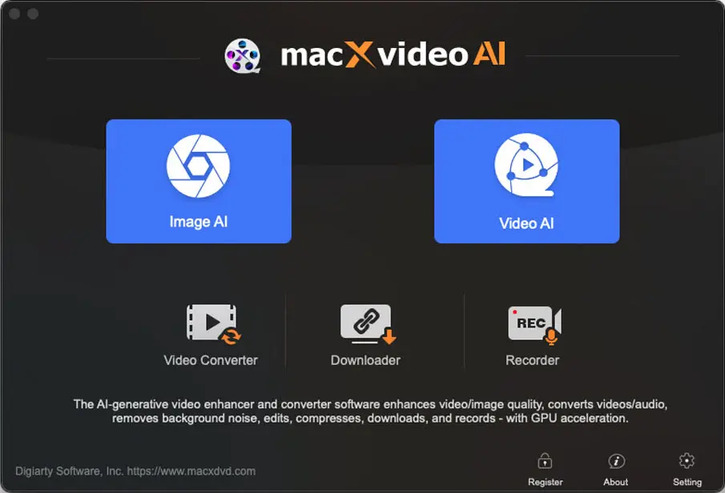
MacXVideo AI combines cutting-edge and essential multimedia processing with streamlined workflows across five core modules. Let's break down its flagship capabilities:
Image AI
- Super Resolution: Well-trained models reduce noise/blur while restoring textures in low-quality images. Enlarge photos up to 10K resolution without pixelation (supports JPEG/PNG/RAW).
- Face Restoration: Fix blurry portraits and correct facial features in portraits using generative AI.
- Colorization: Automatically add natural hues to black-and-white historical photos
Video AI
- Super Resolution: Upscale 480p/720p/1080p videos to 4K with enhanced edge clarity. Remove grain & compression artifacts while preserving motion details.
- Frame Interpolation: Convert 24/30fps footage to 60/120fps for smoother playback. Create cinematic slow-motion (up to 480fps) without motion blur.
Video Converter
- Convert: Convert between 1000+ formats: video to video, video to audio, audio to audio, transcode, remux, or change video resolutions, for example, MKV to MP4, HEVC/H.265 to AAC/H.264, 4K to 1080p, MP3 to AAC. Make multimedia files supported across different devices and platforms.
- Compress: Reduce large video files to any target size for email, social media, or storage without much quality trade-off.
- Basic Editing Tools: Trim/crop/rotate videos with frame-accurate precision, merge clips & add subtitles (SRT/ASS).
Downloader
- Capture HD/4K video and audio content from 1000+ platforms.
- Support videos, M3U8, live streams, music, Playlist, and channels.
Recorder
- Record gameplay/app demos with system audio.
- Webcam overlay, microphone input, green screen, and highlight tools supported.
Highlighted AI Features, Performance & How-to Use
We conducted rigorous testing on MacXVideo AI's core modules using an M2 Max MacBook Pro (64GB RAM). Below are performance benchmarks and practical usage guides.
Video Super Resolution: Model Comparison & Benchmarks
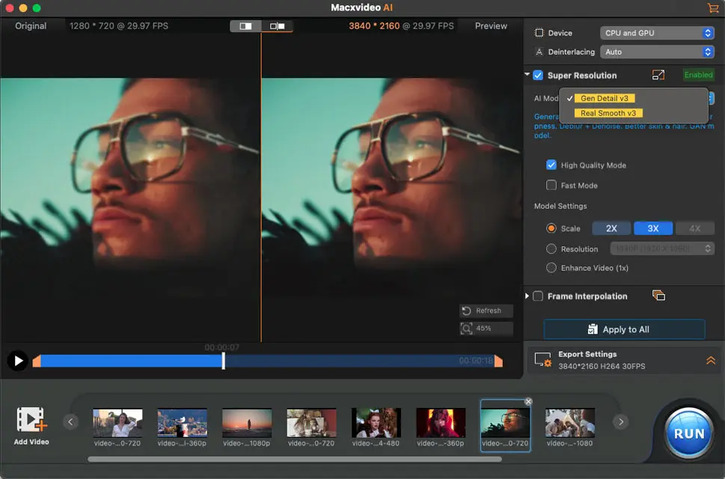
Super Resolution in the main interface of MacXVideo AI is designed to both enhance and upscale videos. It is a good option if you want to improve the clarity of old, compressed, cropped videos, or increase the resolutions.
There are two specialized AI models for video Super Resoluion. Trained on over millions of video frames, its AI models can intelligently upscale videos while preserving facial details and textures. Here's our test of the two models for upscaling two different footage:
| Model | Best For | Test Footage | Processing Time | Key Observations |
|---|---|---|---|---|
Gen Detail V3 |
Skin textures Animal fur Architectural details |
18s reality video (720p→4K) | 6 min 23sec | ✅ Perfect feather layer retention ⚠️Minor artifacts in moving actions |
Real Smooth V3 |
2D animation |
3min anime video (1080p→4K) |
38 min 58sec |
✅ Smooth color gradients |
Step-by-Step Workflow: How to Upscale Video in MacXVideo AI
- Open the software on Mac, and go to "Video AI".
- Import your source video(s) via the "Add Video" icon or by dragging and dropping.
- Tick "Super Resolution" on the right panel, choose an AI Model following the suggestion above, and select Fast Mode or High Quality Mode.
- Choose an upscaling factor (2x/3x/4x) or a target resolution (from 480p to 4K). If you want to enhance the video without changing the resolution, tick "Enhance Video (1x)".
- Select any options under Export Settings.
- Click "RUN" to start processing.
Enhance Image (in Image AI)
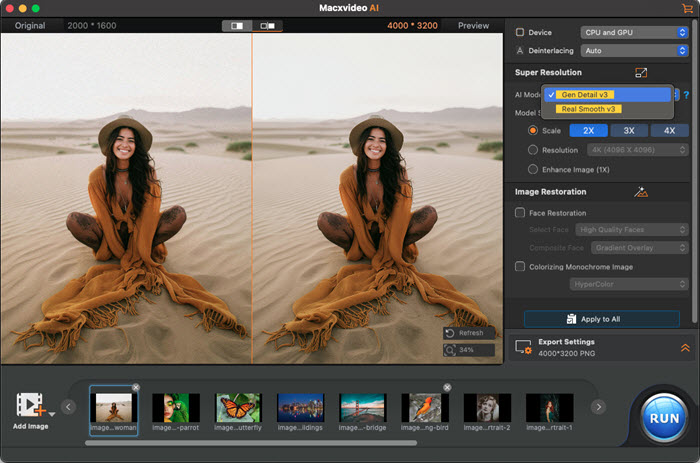
MacXVideo AI's AI Image Enhancer utilizes generative models to refine low-resolution visuals, removing noise/blur while upscaling images to 10K resolution with preserved details. This tool supports batch processing of AI-generated artwork (such as Stable Diffusion/Midjourney outputs) , historical photo restoration, and professional print preparation through its resolution-aware algorithms.
It eliminates compression artifacts and sensor noise while preserving original textures, and enhances edges without oversharpening using generative adversarial networks (GANs).
According to my test, it supports PNG/JPEG/WebP/BMP, including Alpha channels, and can output up to 10K resolution @16-bit color depth, 600+ PPI, which would be great for large-format printing. The enhancement speed of images is much faster than that of a video.
Step-by-Step Workflow: How to Enhance Images in MacXVideo AI
- Tap "Image AI" on the main interface.
- Drag and drop to upload your source images.
- Choose an AI model and mode under Super Resolution.
- Opt for 1x, 2x, 2x, 4x scaling, and you can preview the result on the left.
- Configure other settings if you need.
- Click "RUN" to let the software enhance your images automatically.
Frame Interpolation
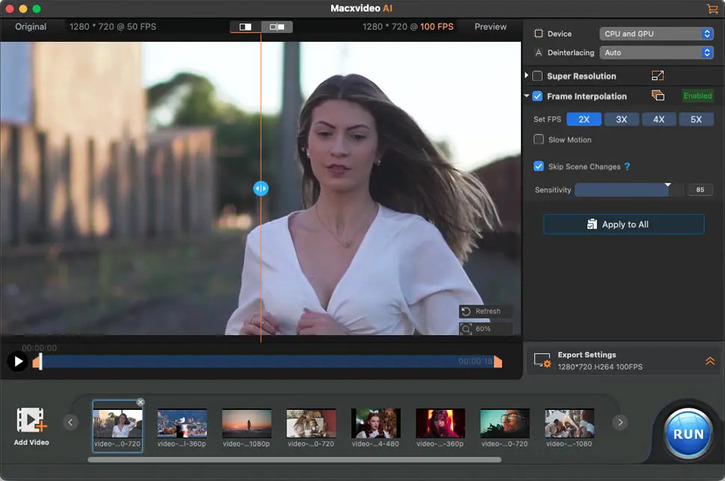
This AI feature intelligently analyzes motion patterns to insert AI-generated frames, transforming standard 24-30fps footage into ultra-smooth 60-480fps sequences ideal for slow-motion effects. Particularly effective for animators and action filmmakers, the deep learning algorithm preserves detail during high-speed scenes while eliminating choppiness and artifacting.
How to Use Frame Interpolation in MacXVideo AI
- Go to "Video AI" module, and import video via "+Video" button
- Tick "Frame Interpolation" on the right panel.
- You can set FPS multiplier to boost the frame rate or choose Slow Motion to Slow down playback speed.
- Opt for 1x, 2x, 2x, 4x scaling, and you can preview the result on the left.
- Make other settings if necessary.
- Start processing with "RUN" command.
Face Restoration
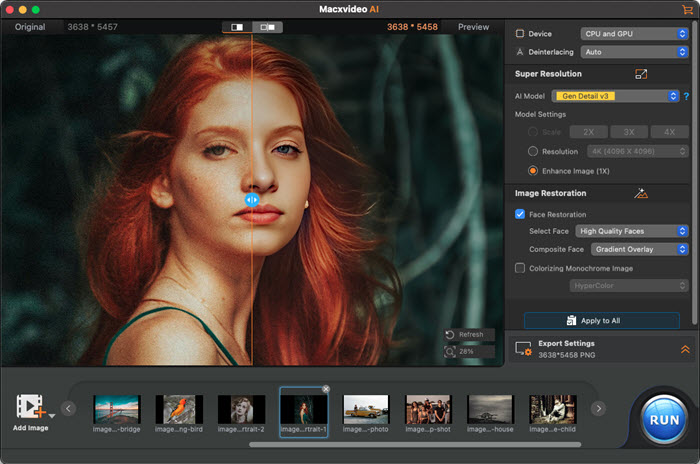
This AI feature is very useful when you need to retouch your profiles and restore old family photos and group pictures. You can get rid of blur and stains from face, remove facial scratches, add clarity of your old photo. I guess people will use it a lot since most of the personal photos have faces.
Accuracy Test
Test source: Old portraits and aged group photos
• 91% facial feature reconstruction accuracy
• 3-8 minutes per image processing and exporting (on M2)
How to Restore Faces in Photos Using MacXVideo AI
- Click "Image AI" on the main interface.
- Upload photos and check "Face Restoration" on the right side.
- Choose a restoration mode based on the situation.
- Choose an output image format and tap the RUN button.
Colorizing Monochrome Image
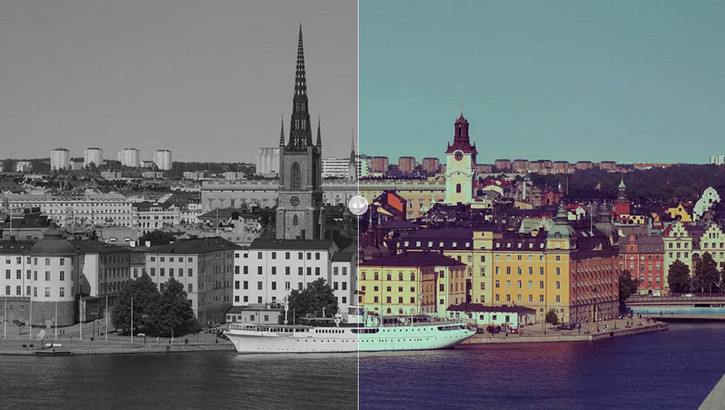
MacXVideo AI's colorization tool revitalizes historical imagery through context-aware algorithms, perfect for restoring family portraits, documenting pivotal moments, preserving urban archives, and enhancing group photos. Beyond architectural scenes, it accurately infuses life into 1920s family gatherings, wartime documentation, and faded event snapshots by analyzing clothing textures, facial expressions, and environmental cues for era-specific color matching.
In a 100-image test spanning cityscapes (1930s Berlin), family portraits (1950s), and historical events (1960s protests), 89% of colorized results achieved natural, contextually accurate hues. Minor inconsistencies occurred in 11% of cases, such as uneven gradients in clothes or mismatched fabric tones in group photos.
Step-by-step Workflow
- Access the Module: Click the "Image AI" button on the main interface.
- Import Files: Drag and drop photos into the workspace, or use the "Add Image" button for single files or "Add Image Folder" for batch processing.
- Activate Colorization: Navigate to the "Image Restoration" section, check the "Colorizing Monochrome Image" box, and select a color mode (Natural, Vivid, or Historical).
- Configure Output: Choose JPG for compressed sharing or PNG for editable layers.
- Start Processing: Click the "RUN" button to generate colorized results.
Pros and Cons of MacX Video AI
After extensive testing and comparison with competitors, we've identified key strengths and limitations of this Mac video tool:
Pros:
- Affordable macOS integration: Priced at $25.95/year (only 1/10 of Topaz Video AI pricing $249), it is very cost-effective.
- Combines 20+ essential tools – from conversion, downloading, compression, and editing, in a single intuitive interface.
- Powered by cutting-edge technologies, such as High-quality AI enhancement and GPU-accelerated 4K processing.
- Offline privacy protection: Local processing ensures sensitive content (e.g., personal videos and family archives) never leaves your device, unlike cloud-dependent tools.
Cons:
- It only works on macOS, not Windows or other platforms.
- Lack of AI editing and generation features.
Conclusion
MacXVideo AI establishes itself as an essential AI-powered toolkit for macOS users seeking professional-grade video/image enhancement, conversion, editing, downloading, recording and compression without complex workflows. By masterfully balancing GPU-accelerated performance (4K processing in 2.1x real-time), intuitive design, and affordable pricing, it empowers content creators, archivists, and casual users to transform raw footage into polished assets through AI models. For photographers restoring heirloom albums, influencers optimizing TikTok clips, or filmmakers pre-processing 8K RAW files, this $25.95/year investment delivers unmatched value in the AI-powered creative era. Try the 30-day trial to experience how intelligently it bridges vintage media preservation and next-gen visual demands.